Chapter 2: The Photograph on the Table
Linda came home forty minutes later.
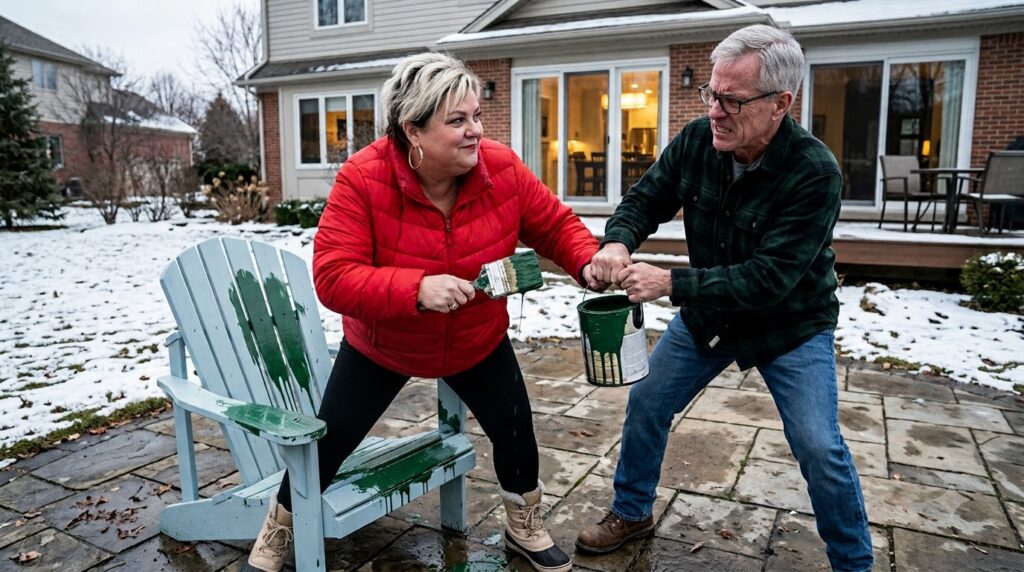
She found Daniel sitting at the kitchen table with the ruined chair visible through the glass doors behind him.
Karen was gone.
Daniel had moved the chair back to its original position, but the damage was impossible to miss. Green paint covered the blue wood in thick, uneven layers.
Linda stopped when she saw it.
“What happened?”
Daniel didn’t answer immediately.
He slid his phone across the table.
On the screen was a photograph of the chair before the paint.
Linda stared at it.
Then she looked outside again.
“Karen did this?”
Daniel nodded.
“She said you sent her.”
Linda’s face went pale.
“I didn’t.”
Daniel watched her closely.
He wanted to believe her immediately.
But Karen had introduced something into their marriage that could not simply be wiped away with a rag.
“She said you asked her to make sure we couldn’t sell the house.”
Linda pulled out a chair.
For several seconds, she sat without speaking.
Then she told him there was something he didn’t know.
Two weeks earlier, Linda had received a letter from the county concerning an old drainage easement running along the rear portion of their property.
The document was decades old.
The easement itself was not new.
What was new was the planned redevelopment of the neighboring lot.
A developer wanted to purchase several properties on their street, including theirs. The offer was substantially higher than what Daniel and Linda had expected.
They had talked about selling.
They had also talked about moving closer to their daughter and grandchildren.
But Linda had become worried after reading the county documents.
The easement appeared to affect a strip of land near the patio.
“If we sell without disclosing it,” Linda said quietly, “we could have a legal problem.”
Daniel leaned back.
“Why didn’t you tell me?”
“I was going to.”
“When?”
“I wanted to understand it first.”
That answer hurt more than he expected.
Linda reached for his hand.
“I called Karen because she used to work for a property management company. She told me she knew someone who could explain the paperwork.”
Daniel frowned.
“Did you ask her to stop the sale?”
“No.”
“Did you ask her to come into our yard?”
“No.”
“Did you tell her to paint my chair?”
Linda looked almost offended.
“Daniel.”
He knew.
She hadn’t.
But another question remained.
“Why would Karen say you asked her to stop the sale?”
Linda looked toward the backyard.
“I don’t know.”
Daniel picked up his phone.
There was a message from their real estate agent.
Need to talk tomorrow. The buyer’s attorney asked whether the rear easement has been disclosed.
Daniel showed Linda.
She closed her eyes.
For months, the house had represented freedom.
A chance to sell, simplify their lives, and spend more time with family.
Now the house had become something else.
A piece of property surrounded by documents, secrets, accusations—and a neighbor who had just vandalized it.
Linda finally looked at Daniel.
“There’s one more thing.”
He waited.
“Karen knew about the easement before I called her.”
Daniel stared at her.
“How?”
“I don’t know.”
Outside, a drop of green paint slid slowly down the chair leg.
And suddenly the question was no longer whether Karen had acted alone.
It was why she seemed so determined to interfere with the sale.