CHAPTER 6: THE GROUND RECLAIMED
The silence that followed the night-vision footage didn’t crack; it widened. The code enforcement deputy leaned in closer to Leo’s phone, his heavy leather utility belt creaking against the door of the city truck as he stared at the glowing pixels. On the screen, the loop restarted, the infrared shape of Brenda kneeling in the dark to wrench the brass stem until the pipe collar tore open.
The deputy looked up from the screen, his gaze moving past Leo’s dirt-streaked shoulder to lock squarely onto the spot where Brenda stood. His boots made a sharp, grinding sound on the gravelly aggregate as he turned his full frame toward her. “Ma’am,” he said, his voice flat, official, and devoid of the bureaucratic patience he had arrived with. “Step away from the resident’s property line. Keep your hands where I can see them.”
Brenda didn’t look at the deputy. She was looking at Miller. The old man had taken three slow steps across the grass, his face hardening into a grim, deeply lined mask as he stared down at the wet, purple-inked forgery pinned under Leo’s tool box.
“You signed my name to a civil lien, Brenda?” Miller asked. His voice wasn’t loud, but it had the rough, abrasive scrape of a dry piston. He reached down and yanked the translucent sheet out of the mud, the wet paper tearing slightly along the margin. “My wife and I have lived on this cul-de-sac for forty years. We don’t use court filings to handle a busted water valve, and we damn sure don’t let our neighbors steal our signatures to cover their own bank notices.”
“Tom, listen to me,” she began, her hand lifting instinctively toward her sunglasses, her fingers trembling against the black plastic frame. Her voice was too high, a thin, desperate rattle that vanished into the hot diesel exhaust of the idling truck. “The property values are dropping. Look at his driveway. Look at the aggregate. If the county lists his parcel as non-compliant, the whole block loses leverage before the quarter ends. I was trying to stabilize the residential footprint.”
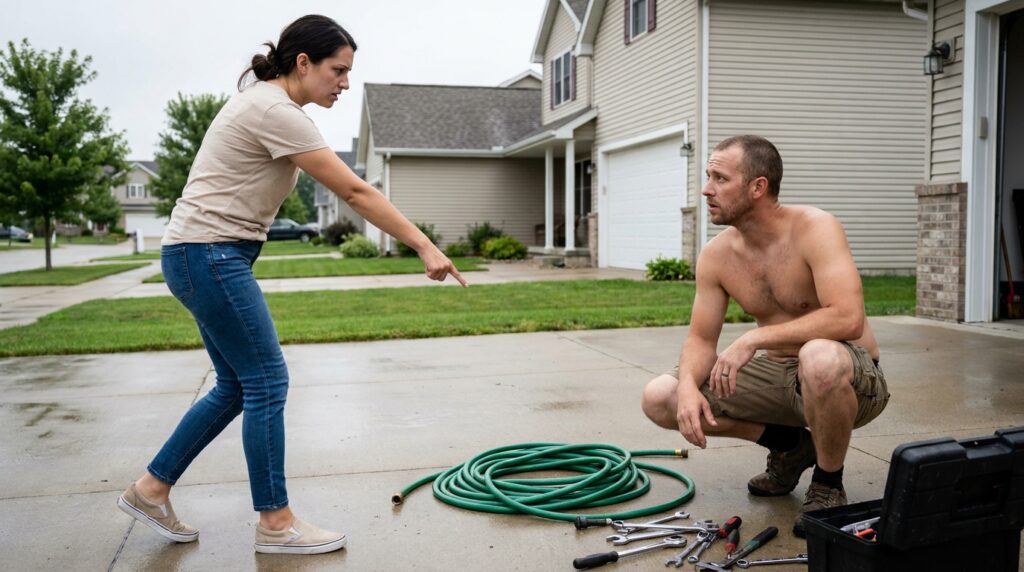
“The only thing you were trying to stabilize was your own timeline,” Leo said. He stepped between her and his trench, his bare chest glistening with grease and dried gray silt. He reached down into his pocket, pulled out a heavy brass coupling sleeve, and set it down onto the concrete with a hard, metallic clank that marked the physical end of the argument. “The city surveyor stamped this line three years ago. Every inch of this repair is within the code. The code enforcement team isn’t here to tow my box, Brenda. They’re here because you filed a fraudulent report to manufacture an emergency asset seizure before the bank could put your own house up on the courthouse steps next week.”
The deputy pulled a thick, coarse-grained citation pad from his rear pocket, the cardboard backing snapping open with a dry slap. “Ma’am, I need you to show me a valid photo ID right now, and you need to remain on your side of the expansion joint while I contact the county registrar’s field office. We have an intentional destruction of municipal utility infrastructure under Section 8-A, and the signature forgery will be handled by the sheriff’s unit moving onto the block.”
Brenda looked around the circle. The two women from down the street had raised their phones fully now, the dark lenses of their cameras tracking her every step as she began to back away. Her clean white sneakers were ruined, covered in a thick, gray coating of the very slurry she had claimed was destroying the neighborhood aesthetic. Her shadow, once straight and rigid across Leo’s driveway, was now short, broken, and pinned beneath her heels as she retreated onto her own dying turf.
She didn’t speak another word. She turned her back to the street, her shoulders hunched as she marched up her driveway, her screen door slamming shut behind her with a tinny, hollow ring that echoed across the cul-de-sac.
Leo didn’t watch her go. He turned back to the trench, his breath coming in slow, measured counts that tasted of iron sediment and the bitter oil of rusted iron tools. The afternoon sun was leaning hard into the western tree line now, throwing long, desaturated bars of orange light across the gray concrete. The water had stopped its rapid hiss, dying down to a slow, manageable drip as the main pressure seal began to hold against the new brass sleeve.
The deputy walked over to the edge of the pit, his pen clicking twice as he noted the blue planning seal on Leo’s laminated survey map. “You’ve got two hours to finish the backfill before the sun goes down, son,” the officer said, his tone shifting into the rough, practical vocabulary of the trades. “The city won’t charge you for the runoff. Just make sure the gravel is tamped level with the public curb.”
“It’ll be level,” Leo said.
He knelt back down on the abrasive concrete, his skin scraping against the stone as he reached into the silt one last time to tighten the primary iron collar. The street was quiet again. Old man Miller walked back to his mower, his heavy hand giving Leo a single, brief nod of acknowledgement before kicking the engine back into gear. Leo took the heavy pipe wrench, clamped its hardened steel teeth around the hexagonal core of the new valve, and turned it until the seal locked home with an unyielding, metallic click. The ground beneath his knees was muddy, raw, and broken—but it was entirely his own.