CHAPTER 2: THE TOOL MARKS
The crescent wrench didn’t slide onto the brass nut; it bit into it, cold iron grinding against soft, wet metal. Leo kept his chest low, the abrasive edge of the driveway concrete scraping against his ribs every time he leaned into the trench. The water didn’t stop. It pooled around his knuckles, thick with a fine, red clay silt that tasted of rust and stale iron. Brenda’s shadow remained pinned to the gray aggregate, a dark, geometric shape that felt as heavy as the midsummer heat pressing down on the back of his neck.
“You’re tracking that slurry onto the public curb,” she said. Her voice didn’t have the volume of a shout, but it carried across the narrow asphalt street with a strange, flat resonance. “The neighborhood infrastructure committee has a strict zero-tolerance policy for runoff. If that silt hits the storm drain, it’s an automatic environmental assessment fee.”
Leo didn’t answer. He didn’t want to give her the satisfaction of a verbal slip, not while Miller’s lawn mower was still idling down the block like an old dog waiting for a fight. Instead, he wedged the edge of his thumb into the narrow gap between the pipe sleeve and the main valve core. The plastic casing had split longitudinally—a clean, violent fracture that ran three inches down the seam.
But it wasn’t the split that caught his eye.
When he turned the small, battery-powered work light toward the bottom of the trench, the beam illuminated the underside of the brass valve housing. The metal wasn’t corroded. It was scored. Three distinct, parallel grooves had been gouged into the hexagonal neck of the fitting. They weren’t the random scratches of a shifting stone or a frost-heave; they were the clean, deep impressions left by a heavy pair of locking pliers with hardened steel teeth. Someone had clamped onto the main shut-off valve with enough leverage to twist the internal seal until the back-pressure sheared the underlying PVC right at the thread.
He felt a cold drip of sweat slide down his temple, cutting a clean track through the gray mud on his cheek. He didn’t look up, but his grip on the wrench tightened until his knuckles went pale beneath the grease. “This valve didn’t freeze, Brenda,” he said, his voice dropping into the quiet, rhythmic cadence of a man checking a measurement. “Someone put an eight-inch jaw on the stem and turned it until the collar snapped.”
The rhythmic tapping of her finger against the clipboard stopped instantly.
For four seconds, the only sound in the cul-de-sac was the steady, low hiss of the escaping water and the faint, hot wind rattling the dry leaves of the maples at the corner. Leo watched her shadow. The silhouette of the clipboard tilted slightly, its sharp corner dipping toward the lawn as if her wrist had momentarily lost its rigidity.
“The equipment on your side of the meter is your liability,” she replied, her tone shifting from the dry recitation of rules to something sharper, narrower. “Defective plumbing isn’t an excuse to turn the cul-de-sac into an open trench project. The county marshal’s office already has the documentation. I’ve signed the formal complaint myself.”
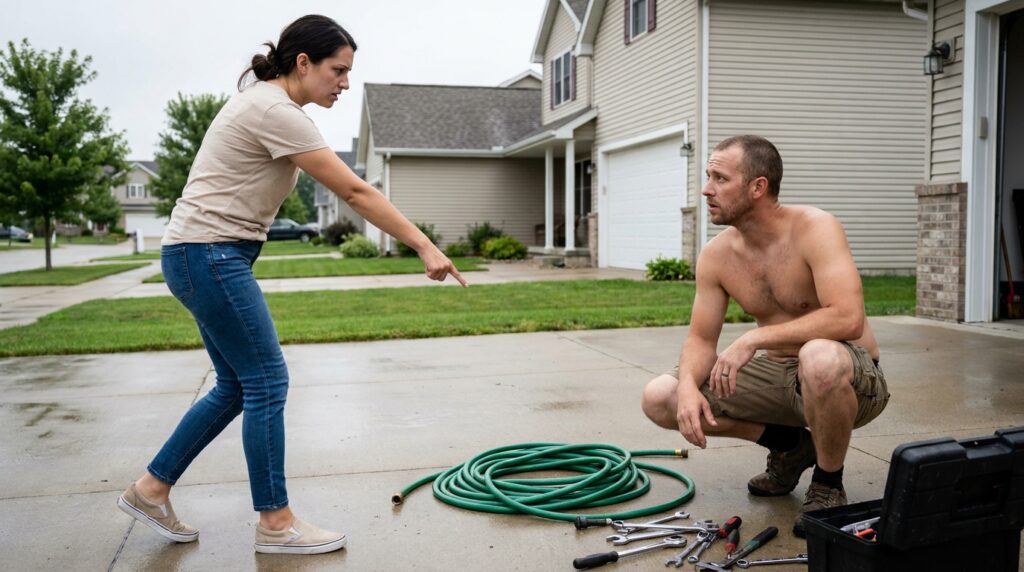
Leo slowly pulled his arms out of the mud, the wet clay suctioning against his skin before letting go with a dull pop. He sat back on his heels, his shirtless torso streaked with gray silt and the dark orange oil of rusted fittings. He didn’t look at Brenda. He looked down at the tool zone between them—the scattered coupling sleeves, the yellow plastic toolbox with its rusted hinges, and the coiled green hose that lay like a dead snake on the wet concrete.
Right at the edge of his tool box, half-buried under a damp rag, lay a yellow carbon copy of a city citation. He hadn’t noticed it when he first dragged the box out of the garage. He reached down, his wet fingers leaving dark, translucent smudges across the paper as he lifted it. The letterhead didn’t belong to the city building inspector. It was a standard, pre-printed HOA notice form, but the lines at the bottom weren’t filled out with the typical fine amounts. Instead, there was a typed amendment under the section labeled Immediate Corrective Actions.
Failure to clear the common easement area within twenty-four hours will result in an immediate lien filing under Section 4-B, pending emergency property receivership.
Leo’s thumb rubbed against the bottom edge of the paper, where the ink was slightly blurred from the humidity. There were three lines for witness verification. The names Miller, Vance, and Grover were written out in a stiff, identical script that didn’t match the signature style of any man on this street. The letters were narrow, slanting sharply to the right, the ink a dark purple ballpoint that looked exactly like the pen Brenda currently had clipped to the pocket of her jeans.
He tucked the paper into the back pocket of his shorts, the damp carbon sticking to his skin. He didn’t mention the names. He didn’t mention the teeth marks on the brass hex. The sun was leaning into the western sky now, the light turning a dull, sulfurous yellow that cast long, distorted shadows across the asphalt.
“The county marshal doesn’t enforce neighborhood association liens, Brenda,” Leo said, his eyes finally lifting to meet her sunglasses. The lenses were dark, completely flat mirrors that reflected nothing but the gray concrete and his own mud-streaked face.
Brenda didn’t flinch. She adjusted her grip on the clipboard, her knuckles white against the black plastic. “They enforce the peace, Leo. And right now, you’re the only thing breaking it.”
Behind her, at the far corner of the driveway boundary, the small, black dome of Leo’s doorbell camera sat nestled under the porch eave. A tiny, blue indicator light flickered twice inside the casing, its silent lens recording the precise angle of her stance and the tight, defensive tremor in her left hand as she stepped half an inch closer to the wet dirt.