CHAPTER 5: THE DIGGING EDGE
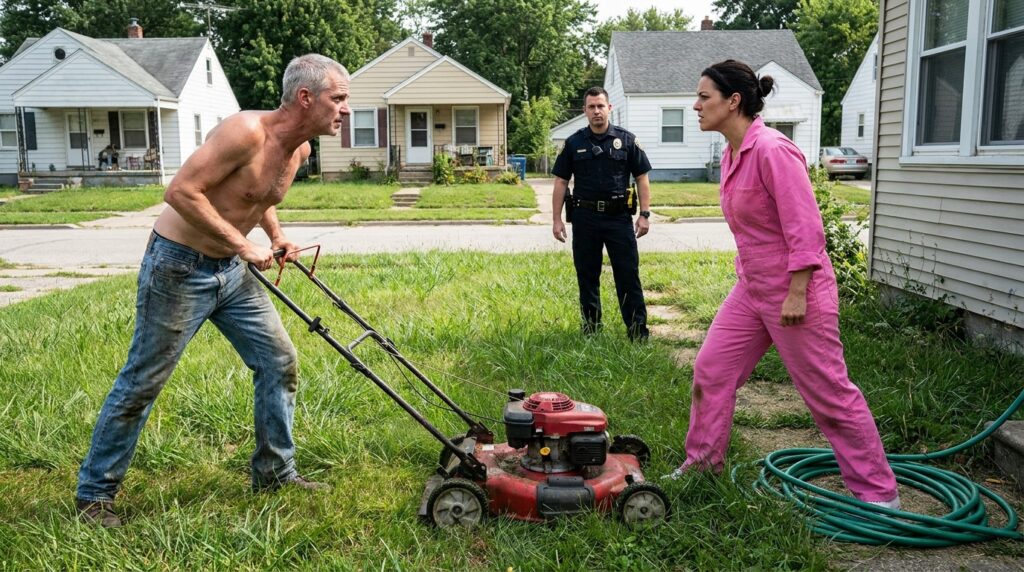
The pressure of Officer Vance’s gloved hand on the handlebar didn’t loosen, but I didn’t pull back. Instead, I reached down with my left hand, my fingers bypassing the mechanical throttle completely to unclip the rusty trenching trowel pinned to the side of the mower’s steel deck. The metal tool was pitted with orange scale, its edge chipped from three seasons of digging out valve boxes at the municipal plant.
“Arthur,” Vance warned, his boots shifting heavily in the dry weeds as his grip tightened on the frame. “I told you to let go of the machine. You’re executing an active non-compliance block in front of a recording device.”
“I’m clearing my line, Officer,” I said.
I dropped to one knee on the parched earth, the dry, coarse stalks of crabgrass poking into my bare skin as I drove the blunt steel tip of the trowel straight into the baked clay behind the green utility box. The ground was hard as brick, resisting the blade with a high-pitched, metallic scritch that sent a jarring shock up my wrist. I leaned my shoulder into the wooden handle, using my body weight to fracture the top layer of packed topsoil.
Amanda stepped closer, her phone held high as her shadow fell across the hole, cutting off the blinding glare of the sun. “Look at him, Officer Vance. He’s destroying the easement right-of-way. He’s deliberately tampering with the municipal grade infrastructure. This is destruction of public property.”
I didn’t look up at her pink jumpsuit. I dug faster, the rusty trowel scooping out chunks of gray, root-choked dirt, throwing the loose debris across the green coil of her garden hose. Three inches down, the blade hit something unyielding with a sharp, iron-on-iron clack. It wasn’t the soft, hollow pop of a plastic utility conduit. It was the solid, unmoving resistance of an old industrial anchor pin.
“Watch the blade, Vance,” I muttered, scraping the edge of the trowel across the buried metal to clear away the wet, caked clay.
The officer leaned over my shoulder, his heavy leather duty belt creaking under the weight of his stance as he peered into the narrow trench. The top of the buried iron pipe was exposed now—a thick, four-inch structural collar caked in dark rust. But as the dirt cleared, a series of deeply stamped, archaic alphanumeric characters appeared along the ridge of the iron. It wasn’t a modern county utility code. The markings read DEV-B1-1994.
Vance froze. His gloved hand slowly lifted off the lawn mower handle. He reached down, his thumb rubbing against the stamped lettering, clearing a long smear of orange oxidation from the steel.
“Ninety-four,” Vance murmured, his voice losing its automated regulatory tone. He looked from the buried pipe to Amanda’s laminated map folder, which was still resting on the hood of his cruiser. “The subdivision plats weren’t even filed until January of ninety-six. This pin was set before the main road was ever cut.”
“It’s a secondary marker,” Amanda said, though her voice hitched on the high note, her thumb wavering slightly against the glass of her phone screen. She didn’t lower the camera, but her feet edged three inches back toward the asphalt shoulder. “The board records show all preliminary anchors were integrated into the final utility grid. It doesn’t change the status of yesterday’s emergency injunction.”
“The injunction was pulled using the ninety-six layout,” I said, driving the trowel deeper into the side wall of the trench until the metal scraped a second, lower ridge of the pipe. “But look at where the casing runs, Officer. This isn’t a drainage pipe. This is the heavy-walled baseline jacket for the original main water line. The developer laid it four feet off the county grid to save on the rock excavation costs along the south hill. If Amanda’s maintenance crew brings a high-volume collector drill down this ditch based on her modern map, they aren’t going to clear an easement—they’re going to pierce the main pressurized line for the entire block.”
Vance stood up completely, his face gray under the brim of his hat. He looked down the street, his eyes tracking the long, uneven line of front yards where every mailbox and fence post sat aligned with my mower’s current track. If my line was wrong by four feet, every single boundary on the subdivision block was built over a structural lie.
The radio on his shoulder clicked again, a low hum of static signaling the dispatcher’s return, but before the voice could break through, a heavy, black commercial utility truck rounded the far corner of the street. It didn’t have county decals on the door; it carried a magnetic sign for Horizon Excavation, and strapped to its bed was a heavy, hydraulic trenching auger.
Amanda’s phone dropped to her side. She didn’t look at the officer or me; she looked straight at the approaching truck, her fingers twitching against the pink fabric of her pockets as the heavy diesel engine rumbled down the quiet street, its steel tracks rattling against the blacktop.
“Arthur,” Vance said, his hand dropping slowly to his side as he turned toward the road. “Get your machine out of the path of that truck. Not because of the order. Because if that rig drops its outriggers on this soft shoulder before I check the sub-surface log, the whole ditch line is going to cave into Miller’s cellar.”
I didn’t pull the mower back. I stood up, wiping the wet clay off my bare palms onto my blue jeans, keeping my body directly between the Craftsman deck and the advancing commercial grill. The decoy map in Amanda’s folder had just shattered under the scratch of a rusty trowel, but the true weight of the developer’s thirty-year-old error was rolling right toward my lawn, and the ground beneath our boots was already starting to give way.