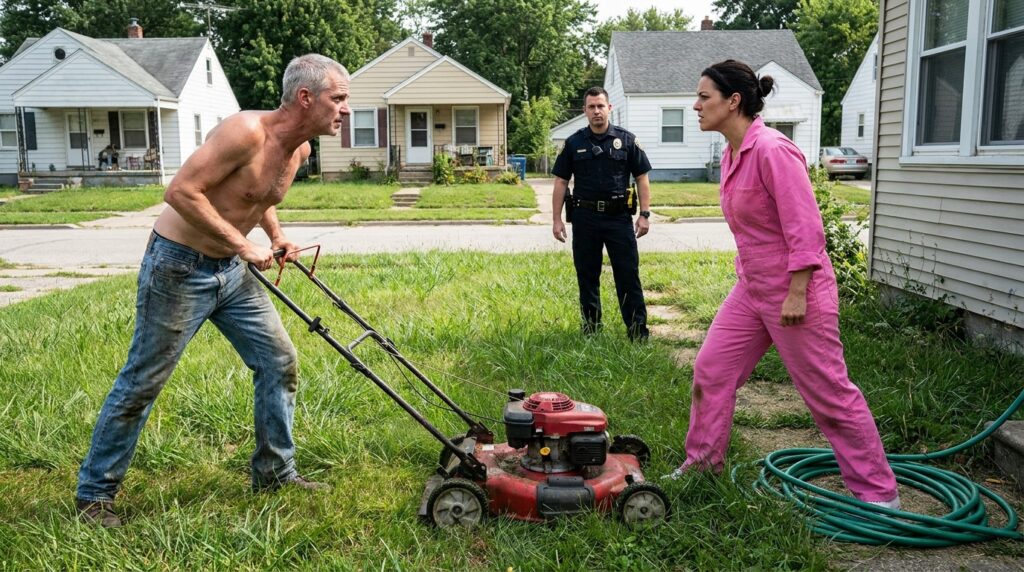
CHAPTER 2: THE FORGED PERMIT
“You’re standing on township dirt, Arthur,” Amanda said, her voice dropping into a low, jagged rasp that barely cleared the heavy, mechanical pulse of the idling Craftsman. She didn’t blink. The pink polyester of her jumpsuit looked chalky under the blinding midday glare, coated in a fine layer of gray road dust and dried grass clippings. She tapped the laminated folder against her thigh, a sharp, rhythmic snap that sounded like a small bone breaking over and over. “Look at the signature. Civil Engineer Vance. 1996. This whole corner pocket—the grass, the ditch, the space beneath your mailbox—it belongs to the association’s drainage easement. You don’t get to touch it.”
I kept my palms flat against the black rubber handle of the mower, letting the heat of the engine bay cook the skin of my shins. The iron deck was rattling against a buried limestone rock, a dull, metallic clank that vibrated through my work boots.
“Arthur Vance died in the winter of ninety-five,” I said. My voice was flat, dry as the sun-scorched clay beneath our feet. I didn’t reach for the folder. I didn’t have to. I knew every line of the real deed; I’d spent three years paying down the principal with forty-four hours a week at the chemical tanks. “The county records office doesn’t accept signatures from the cemetery, Amanda. Whoever inked that sheet for you didn’t check the obituaries.”
The color didn’t leave her face—it fixed into a dark, blotchy red along her jawline. Her fingers tightened around the edge of the plastic sleeve, the material crinkling under the pressure of her grip. To our left, the white-and-black door of the county cruiser didn’t open yet, but the reflection of the sun off the chrome spotlight shifted. The officer inside was watching through the tinted glass, waiting to see if the heat would make one of us break first.
“The board approved the utility access three weeks ago,” she hissed, stepping closer. The smell of her cheap floral perfume mixed with the sour stench of boiling oil from the mower’s crankcase. She tilted the folder toward me, her fingernail digging into the margin of the paper. “We are putting the high-volume collector line through this strip whether you like it or not. The county needs the runoff space. Your overgrown weeds are clogging the drainage flow, and I have every right to preserve the value of this block.”
I looked past her shoulder toward the curb. A standard green utility box sat crookedly in the ditch, its metal base rusted through where the salt trucks spit their brine every January. There were no yellow flags in the dirt. No white spray paint marking the excavation path. In Indiana, you don’t bring a commercial project to a residential lot without a state-certified dig number pinned to the post, but Amanda’s hands were completely empty of county seals.
The silence between us stretched, thick and heavy with the smell of parched earth. From three doors down, the high-pitched squeak of an old aluminum screen door signaled another spectator joining the porch line. Old man Miller was out on his steps, his arms folded across a grease-stained mechanics apron, watching the pink jumpsuit block the shirtless man with the machine.
“The association didn’t vote on a collector line,” I said, my knuckles locking against the mower handle. “Because a collector line on this grade would back up into Miller’s cellar before it ever hit the main culvert. You’re trying to divert the retention pond overflow away from your own foundation, aren’t you? You dug out your crawlspace last spring without a structural permit, and now the south wall is weeping.”
Amanda’s chin dropped half an inch. The bravado didn’t vanish—it weaponized. She reached into the deep pocket of the jumpsuit and pulled out her phone, her thumb sliding across the glass with a wet, aggressive snap.
“The officer isn’t here to debate zoning with a water-plant laborer, Arthur,” she said, her voice rising just enough to carry toward the idling cruiser. “I called in a hostile obstruction of a public right-of-way. He has the order on his dash. If you don’t kill that engine and pull this junk back to your garage, you’ll be explaining your engineering theories to a magistrate in the county seat.”
As if on cue, the heavy steel door of the police cruiser swung open with a long, ungreased groan. The responding officer stepped out into the shimmering heat waves rising from the asphalt. His black uniform was crisp, his duty belt popping with the dry friction of molded leather as he adjusted his posture. He didn’t draw a baton, and his hand stayed clear of the Glock at his hip, but his boots made a heavy, deliberate crunch against the gravel shoulder of my driveway.
He didn’t look at Amanda first. He looked at the green hose she had dragged across my property line, its brass nozzle resting deep in the tall, uncut clover of my private lot.
I kept my hands where they were. The engine gave one final, ragged sputter as the fuel line coughed against the heat lock, dropping the entire front yard into a sudden, suffocating quiet that made the birds in the maple trees sound ten times louder. The weight of thirty years of bad concrete and hidden developer shortcuts was sitting right there in the dirt between us, waiting for someone to clear the weeds away from the iron.