
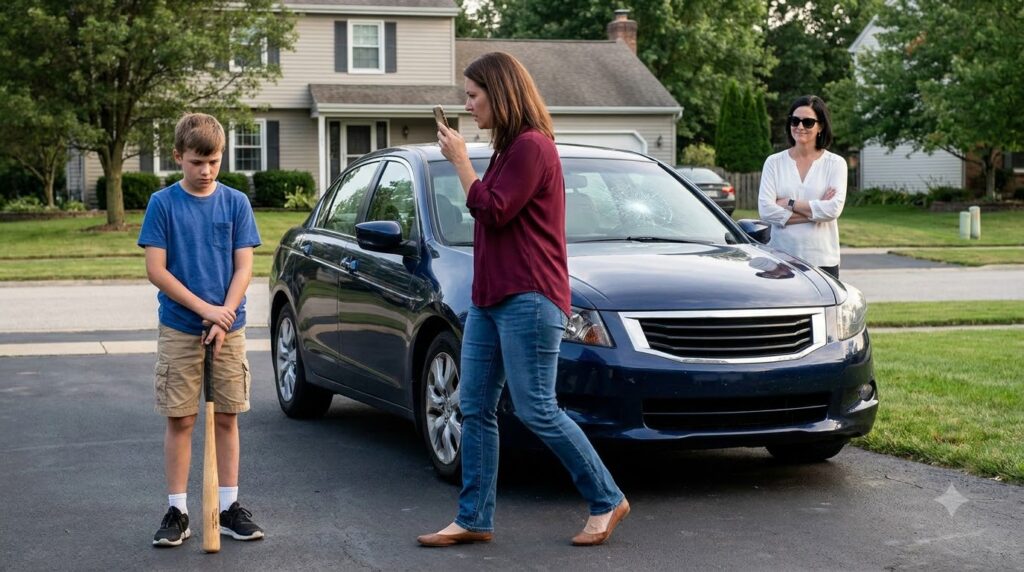
CHAPTER 4: THE TACTICAL INTERCEPT
“I’d suggest you hold that screen steady right there, ma’am,” Deputy Miller said, stepping onto the concrete pad. His polished leather boots brought him within arm’s length of Laura, his frame blocking the harsh sun and casting a long, hard shadow across the shattered windshield.
“Officer, you cannot seriously take a private, unverified recording as gospel,” Brenda interjected instantly. She closed the distance between them with quick, precise steps, her heels clicking against the concrete like small hammer strikes. “She’s been harassing my family for six months! She sets up camera traps, she leaves her vehicle parked in a manner specifically designed to provoke an incident, and now she’s terrorizing an eleven-year-old child with a smartphone screen!”
Deputy Miller didn’t turn his head. He merely held up a single gloved left hand, flat and decisive, halting Brenda’s momentum two feet short of Laura’s shoulder.
“Miss Vance, I am speaking with Miss Miller right now,” the deputy said, his tone dropping into the low, unhurried cadence of a patrol veteran who had parsed a thousand driveway arguments. “You’ll have your turn to make a statement. Step back to the grass line, please.”
Brenda’s jaw tightened into a rigid square. For a second, her dark sunglasses reflected the deputy’s badge, her posture quivering with the indignant weight of someone unaccustomed to being ordered off her own neighborhood stage. But under the deputy’s flat, unblinking glare, she retreated two paces, her heels biting back into the turf.
Laura adjusted her grip on the smartphone, angling the screen so the midday glare didn’t wash out the playback. She pressed play.
The high-definition video opened with the crisp, wide-angle perspective of her front porch camera before seamlessly cutting to her live handheld footage. On the screen, the spatial relationships were undeniable. The camera captured Brenda standing two paces behind Timmy, her hands folded over her chest, her dark glasses tilted toward the dark blue sedan. The audio cut through the hum of the idling patrol car with brutal clarity:
“Go on, Timmy. It’s just an old junk car the owner abandoned. Give the windshield a good whack, it’s getting scrapped anyway.”
Deputy Miller leaned in closer, his brow furrowing as he watched the child raise the Louisville Slugger, saw Brenda’s lips curve into a distinct, unmistakable smile, and then heard the sharp, terrifying crack of the windshield shattering.
The deputy’s chest expanded in a slow, deep breath. He tapped the screen to pause the video, freezing the frame on Brenda’s smiling face right beside the swinging bat.
“Is that your nephew, Miss Vance?” Deputy Miller asked, his voice turning ice-cold as he finally turned his head toward the grass line.
“That clip is taken out of context!” Brenda’s voice cracked slightly, losing its polished, aristocratic cadence. She crossed her arms again, but her fingers were trembling against her linen sleeves. “I was using hyperbole! I was trying to illustrate to the child how an abandoned, illegally parked vehicle creates a nuisance! I never intended for him to actually make contact—”
“You told an eleven-year-old child to hit a motor vehicle with a wooden baseball bat,” Deputy Miller interrupted, his right hand moving off his belt to unclip a leather notebook from his side pocket. “And then you stood by and watched him do it.”
“He misjudged the distance!” Brenda shouted, her eyes darting past the deputy toward the sidewalk, where three more neighbors had gathered near the fire hydrant, their faces pale and watchful in the heat. “He was trying to tap the dead tree branch behind the trunk! Look at the curb! The property line runs right through that soil patch!”
Laura’s gaze followed Brenda’s desperate pointing gesture down to the edge of the curb. Near the front tire of her sedan, a small square of topsoil looked freshly turned, loose dirt scattered over the sun-bleached grass. Sticking out of the dark earth by less than an inch was the glint of a brass cap—the official county survey pin marking the exact property boundary.
The pin hadn’t been exposed yesterday. Someone had used a trowel to dig up the sod within the last two hours, trying to visually shift the perceived property line six inches closer to Laura’s tire.
Laura felt a cold ripple run down her spine. The decoy story about the boy hitting a rotting stump or misjudging a tree branch wasn’t just an on-the-spot lie—it was part of a meticulously pre-dug defense. Brenda had altered the physical boundary markers before handing the boy the bat, creating a physical discrepancy she could point to when the police arrived.
“Deputy,” Laura said, her voice steady as she gestured toward the curb. “Look at the dirt near my front tire. That survey pin was buried under established turf this morning.”
Deputy Miller looked down at the freshly turned earth, then back at Brenda’s pale, sweat-sheened face. The trap was springing, but not the one Brenda had spent six months preparing.








