
CHAPTER 3: THE EASEMENT ARCHIVE
“An easement dispute costs whatever you let it cost,” Laura said softly under the rumble of the approaching cruiser.
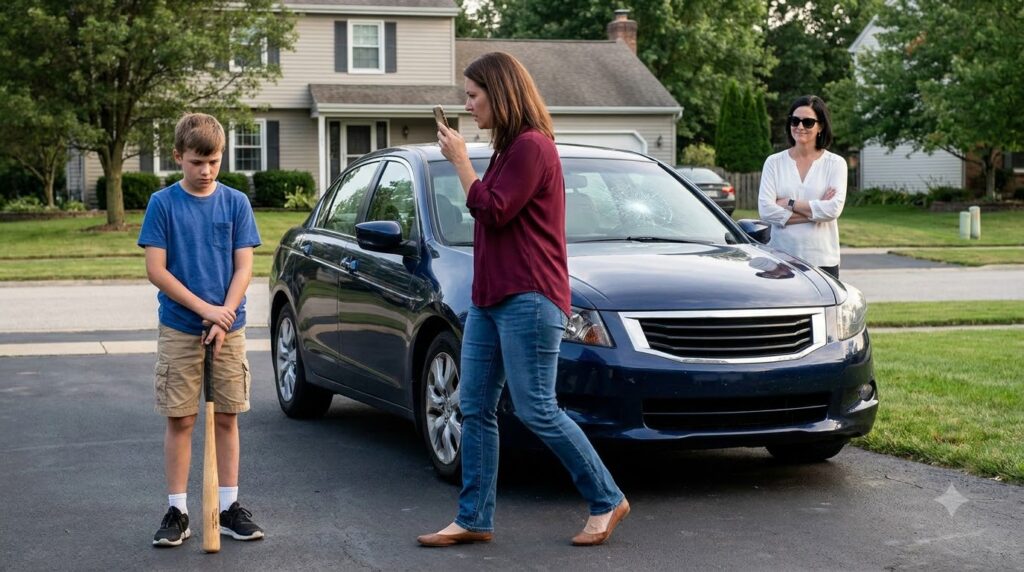
She reached out with two fingers, pinching the corner of the neon cardstock where it lodged beneath the rubber wiper blade. The glass beneath it crackled faintly, a microscopic hair-line fracture expanding an eighth of an inch from the primary starburst strike. As she pulled the paper free, her thumb brushed the rough, hand-cut edge. It wasn’t an official citation from the township code enforcement department. It was a section cut from an archaic legal filing, complete with a typed excerpt and a heavy, underlined handwritten note at the bottom: Ordinance 84-B: Unobstructed Turning Radius & Timber Encroachment.
Laura’s mind raced back through six months of relentless, quiet escalation.
When she had bought the two-story home four years ago, the shared concrete driveway had been nothing more than a shared strip of pavement—twenty feet wide, divided down the center by a subtle seam in the pour. For three and a half years, there had been silence. Laura parked her dark blue sedan on her concrete apron, well within her ten-foot boundary, leaving ample room for any vehicle to pass.
Then Brenda had filed her first formal grievance in March.
It had started with an anonymous municipal complaint alleging that Laura’s sedan was inoperable and blocking emergency vehicle access. When the inspector arrived, Laura had turned the key, started the engine on the first crank, and produced a clean registration and insurance card. The inspector had apologized, signed off on the compliance form, and left.
Two weeks later, the passive-aggressive notes began appearing. “Please consider your neighbors’ property values.” “A driveway is for movement, not storage.” Then came the bogus hazardous tree filing targeting the mature oak near the rear fence line. Every attempt followed the exact same pattern: Brenda would weaponize an administrative lever, wait for Laura to defend herself, and then shift to a new angle the moment the previous claim collapsed under legal scrutiny.
Laura stared at the handwritten numbers on the cardstock: Case 409-E: Mutual Easement Dissolution & Forced Partition.
The realization hit her like a cold shock despite the sweltering heat. Brenda hadn’t just been trying to force her to move the car out of petty malice or suburban snobbery. Brenda was laying a documented paper trail of alleged safety hazards and property line disputes. Under the township’s civil code, if an easement became a persistent site of safety violations, hazardous obstructions, or physical property damage, a co-holder could petition the county land court for a forced dissolution—allowing the dominant parcel to buy out the subordinate parcel’s access rights at a discounted appraisal rate.
Brenda wasn’t trying to make Laura park on the street. She was trying to seize the driveway.
She had given the boy the baseball bat under the guise of clearing a “dead ash stump” on the property line so she could claim in court that the shared lane was structurally hazardous, poorly maintained, and prone to violent accidents caused by Laura’s obstructed sightlines. The smashed windshield was supposed to be the final physical evidence attached to her petition—a child’s panic, caused by an illegally parked car blocking his view.
Laura folded the yellow paper into a neat square and slid it deep into her jeans pocket. She looked up just as the white-and-green patrol car brought its front tires to a gentle rest against the curb.
The driver’s door swung open. Deputy Miller stepped out into the heat, his dark sunglasses reflecting the sun-bleached asphalt, his left hand resting casually over his duty belt near his radio. He looked at the cracked windshield, then at the wooden bat resting in the grass, and finally at Brenda, who had already plastered a tight, pained expression of civic concern across her face.
“Afternoon, ladies,” Deputy Miller said, his boots crunching against the loose gravel at the edge of the apron. “Dispatch got a call about a disturbance and property damage. Who wants to tell me what happened here?”
“Officer, thank goodness,” Brenda began immediately, stepping forward with her hands clasped in front of her white blouse. “It was a terrible, chaotic accident. My nephew was trying to help me clear an unsafe dead branch near the easement line, and he panicked when he couldn’t see past Miss Miller’s vehicle.”
Laura didn’t interrupt. She simply unlocked her smartphone screen, opened the video playback menu, and held the glass up toward Deputy Miller’s eye level.
“I have the accident on video, Deputy,” Laura said quietly. “Along with the exact instructions Miss Vance gave him before he took the swing.”








