
CHAPTER 5: THE AUTHORITY COLLAPSE
“Step back from the gate, Mrs. Hensley.”
The command hung in the humid, midday air like a lead weight. Clara did not move immediately. Her sneakers stayed wedged against the asphalt line, her fingers white where they clamped the upper rim of the clipboard. But the deputy’s hand remained steady on the plastic board, his thick thumb pressing down against her fake ledger sheets until the cheap aluminum clip groaned under the strain.
“Deputy, you are misinterpreting the physical boundaries of this development,” Clara said, her voice dropping its standard, sharp resonance, turning thin and rapid as the paper under her hand began to wrinkle. “The association paid for the gate posts. The drainage trench is an authorized capital improvement project. You don’t have the administrative standing to seize private property markers.”
“This isn’t private turf, ma’am,” the deputy said. He didn’t raise his voice, but his boots shifted, his heavy utility belt clicking as he leaned slightly forward, cutting her off from the pathway. With a slow, deliberate twist of his wrist, he unclipped the blue municipal security fob from her board. The metal ring snapped like a small pistol shot in the silence of the lane. “This fob belongs to District Four Water and Infrastructure. It was logged missing from the county garage ledger three months ago. Possession of municipal utility keys by unauthorized personnel is a Class A misdemeanor under state civil code.”
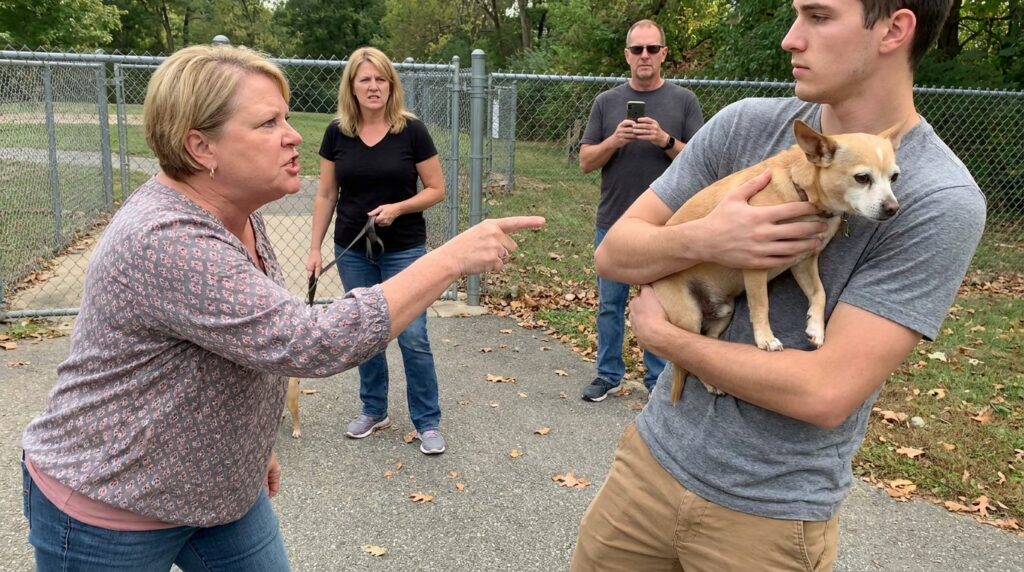
Leo let his shoulders drop by a fraction of an inch, though he didn’t loosen his forearms around the dog. The small tan animal had finally stopped its rapid rib movement, its pale muzzle resting flat against the gray fabric of his T-shirt, its large ears pointed toward the deputy’s ledger. The weight of the animal felt solid now, no longer a liability to be hidden, but a fixed marker of his presence on the path.
Sarah Miller stepped closer, her retriever sitting quietly by her heel. Her face had completely cleared of the suburban anxiety that usually governed the block. “The county notice came from the regional registrar’s office, Clara. The registry showed that this whole strip—the park, the gate, the first twenty lots along the bypass road—was designated as a non-exclusive public access corridor back in ninety-four. You’ve been fabricating the registry fines because the digitization project was scheduled to go live this month. If the families left before the county updated the spatial parcel maps, the association could claim adverse possession.”
The truth didn’t enter the space as a dramatic twist; it landed with the dull, heavy thud of an iron door closing.
Clara’s hand slowly released the clipboard. Her arm dropped to her side, her extended index finger finally curling back into her palm. Without the board, her stocky frame looked smaller, the loud pink and gray patterns of her blouse suddenly looking out of place against the raw, unpainted metal of the chain-link fence. The sunglasses hid her eyes, but the sharp, downward turn of her mouth revealed the absolute ruin of her calculations.
“We were preserving the perimeter,” Clara whispered, her eyes fixed on the limestone dust settling over her sneakers. “The county doesn’t care about the maintenance logic. They don’t care about the equity built into these lanes. If you open the gates, the outside road comes straight through the center of the community.”
“The road belongs to the county, Mrs. Hensley,” the deputy said. He pulled the yellow carbon citation book from his belt, his pen scratching against the page with a dry, rhythmic hiss that was the only sound left on the paved path. He tore the top sheet off—a bright, official slip of paper that he held out directly against her chest. “This is a formal citation for public nuisance, spatial gatekeeping violations, and unauthorized possession of municipal property. The county surveyor’s office will be out here at eight tomorrow morning to pull your trenching crew off the easement.”
Clara didn’t take the paper immediately. It fluttered in the light breeze, the yellow corner scraping against her blouse before her fingers closed around it like a dry leaf. She didn’t look at Leo. She didn’t look at Sarah or the steady, dark lens of Marcus’s phone. She turned around, her thick-soled walking shoes dragging through the loose gravel as she began the long, silent walk back up Oak Ridge Lane alone.
Leo watched her shadow shrink against the white glare of the asphalt until she cleared the first row of hedges. He slowly lowered his arms, letting the small tan dog’s paws touch the cool, dry grass inside the fence line. The dog shook itself once, its brass collar clip ringing softly against the D-ring, then trotted two feet forward to sniff at the base of the galvanized gate post.
Sarah Miller let out a long, slow breath, her hand loosening its grip on the heavy nylon leash for the first time in an hour. “She’s been running the board for twelve years, Leo. Nobody had the records to challenge the logic.”
“The records were always public, Sarah,” Leo said. He adjusted the gray fabric of his shirt, his chin turning toward the road where the county cruiser’s lights were finally shutting off. “She just counted on everyone being too tired to look them up.”
Marcus Vance lowered the smartphone, his face remaining perfectly neutral as he slipped the device into his pocket. He gave Leo a single, brief nod—a silent calculation concluded, a hard boundary permanently restored at the threshold of the gate.








