CHAPTER 2: THE LAWS OF DISPLACEMENT
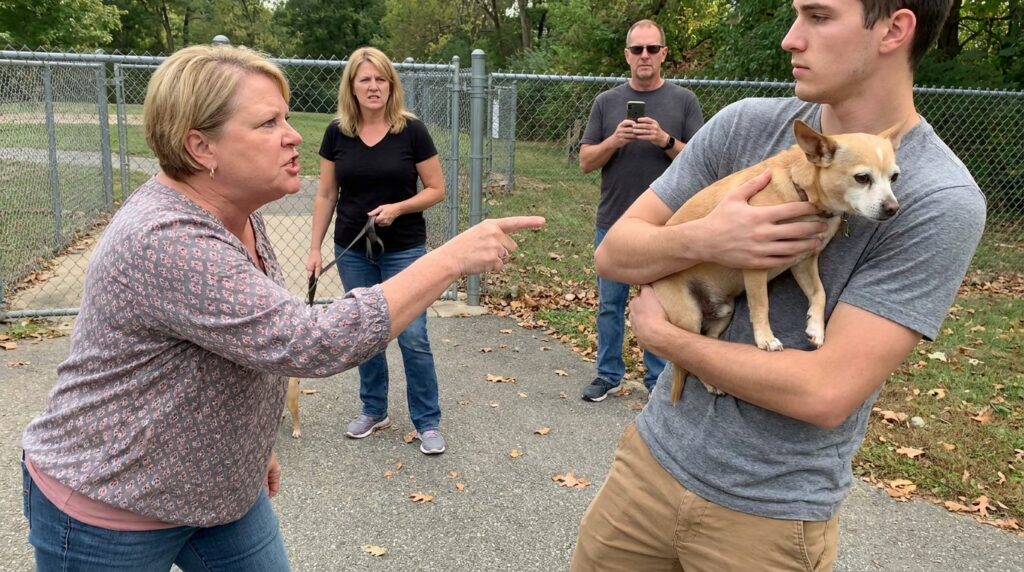
Clara Hensley did not flinch, but the micro-movement of her hand told a different story. The blue municipal security fob clicked against the plastic lower rim of her clipboard, a sharp, synthetic chime that didn’t match the dull, sun-baked landscape of the Oak Ridge common area. Leo kept his weight low, the balls of his boots grinding into the gritty asphalt. The small tan dog shifted against his ribs, its ribs expanding with a fast, shallow rhythm, but it didn’t growl. It knew the rules of the house; it knew that noise brought the stick.
“I asked you a question, Leo,” Clara said, her voice dropping into a rhythmic, practiced register that carried easily toward the fence line where Sarah Miller stood. She didn’t look at the dog anymore; she looked at the space just above Leo’s left shoulder, addressing the invisible court of public opinion she always carried with her. “The neighborhood association agreement is very clear about the weight restrictions and registration procedures for common-area use. If you don’t have the laminated ledger tag visible on the harness, you are technically in violation of civil trespassing guidelines.”
“It’s a public easement, Clara,” Leo said. The words left his mouth cold, flat, and dry. He didn’t raise his hands. He didn’t point. He kept his forearms locked over the dog’s flanks, tracking the way the sun caught the edge of the blue fob. It wasn’t standard HOA issue. The neighborhood association tags were cheap, injection-molded orange plastic. This was a heavy, commercial-grade proximity key stamped with a three-digit municipal inventory code. The kind used by the county parks department to open the heavy automated vehicle barriers at the main reservoir road three miles north. “The county updated the plat maps four months ago. The sidewalk strip and the first twelve feet inside the fence line are cleared for public foot traffic.”
Clara’s jaw tightened, the skin along her throat turning a mottled, angry pink that matched the loud patterns of her blouse. “The association maintains this turf. We pay the landscaping crews. We set the logic for who uses the gates. If we allow every unregistered animal from the bypass road to tear up the sod, the value of every property on this lane drops five percent by the end of the quarter. My husband didn’t spend thirty years in corporate compliance to watch the perimeter fail because a few renters don’t want to fill out the registry.”
She took a step sideways, her thick-soled walking shoes scraping against the dry oak leaves underfoot. The movement was calculated; she was blocking the narrow gap between the galvanized gate post and the edge of the park sign. To pass her now, Leo would have to shoulder-check her out of the way or step off the asphalt into the fresh, deep mud where the HOA utility crew had been trenching for new drainage lines earlier that morning.
Leo watched her eyes behind the sunglasses. He didn’t look at her face; he watched the reflection of the chain-link fence in her lenses. He could see Sarah Miller’s silhouette in the curved plastic—Sarah was leaning slightly forward now, her knuckles white around the nylon leash, her mouth slightly open but silent. Beyond her, Marcus hadn’t moved an inch. The smartphone remained held perfectly at chest level, the lens dark and steady.
“The registry isn’t a county requirement,” Leo noted, his voice dropping an octave to match the low rumble of a delivery truck shifting gears out on the main highway. He adjusted his grip on the dog, his fingers finding the small, brass clip on the collar. The metal was cold despite the midday heat. “You’re asking for tax returns and lease agreements just to issue a gate code. That’s not administrative compliance. That’s data mining.”
“It’s called preservation,” Clara snapped, her finger rising again, this time jabbing toward the deep, black mud of the trench line. “Look at that soil. The county didn’t pay for that remediation. We did. We protect what’s ours. And if you think you can use this park as a loophole because your family’s name is on an old parcel deed from before the incorporation, you’re severely mistaken. The board has the authority to issue immediate summary fines for non-compliant utility use, and I have the ledger right here.”
She turned the clipboard toward him, the white sheets of paper glaring in the sun. Leo didn’t look at the text, but his eyes locked onto the bottom corner of the board where the blue fob hung. The municipal stamp was clear now: PROPERTY OF MUNICIPAL REGISTRY – DISTRICT 4 EASEMENT ACCESS.
A realization clicked into place behind Leo’s eyes, cold and sharp. District 4 wasn’t the residential zone for Oak Ridge. It was the public utility district that handled municipal drainage and lower-income community development grants. Clara wasn’t using an HOA key to lock the gates; she was using a county-issued master key that belonged to a department she had no legal right to represent.
“The county service truck comes by on Tuesdays,” Leo said softly, his eyes shifting back to Clara’s face. He didn’t smile, but his posture straightened, the slouched, defensive lean disappearing as he stepped fully into the center of the lane. “They use that exact fob to check the water meters behind the fence. Why do you have a public utility key on an association clipboard, Clara?”
Clara’s hand went instantly still. The confidence didn’t drain from her face—it froze into something harder, a rigid mask of defensive calculations. She didn’t drop the clipboard; she pulled it back against her chest, her fingers covering the blue plastic piece as she glanced past Leo toward the road where the distinct, low whine of a municipal siren began to rise in the distance.