
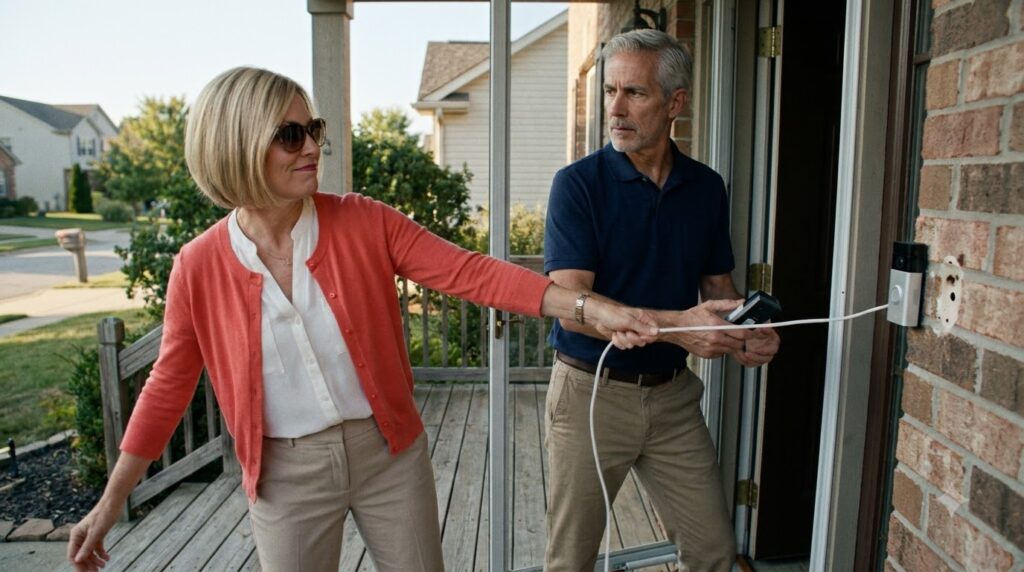
CHAPTER 4: THE SHARED JUNCTION
Frank closed his hand into a tight, leathery fist, the corroded teeth of the padlock key digging hard into the flesh below his ring finger. He didn’t look back toward the road. Down here, belly-level with the boxwood roots, the street was nothing but a strip of heat shimmer over crushed limestone, but the hum of an unhurried, heavy engine idling out near the county culvert had settled into the soles of his boots.
“Get up,” Frank told her. His voice barely rattled the dried spider webs clinging to the cedar joist. “Get out from the dirt.”
Karen didn’t argue. Her knees made a wet, sucking sound as she pushed up from the red mud, leaving two dark, damp ovals on the knees of her tailored slacks. The arrogance had peeled away entirely, leaving behind the jagged skeleton of pure survival. She kept her back hunched, staying low behind the line of the privet hedge as Frank hauled himself up against the porch stringer.
His knees protested, bone grinding against cartilage with a sharp ache he ignored. He shoved the sheepfoot blade back into his jeans, palming the little green-skinned key.
“The fence line,” Frank muttered. “Move.”
They stayed within the dead space—the six-foot alley between his weathered shiplap and her neat, painted stucco where the sun never fully reached. The ground was thick with dropped pine needles, dry and slick as grease under their soles. At the rear corner of the property, half-swallowed by an unpruned trumpet vine, the weathered galvanized post leaned outward under forty years of frost heave. Bolted to its flank was a six-by-eight-inch utility enclosure, its olive-green enamel blistered into brittle scabs by decades of summer sun.
The split black garden hose ran out of the ditch, crawled up the rusty zinc pipe, and disappeared straight into the bottom knockout hole of the box.
The padlock hanging from the hasp wasn’t a standard utility company cylinder with a brass badge and a stamped seal. It was a cheap, heavy master lock, mottled with gray oxidation, its shackle pitted with red scale.
Karen stood three paces back, her fingers hooked into the hem of her cardigan, knuckles tight. “It’s been locked since they poured the curb,” she whispered. “Nobody has the key.”
“Somebody did,” Frank said.
He stepped into the tangle of dead vines, ignoring the dry stalks snapping against his shins. He brought the little notched key up, lining its corroded ward against the narrow keyway. He didn’t force it; forty years of turning rusted valves had taught him how metal gave way when it was ready. He seated the blade, applied a slow, steady torque with the ball of his thumb, and felt the tumbler seize, resist, and then pop with a sharp, dry tink.
The hasp swung loose, trailing a flake of rust that fell silently into the dead needles.
Frank caught the iron door before it could creak open on its pins. He eased it wide an inch at a time, shielding the interior from the harsh glare of the late sun with his shoulder.
Karen leaned in, her breath coming fast and shallow, hitching on each inhale. “Is the transformer in there?”
The interior wasn’t a power tap.
Mounted against a backer of scrap plywood was a pair of terminal blocks, neat as an instrument panel in an aircraft. The silver wire from Frank’s porch didn’t link to a battery, nor did it tap into the neighborhood’s municipal lines. It terminated inside an aluminum housing no larger than a deck of cards, anchored to the cedar post with four drywall screws.
Beneath a tiny glass lens on the housing, an amber diode gave two slow, rhythmic blinks. Not the green light Karen had claimed went dead, and not the erratic flutter of a power surge.
It was an interrogation beacon.
Frank squinted, his thumb tracing the braided lead that exited the opposite side of the aluminum unit. The line didn’t head toward Karen’s house. It didn’t drop into her meter. It plunged straight down through a core-drilled hole into the steel fence pipe itself, using the hollow post as a conduit down into the bedrock.
“That’s not an antenna,” Frank said softly. His thumb found the twin silver strands where they entered the terminal screws. They were cold. Utterly dead of current. “There’s no power running here, Karen. None.”
She blinked, stepping closer until her sleeve brushed his shoulder. “What are you talking about? The drain—the line from the hall—”
“It’s a dry contact loop,” Frank said, the mechanic in him taking over, piecing together the iron reality of the circuit with brutal clarity. “It doesn’t pull power. It monitors resistance. The moment you took the pry bar to my doorframe and yanked those screws, you didn’t cut off a camera. You opened the loop.”
He turned his head toward the front yard. Through the narrow slot between his garage roof and her chimney, out on the shoulder of the county road where the gravel met the culvert, the door of the white panel van slid open on greased nylon rollers with a low, unmistakable rattle.
A man in a clean gray twill uniform stepped out into the dust, carrying an aluminum clipboard under his arm and a canvas tool roll in his left hand, walking not toward Frank’s porch, but straight down the easement toward the fence line.








