
CHAPTER 3: THE CIRCUIT TRACE
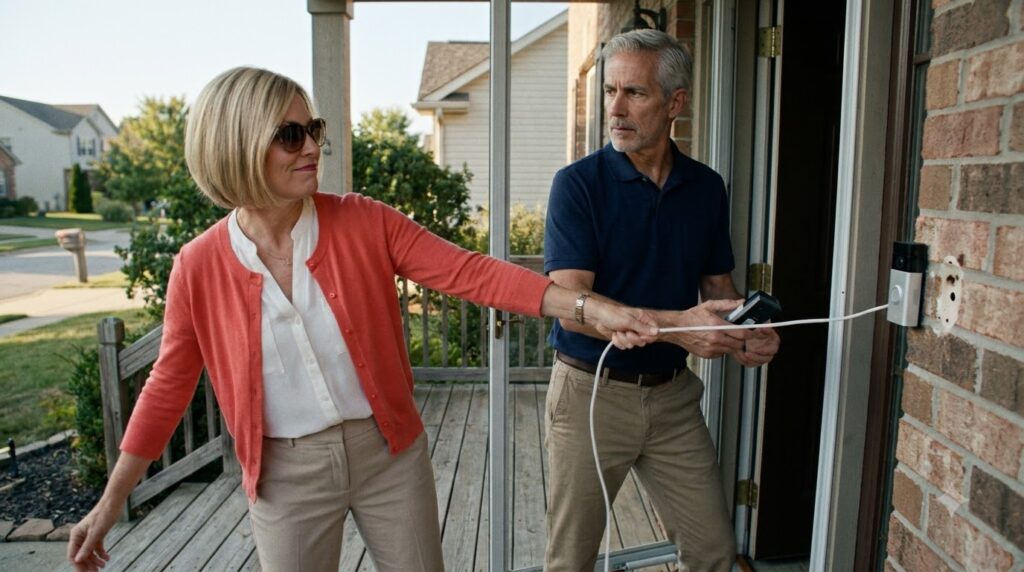
Frank didn’t drop the bell housing. He closed his fingers around it, letting the sharp mold-seams bite into his palm, and walked down the three porch steps.
The heat was thicker down on the red gravel, caught in the stagnant pocket between the cedar skirt and the thick, waxy hedge of overgrown boxwoods. His knee gave off its familiar, dry crunch as he crouched, the gravel grinding beneath the tread of his work boots. The smell down here was different—no baked paint, just sour dirt, decaying mulch, and the metallic tang of oxidized galvanized iron where the downspout discharged into the ditch.
Karen followed, her canvas sneakers crunching lightly behind him. She didn’t offer to help, and she didn’t leave. Her shadow fell long across the dirt, stretching past Frank’s shoulder until it touched the wooden lattice panels protecting the crawl space.
“Second bay from the corner,” she said, her voice dropping into the hedge line. “Under the cleat.”
Frank didn’t answer. He took his pocketknife out of his trouser pocket, thumbing open the short, curved sheepfoot blade with a heavy click. The brass liners were worn down from thirty years of pocket lint and oil, but the steel still had an edge that could shave pine. He slid the flat of the steel under the lower trim strip of the lattice, levering it back just enough to pop two rusted brads from the framing.
The wood parted with a sound like a dry branch snapping underfoot.
Inside the void beneath the floorboards, where the porch joists rested on rough-poured concrete piers, the darkness smelled of mouse droppings and damp lime. He reached up, feeling along the backside of the corner post where the siding ended.
His knuckles found the line immediately.
It wasn’t stapled down with standard insulated romex staples. Someone had used common fence wire—rusty, barbed baling wire twisted into crude U-hooks—to pin the run against the underside of the cedar decking. Beside the heavy black sheath of the old chime circuit, that whisper of silver wire ran unbroken, taut as a piano string. It didn’t snake toward the indoor subpanel beneath the stairwell. It cut directly south, running flush against the rim joist toward the narrow property gap between the two bungalows.
“Told you,” Karen whispered from above him. She had taken off her oversized sunglasses, tucking one arm of the tortoiseshell frame into the neckline of her cardigan. Without them, her face looked smaller, stripped of suburban arrogance, the pale skin around her sockets hollow and bruised by lack of sleep. “You think you’re isolated out here, Frank. You think because the mortgage is paid off, the ground belongs to you.”
Frank’s fingers traced the silver strand until it hit the edge of the second concrete pier. Here, the line vanished into a split length of ribbed black garden hose, zip-tied tight against the iron drain pipe that carried greywater out from the laundry tub. It was sloppy work, but pragmatic—the kind of installation done by someone working on their knees with a headlamp in the dark, knowing no inspector would ever belly-crawl through four inches of damp clay just to check the grade.
He pulled the wire taut. It didn’t give.
“Who crawled under here, Karen?” Frank asked, not looking back at her. His thumb brushed against something metallic wedged in the seam where the lattice met the post. It was small, cold, and flat: a notched brass padlock key, corroded green with verdigris, shoved into a slit in the dry pine like a hidden razor blade. He didn’t pull it out; he let his palm mask it as he leaned his weight forward.
“Nobody crawled under here from the street,” she said. Her voice tightened, carrying that thin, vibrating edge again, like a belt slipping on an alternator. “They came through the easement behind my garage. Dug a trench three inches deep through the pine straw last October when the leaves were coming down. I thought it was the cable company laying drops for the high-speed line.”
“Cable company doesn’t run bare silver conductor,” Frank muttered.
“No. They don’t.” She knelt down, the knees of her beige slacks pressing directly into the reddish dust without hesitation. She reached toward the garden hose, her manicured nail tapping the ribbed plastic. “They run co-ax. They run marked fiber. This is an antenna tap, Frank. It’s a parasite bridge. It’s taking the feed from your lens, pulling the continuous power from the telephone ground, and repeating the packet over the boundary fence into the junction box on the county pole.”
Frank turned his head slowly, his eyes meeting hers beneath the brim of his faded cap. The distance between them was less than two feet now. The false front had collapsed; neither of them was performing for the neighborhood anymore.
“Why tear it down now?” Frank asked. “If it’s been in the dirt since October, why pull the screws today?”
Karen’s gaze flicked past his ear, staring deep into the dark, dusty throat beneath his porch joists. Her throat bobbed as she swallowed.
“Because this morning, the green light on the junction box turned off,” she whispered. “And an hour ago, someone sent a delivery van to sit on the shoulder by my mailbox. Not an Amazon truck, Frank. Not the mail. Just a white panel van with out-of-county plates and an aerial mast folded down flat along the roof rack.”
Frank looked down at his hand. The brass key under his palm felt suddenly heavier than the steel blade of his knife.








