Chapter 7: What Remained
A year after the fire, Harold hosted a neighborhood barbecue.
The repaired house looked beautiful.
The new kitchen had modern appliances.
The smoke alarms had all been replaced.
The emergency-access markings on the street were fresh and visible.
Neighbors gathered in the backyard.
Children played near the fence.
Older residents sat in folding chairs and talked about everything from property taxes to grandchildren.
Karen arrived carrying a casserole.
Harold looked at it suspiciously.
“You cooked?”
“I can cook.”
“That’s not what I asked.”
She laughed.
The tension that once existed between them had disappeared.
Not because everyone forgot.
They hadn’t.
The incident remained part of neighborhood history.
But history didn’t have to remain a wound.
Near sunset, Daniel arrived with two firefighters from his station.
Harold thanked them again.
Then he showed them the restored wedding photograph.
The frame had been replaced.
The photograph was no longer damaged.
It showed Harold and Evelyn beneath the oak tree, smiling at a future they couldn’t possibly have imagined.
Daniel studied it.
“You’re lucky.”
Harold shook his head.
“No.”
He looked toward the street.
“We were reminded how quickly everything can change.”
Daniel understood.
Karen stood nearby, listening.
She had once believed the most important thing in life was protecting what was hers.
Now she understood that sometimes the most valuable thing you could do with your home was make sure there was room for someone else to reach it.
Before leaving, Daniel handed Karen a small department sticker.
She stared at it.
“What am I supposed to do with this?”
“Put it somewhere you can see it.”
She smiled.
“I thought firefighters hated people who put stickers on their cars.”
“Only if they park across the road.”
Karen laughed.
This time, everyone around her laughed too.
The street was quiet that evening.
No sirens.
No shouting.
No confrontation.
Just porch lights turning on one by one as families went home.
Karen stood at the edge of her driveway and looked down the road.
For years, she had seen that street as something she needed to control.
Now she saw it differently.
It was a passage.
A way home.
A way out.
A way for an ambulance to reach a frightened family.
A way for a firefighter to reach someone trapped inside a burning house.
A way for neighbors to come together when something went wrong.
And perhaps most importantly, it was a reminder that none of us truly owns the world around us.
We only borrow our little corner of it.
What matters is what we leave clear for the people who come after us.
Harold had nearly lost his life that afternoon.
The neighborhood had nearly lost something else too—the willingness to stand up when a boundary was crossed.
But sometimes one terrible day can teach an entire community what years of ordinary life could not.
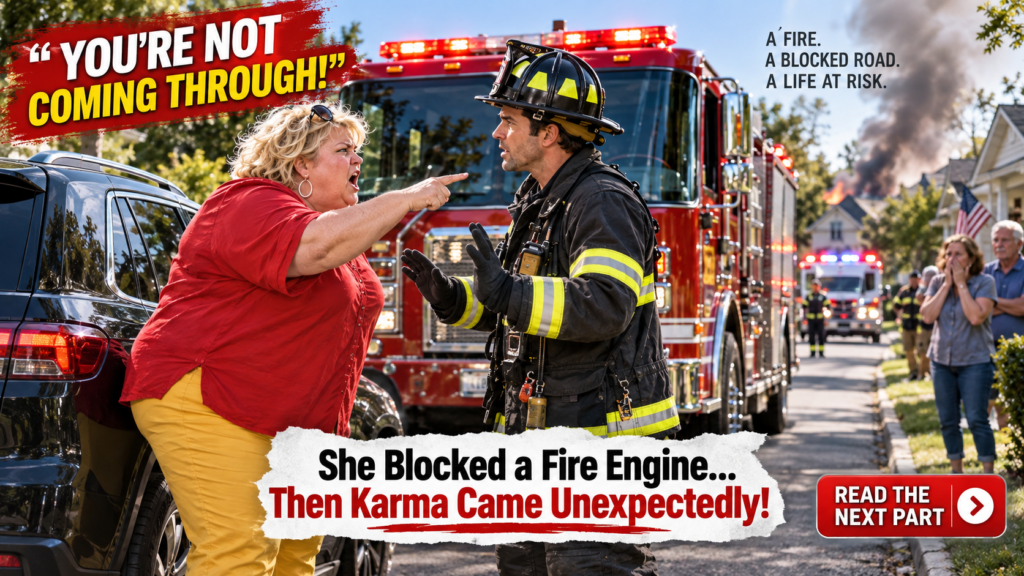
Karen never forgot the sound of the fire engine stopping behind her SUV.
She never forgot the smoke above Harold’s roof.
And she never forgot the moment she realized that being right about a parking space could never matter more than being decent to another human being.
The road had always belonged to everyone.
She had simply needed to learn it the hard way.