CHAPTER 1: The Weight of the Curb
The idling diesel engine vibrated through the floorboards of the cab, humming a low, flat bass note that rattled against Marcus Holloway’s chest. He stood near the open tailgate of his crossover, a pair of heavy work gloves dangling from his left hand, watching the red indicator light of the delivery truck blink against the glare of a Sacramento afternoon.
Thirty-eight minutes ago, the boxes had still been a chaotic wall blocking his living room. Now, they were a promise of permanence he wasn’t sure he was ready to keep.
Then the shadow cut across the pavement.
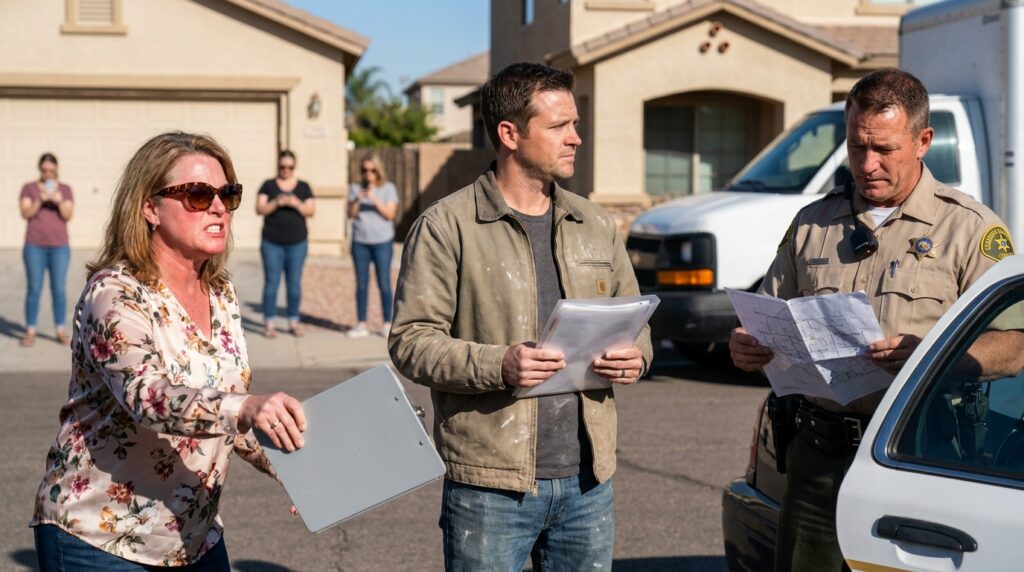
She moved with an practiced, rhythmic certainty—the sort of walk belonging exclusively to people who believed the earth rotated on an axis of their own choosing. Brenda Vance. Mid-fifties, draped in a silk floral blouse that looked immune to dust, wearing oversized tortoiseshell sunglasses that mirrored the pale beige stucco of the houses lining Pembroke Court. Her right hand clutched a gray plastic clipboard holding a laminated permit sheet.
She didn’t look at Marcus. She looked at the front bumper of the multi-axle freight truck as if it were an uninvited insect.
“Cut the engine,” she said. Her voice didn’t carry the raw volume of a shout; it carried the thin, brittle authority of a woman accustomed to being obeyed before she finished her sentence.
The driver, a young man with a sweat-stained collar and a lanyard dangling from his pocket, glanced uncertainly toward the rearview mirror, then down at Marcus.
Marcus stepped forward, his canvas jacket stiff against his forearms. “Is there a problem, Ms. Vance?”
“There is a commercial obstruction problem, Mr. Holloway,” Brenda said, finally turning her head. The tortoiseshell lenses locked onto him with zero warmth. “Commercial freight transport is strictly prohibited on residential cul-de-sacs on weekdays without a pre-approved architectural release form and a seventy-five-dollar impact processing fee paid directly to the board office.”
She tapped the corner of her clipboard against her palm. A hollow, rhythmic clack-clack.
“This is a delivery of residential shelving,” Marcus said, keeping his voice level. He had spent ten years as a senior compliance analyst dissecting corporate risk portfolios; he knew the exact cadence of a person inventing policy on the fly to mask a total absence of jurisdiction. “It takes twenty minutes. It’s not a commercial route.”
“Everything that enters Pembroke Commons through Gate Seven falls under architectural review,” Brenda replied, her chin lifting an imperceptible fraction of an inch. “Which you would know if you had submitted to your mandatory new-resident interior layout orientation during your first week. That’s strike two on your compliance ledger.”
Across the street, a pair of hedge shears stopped clipping. A retired neighbor three houses down paused behind a row of boxwood, pretending to inspect a leaf while his ears strained for the audio.
Marcus felt the old, familiar weight settle behind his ribs—the cold, calcified irritation he’d felt every time a vice president in his former firm asked him to sign off on a metric he knew was fabricated. It wasn’t anger. It was the heavy exhaustion of dealing with small minds armed with rubber stamps.
“There is no provision in the Pembroke Commons governing documents for interior inspections, Ms. Vance,” Marcus said, his gaze steady. “And there is no restriction against delivery trucks using a public access lane.”
Brenda’s mouth tightened into a pale, hard line. The warmth of her welcome packet routine had completely evaporated, leaving behind the raw, naked mechanics of control.
“We define the rules of this community, Mr. Holloway,” she said, stepping closer, her perfume—something sharp and expensive—cutting through the smell of hot asphalt. “And if that truck does not back out of this cul-de-sac within sixty seconds, I’ll be issuing an immediate five-hundred-dollar emergency violation notice. Let’s see how comfortable your living room boxes feel when your account is sent to collections.”
She turned her back on him, waiting for the compliance machinery to crush him as it always had.