
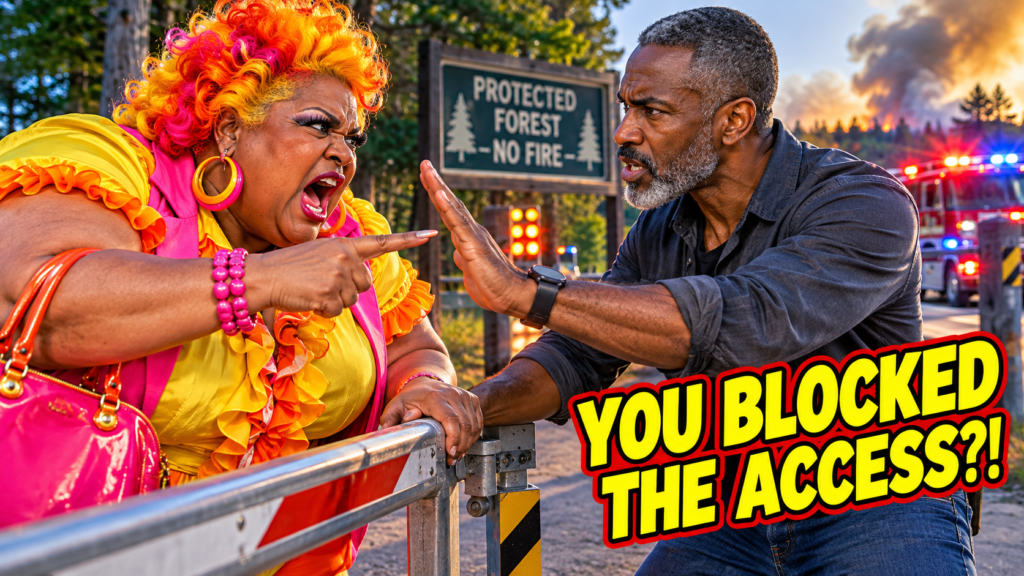
Chapter 2: The Paper in His Hand
Karen reached for the document.
The Neighbor pulled it back before she could take it.
“Let me see it.”
“You already saw it.”
“I said let me see it.”
He held the laminated card at his side.
The conflict had changed.
A few minutes earlier, Karen had been acting as though possession of the barrier gave her control over the entrance. Now the barrier itself had become almost irrelevant.
The Neighbor had something she could not physically move.
An authorization.
Karen looked toward the forest road again.
She had lived in the neighborhood long enough to know that most residents treated the protected area as someone else’s responsibility. There were signs, locked gates, seasonal restrictions, and occasional maintenance crews.
But she had always believed one thing very strongly:
If she could stop someone from crossing a boundary, she could make them explain themselves.
She had used that assumption before.
This time, it was failing.
“You’re not an emergency responder,” she said.
“No.”
“Then why do you have access?”
“Because I volunteer with the community fire-watch program.”
Karen’s eyes narrowed.
The Neighbor pointed toward a second, narrower lane beside the main barrier.
“I’ve had that authorization for three years.”
Karen looked at the lane.
She had never noticed the small access sign before.
Or perhaps she had noticed it and simply never considered that it applied to someone like him.
Her hand tightened around the barrier.
“You could have shown me that before.”
“I tried.”
The answer irritated her more than an argument would have.
The Neighbor reached into his jacket again.
This time he removed a second item: a small folded map of the forest perimeter.
He opened it on the hood of his truck.
There were several access points marked in blue.
The entrance Karen had blocked was one of them.
“So what?” she said.
“So when you moved the barrier, you didn’t stop me from getting information or getting help.”
He pointed toward another road that ran behind the trees.
“You only blocked the route everyone else was supposed to use.”
Karen looked toward that road.
A realization settled slowly across her face.
Her attempt to control the entrance had not isolated him.
It had isolated everyone.
And if emergency crews needed that route, she had just created a problem that was larger than the argument between them.
The Neighbor folded the map.
“I’m going to report the obstruction.”
Karen’s head snapped up.
“You wouldn’t.”
“I already have.”
She stared at him.
The radio on his belt crackled.
A voice from the emergency crew asked whether the access lane was clear.
The Neighbor looked directly at Karen.
For the first time, she understood that the person she had been trying to control had already opened another door.








