Chapter 7: What Home Was Really Worth
Months later, the landscaping had recovered.
The raised border looked almost exactly as it had before the dispute.
The garden marker stood straight.
The storage bins were neatly stacked.
The generator sat securely in its proper place.
And the extension cable was no longer lying across anyone else’s property.
The neighborhood returned to its normal rhythm.
Robert still saw Karen occasionally.
They did not become friends.
They did not need to.
Some relationships were healthiest when reduced to simple respect.
A nod.
A brief greeting.
Enough distance to prevent unnecessary conflict.
The incident became neighborhood history.
People remembered the machine.
They remembered the tangled cable.
They remembered the bins crashing down.
But Robert remembered something else.
He remembered the moment Karen had said that if he cared about his property, he should have stopped her before she used it.
At the time, the statement had made him angry.
Later, he realized why.
It placed responsibility for someone else’s decision onto the person who had been wronged.
That was the part he could not accept.
A boundary did not become meaningless because someone crossed it before being physically stopped.
Permission did not appear simply because resistance was inconvenient.
And respect was not something a homeowner had to earn by constantly defending every inch of his property.
Robert had spent much of his life believing that keeping peace meant avoiding confrontation.
The experience taught him a more complicated lesson.
Sometimes peace required a boundary.
Sometimes fairness required documentation.
And sometimes the strongest response was not to fight harder, but to stop allowing someone else’s behavior to dictate your own.
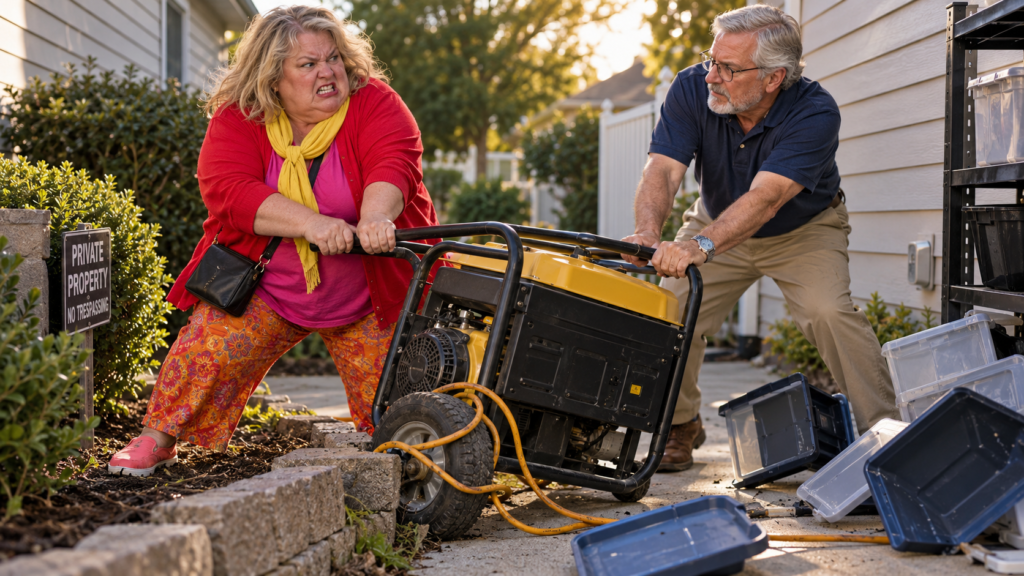
The machine had started as an object of pressure.
Karen had tried to use it to force her way across a line.
She had pulled it.
Robert had pulled it back.
The wheel had caught.
The cable had tangled.
The bins had fallen.
The ground had been damaged.
And eventually, the very object she had used to create pressure became the clearest evidence of what had happened.
Robert never had to defeat Karen.
The consequences of her own choices did that work.
One autumn afternoon, he stood beside the garden border with a cup of coffee.
The sun was low.
Leaves moved gently across the pavement.
Everything was quiet.
He looked toward the neighboring house.
For a moment, he wondered whether the whole dispute had been worth the stress.
Then he looked at the restored stones beneath his feet.
This was his home.
Not just the walls.
Not just the yard.
The years of work.
The memories.
The privacy.
The right to decide what happened on his own property.
He took a slow breath and smiled.
The most satisfying part was not that Karen had finally stopped.
It was that Robert no longer felt the need to watch for her.
He had his home back.
And sometimes, after enough noise, that quiet is the clearest sign that a boundary has finally been respected.