Chapter 2: The Line Nobody Was Supposed to Cross
Robert had lived on Willow Creek Lane for almost three decades.
He had watched children grow into adults, watched old neighbors move away, and watched new families arrive carrying boxes into houses that had once belonged to people he knew.
The neighborhood had changed.
The expectations had not.
People generally respected fences, driveways, lawns, mailboxes, and the invisible boundaries between one home and another.
Karen had always been different.
She had moved in two years earlier.
At first, Robert had tried to be welcoming.
He had waved when he saw her.
He had helped her identify the shutoff valve for an outdoor water line after she bought the house.
He had even carried a heavy package from her driveway once when she was struggling with it.
The relationship never became friendly.
Karen seemed to interpret ordinary neighborly courtesy as an invitation to become involved in other people’s business.
She commented on Robert’s yard.
She complained about where he parked.
She once moved a decorative planter because she said it made the shared view “look cluttered.”
Robert had moved it back.
Neither had mentioned it again.
Then came the generator.
A week earlier, Karen had complained that her own outdoor equipment was taking up too much room beside her house.
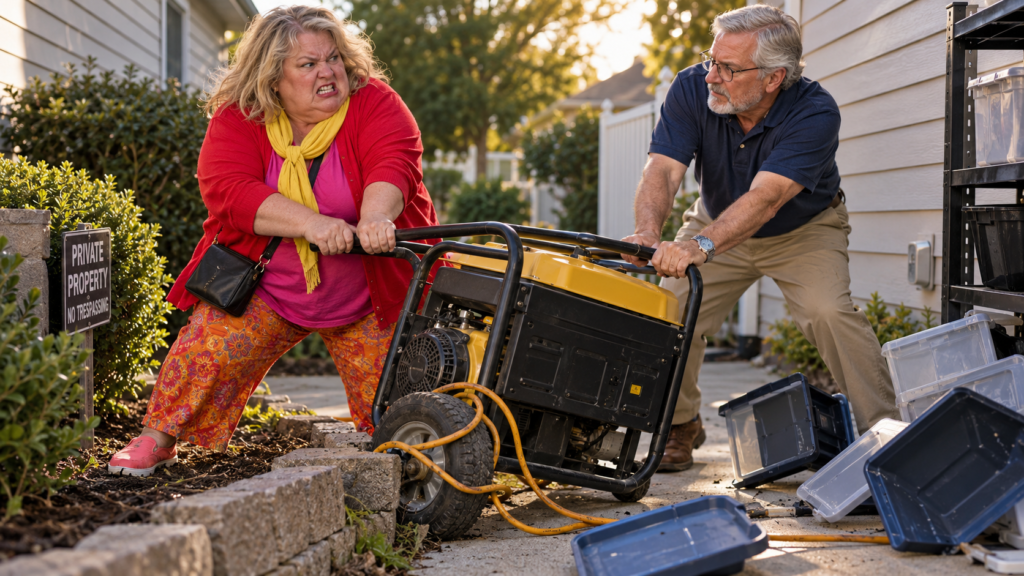
Robert had a large wheeled generator stored along the side of his property. It was his equipment, his responsibility, and normally kept secured when not in use.
Karen had apparently decided that its location was inconvenient for her.
The first time Robert noticed the machine out of position, he assumed he had moved it himself and forgotten.
The second time, he found tire marks near the property line.
The third time, he saw Karen standing beside it.
She claimed she was only moving it temporarily.
Robert told her not to.
She responded that the machine was “in the way.”
That should have been the end of it.
Instead, Karen began treating Robert’s refusal as an obstacle rather than an answer.
Now the appliance sat crookedly beside the landscape border, one wheel caught and the extension cable wound around it.
Robert carefully approached.
Karen remained beside the machine, arms folded.
She was still angry.
But the anger had changed.
She was no longer angry because she had failed to move the appliance.
She was angry because the physical evidence around her made it increasingly difficult to pretend she had done nothing wrong.
Robert crouched and examined the cable without touching it.
He saw exactly what had happened.
The cable had not been damaged.
It was simply tangled tightly around the wheel.
The storage bins had fallen, but most were empty.
Nothing appeared seriously damaged.
Still, Robert did not want to make the situation worse.
He stepped away.
“I’ll deal with this tomorrow,” he said.
Karen laughed bitterly.
“Of course you will.”
Robert went inside.
From his kitchen window, he could still see the machine.
And he could see Karen.
She stood there for several minutes, staring at it.
Then she walked back toward her house.
Robert assumed she had finally given up.
He was wrong.
The next morning, the machine was gone from the place where they had left it.
And the cable was missing.