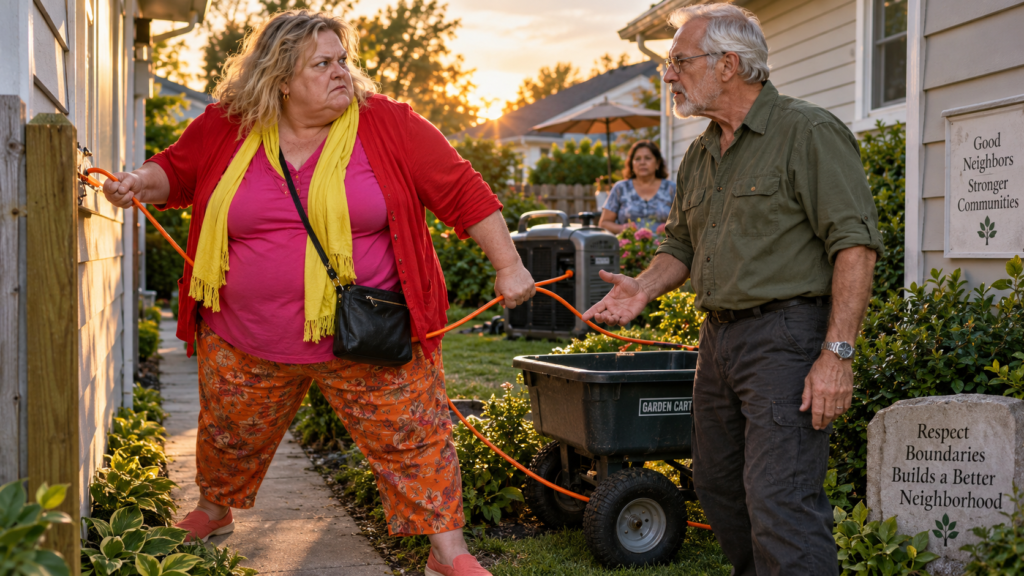
Chapter 5: The Notice on the Door
Three days later, a formal notice arrived.
The planters had to be moved.
The chair had to be removed.
The passage had to remain clear.
Temporary cables could not obstruct the designated access route.
Karen was given a deadline.
Frank thought the matter might finally settle.
It didn’t.
Instead, Karen began telling neighbors that Frank had “weaponized the HOA” against her.
She claimed he was trying to control her property.
She said the garden cart incident proved that he had deliberately sabotaged her equipment.
That version of events traveled faster than the truth.
For several days, Frank avoided discussing it.
Then Mrs. Alvarez called him.
“Frank, she says you caused damage.”
Frank frowned.
“To what?”
“Her appliance.”
He closed his eyes.
The appliance had stopped running because the cable had shifted.
There had been no damage.
Karen simply wanted everyone to believe that Frank had done something to her.
Frank finally understood the danger of endless explanations.
If he answered every accusation, the argument would never end.
So he sent the HOA one message.
He attached the photographs.
Nothing more.
Susan inspected the appliance with Karen present.
There was no damage.
The cable was intact.
The connection was intact.
The only problem was that Karen had been using equipment she had not been authorized to use.
Then Susan noticed something else.
Karen had plugged another appliance into a different extension cord.
This one ran across the edge of her own driveway.
It was not Frank’s.
But it was positioned dangerously close to a sprinkler line.
Susan told her to move it.
Karen refused.
“This is my property.”
Susan replied that the property was hers, but safety and community access still applied.
That distinction became the center of the dispute.
Karen believed ownership meant complete control.
The HOA rules treated ownership differently.
You could own your home without owning the space everyone needed to safely pass through.
You could own a yard without owning another person’s right to access their own property.
And you could borrow something without transforming it into yours.
Frank had learned those distinctions slowly.
Karen refused to learn them at all.
Then came the storm.
The weather service issued a warning for heavy rain and strong winds.
Frank spent the afternoon securing his yard.
He tied down the tarp.
Moved loose furniture.
Checked the gutters.
He also moved his garden cart away from the passage.
This time, he placed it completely inside his own yard.
The passage was clear.
For the first time in weeks, there was nothing to argue about.
Frank thought that might be the end.
Then, just before sunset, he heard a loud clatter from Karen’s yard.
He stepped outside.
A large decorative canopy had shifted in the wind.
One of its support poles had fallen toward the passage.
Frank watched it sway.
Karen ran outside.
She saw the pole.
Then she saw the narrow passage.
Then she looked toward Frank.
For a moment, neither spoke.
The storm had created a problem neither of them could argue away.
The passage needed to remain clear.
And Karen was standing beside the very boundary she had spent months trying to control.
Frank grabbed his flashlight.
He did not go into her yard.
He simply called across the passage.
“Move away from the pole.”
Karen stared at him.
For once, she did exactly what he said.