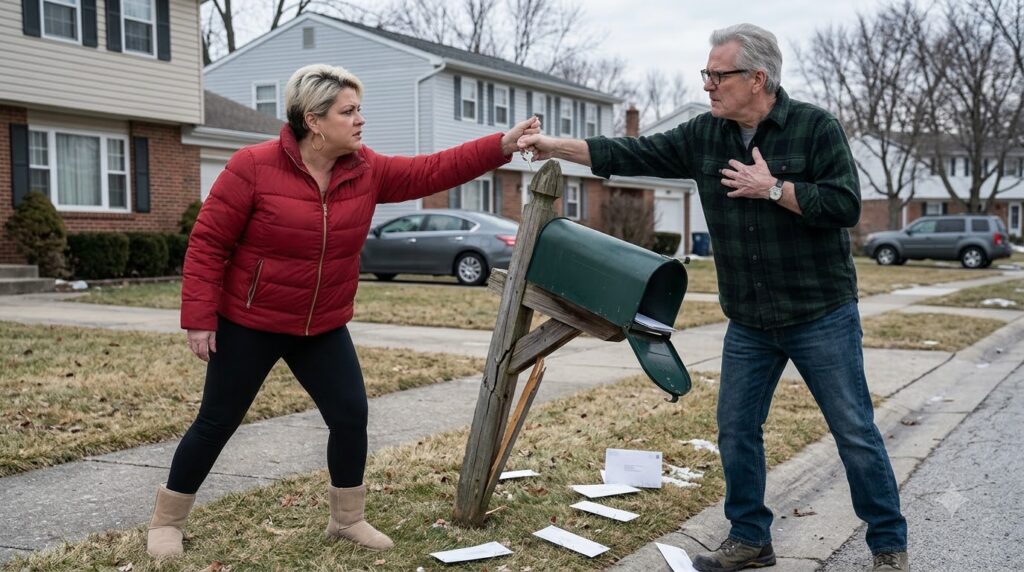
Chapter 5: The Reversal
Two days later, Peter Lawson appeared at the Mercers’ front door.
He was a polished man in his late forties, wearing a navy jacket and expensive-looking shoes.
He introduced himself politely.
Frank recognized him immediately.
“I understand there’s been some confusion,” Peter said.
“There has.”
Peter smiled.
“I’d like to resolve it.”
Frank didn’t invite him inside.
Peter explained that the complaints had been part of a “miscommunication.”
He claimed Karen had provided some information to him months earlier and that the paperwork had been entered incorrectly.
Frank listened.
Then asked one question.
“Why did you use my address?”
Peter’s smile disappeared.
“I didn’t.”
Frank had expected that answer.
“Then why is it on four county complaints?”
“I don’t know.”
“And why is your email address connected to the HOA messages?”
Peter paused.
That pause said more than an answer.
Frank stepped closer.
“You’ve been trying to make Karen look like a terrible homeowner.”
Peter’s face hardened.
“That woman has caused problems for everyone.”
“That doesn’t answer my question.”
Peter finally admitted that he had helped prepare several complaints.
He insisted they were based on real issues.
Maybe some were.
But the identity attached to them had been manipulated.
Peter had used Karen’s name because he wanted officials to believe the complaints came from her.
And the Mercers’ address had been added because it made the paperwork look connected to an established neighborhood complainant.
Peter believed nobody would notice.
He was wrong.
What Peter didn’t know was that Linda had kept every HOA communication from the previous two years.
She had also kept handwritten notes.
Dates.
Times.
Photographs.
Names.
That afternoon, Frank and Linda met with the HOA board.
Karen attended.
Peter attended too.
For the first time, all four sat at the same table.
The board reviewed the documents.
The fabricated complaints were separated from the legitimate ones.
Some complaints about Karen’s property were found to be valid.
Others were clearly manipulated.
The distinction mattered.
Frank insisted on that.
He didn’t want Karen declared innocent of everything simply because someone had mistreated her.
Karen, to her credit, didn’t ask for that either.
She admitted she had ignored several HOA notices.
She admitted she had argued with neighbors.
She admitted she had damaged Frank’s mailbox.
Then she did something Frank had not expected.
She apologized.
Not dramatically.
Not tearfully.
Just directly.
“I was wrong,” she said.
Frank nodded.
“That matters.”
Peter’s lawyer later advised him to cooperate with the investigation.
The board referred the document manipulation to the appropriate authorities.
But there was still one problem.
The mailbox.
Frank’s mailbox had become a symbol of everything that had gone wrong.
Karen had damaged it.
Peter had indirectly helped create the circumstances that led to the confrontation.
And Linda’s legitimate complaint had become tangled in a false paper trail.
The Mercers decided to replace the mailbox themselves.
They could have demanded Karen pay for everything.
Instead, Frank asked her to help install it.
Karen looked surprised.
“Why?”
“Because if we’re going to live on the same street,” Frank said, “we might as well learn how to fix things instead of breaking them.”
For the first time, Karen smiled without sarcasm.