
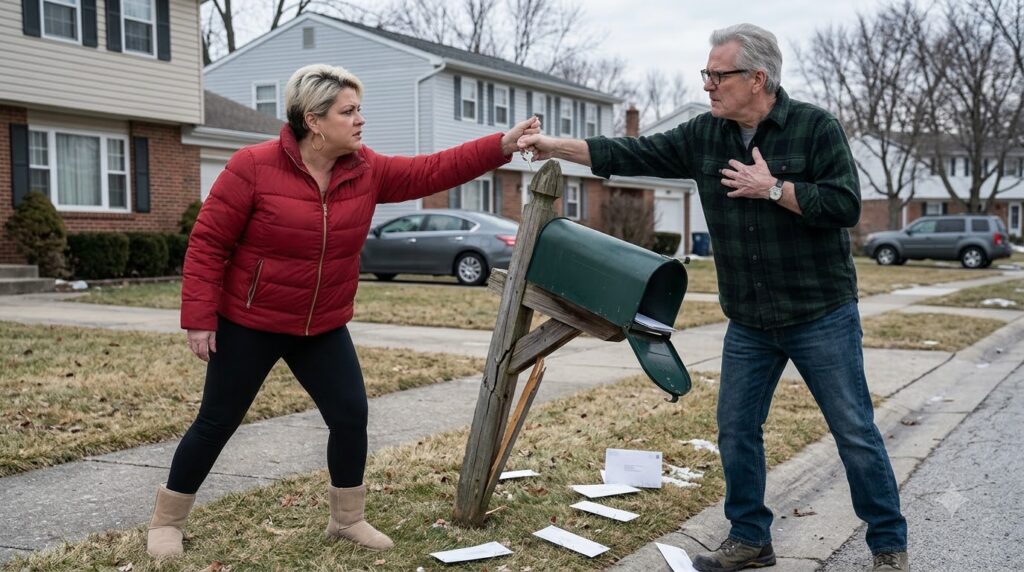
Chapter 4: What Karen Had Been Hiding
The next morning, Frank visited the county records office.
He wasn’t looking for gossip.
He wanted facts.
The property records showed that Karen had purchased Harold Benton’s old house eighteen months earlier.
The county clerk also confirmed that several official notices had been returned because the address information was inconsistent.
Frank asked whether his address had ever been associated with Karen Whitmore.
The clerk checked.
“Yes,” she said.
“Why?”
“I can’t discuss another person’s private account.”
Frank understood.
Privacy worked both ways.
He thanked her and left.
On the drive home, he stopped at the post office.
He explained the situation to the postal supervisor.
The supervisor listened carefully.
Then she said something Frank hadn’t expected.
“If someone is receiving mail meant for another person, they should not be opening it. They should mark it and return it.”
Frank nodded.
“What if someone is using another person’s name with a different address?”
“That can create a serious problem.”
“Could someone deliberately do that?”
“Yes.”
Frank went home.
Linda was waiting.
She had found an old neighborhood email.
It was from the HOA.
The message was dated six months earlier.
It concerned complaints about Karen’s property.
The sender was listed as “Karen Whitmore.”
But the email address wasn’t Karen’s.
It belonged to a man named Peter Lawson.
Linda remembered him.
“He attended the May meeting.”
Frank searched his memory.
Peter was a property investor who had recently bought two houses in the neighborhood.
Why would he impersonate Karen?
The answer emerged slowly.
Peter had been trying to buy Karen’s house.
She had refused.
The property sat on a corner lot that could potentially be divided or redeveloped.
Karen wanted to keep it.
Peter wanted it.
The complaints began after their disagreement.
Trash violations.
Noise complaints.
Unapproved construction.
Parking complaints.
Everything appeared to come from Karen herself.
The goal, Frank realized, was simple.
Make Karen look like a problem homeowner.
Create a record.
Pressure her into selling.
But why use Frank’s address?
Because Frank and Linda had once submitted a legitimate HOA complaint.
Their address was already associated with neighborhood paperwork.
Someone had altered the records to make the complaints appear to come from Karen using the Mercers’ address.
Frank sat back.
It explained the strange accusation.
It explained the paperwork.
It explained why Karen had been so desperate to get inside his mailbox.
But it did not excuse what she had done.
She had still smashed his mailbox.
And she had lied about it.
Frank wasn’t going to let one wrongdoing erase another.
That afternoon, he walked across the street.
Karen opened her door.
For once, she didn’t look angry.
She looked exhausted.
“I know about Peter Lawson,” Frank said.
Karen stared at him.
“How?”
“I found the connection.”
She said nothing.
“Did Peter use our address?”
Karen finally nodded.
“Yes.”
“Why didn’t you tell me?”
“Because you already hated me.”
Frank shook his head.
“I was angry with you. That’s different.”
Karen looked down.
Then she said something that surprised him.
“I knew your wife wasn’t responsible.”
Frank’s expression changed.
“You knew?”
“I knew someone was using your address.”
“Then why did you accuse Linda?”
Karen looked toward the street.
“Because I needed you to believe me.”
Frank stared at her.
“And destroying my mailbox was supposed to accomplish that?”
“No.”
Her voice softened.
“That was because I was angry.”
It was the first honest thing she had said.
But honesty did not erase consequences.








