CHAPTER 4: THE THRESHOLD SHIFT
“You don’t get to decide that for me.”
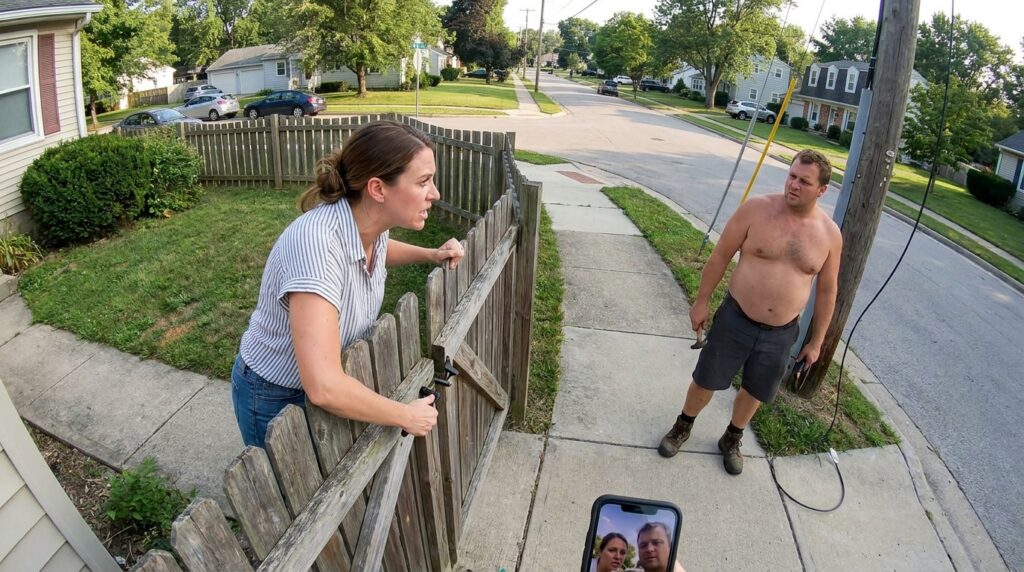
The latch didn’t slip; it gave way with a dry, mechanical snap under Sarah’s thumb, the rusted iron bar pivoting out of its cedar slot with the dull scrape of old oxidized metal. The heavy picket gate swung outward three inches before the weathered pine bottom dragged against the parched gravel. Sarah didn’t step through the opening. She leaned her weight directly against the crossbeam, her shoulders squaring against the blistering midday heat that vibrated off the fence lines.
Brenda’s clipboard dropped two inches, exposing the aggressive set of her mouth below the tortoise-shell lenses. The yellow carbon copies rustled under the sudden intake of her breath, their edges crinkling like dry autumn leaves in the hot, stagnant draft from the asphalt. “Sarah, this is an active regulatory enforcement matter. The utility worker has already been notified of the setback violation. Step back inside your boundary.”
“My boundary is under my boots, Brenda,” Sarah said. Her voice stayed flat, matching the sun-bleached look of the road stones. She didn’t raise her phone yet, but her hand remained clamped around the plastic casing inside her denim pocket, the screen warm against her thigh. “And the man with the cable spool isn’t employed by the association. He doesn’t answer to a committee that doesn’t have a registered tax number at the courthouse.”
The stocky technician looked from Sarah’s gripped hand on the gate latch to the rigid clipboard in Brenda’s hands. Sweat ran in clean, pale tracks through the gray stone dust coating his bare shoulders. His leather tool belt shifted with a heavy, metallic clink as he adjusted his stance, his boots settling into the weeds beside the cedar pole. He looked less like a worker about to abandon a job now and more like an evaluator weighing the thickness of two different walls.
“Section four is very specific about common access easements,” Brenda said, her voice rising an octave, losing its tight, administrative cadence. She thrust the clipboard forward again, the plastic edge nearly touching the outer face of the wooden gate. “The county charter gives the board clear oversight regarding the installation of above-ground distribution boxes. If you interfere with the stop-work directive, I will have the neighborhood security officer document the trespass.”
“Call him,” Sarah said. She didn’t blink against the solar glare. Her gaze remained fixed on the warped reflection of her own gate in Brenda’s sunglasses. “Tell him to bring the county land registry map from nineteen seventy-four while he’s at it. The one where the developer failed to sign over the common parcel deeds before the bankruptcy filing. He can look at the bureau stamp right next to my mailbox.”
Brenda’s posture went entirely rigid. The tip of her ballpoint pen jerked, tearing a short, jagged line through the top sheet of her violation log. For a fraction of a second, her eyes shifted past Sarah’s shoulder toward the porch steps, where the heavy manila folder from the county archives lay weighted down by a red clay brick. She didn’t ask what was inside it; the mere mention of the year had caused the skin around her jaw to tighten into pale, unyielding knots.
The technician caught the change in momentum. He didn’t wait for Brenda to counter. He stepped around her broad silhouette, his heavy work boots grinding a sun-faded orange safety cone into the gravel as he reached up to catch the loose end of the telecommunication cable. The thick black jacket of the wire groaned against the iron bracket of the pole as he pulled it taut, completely ignoring the clipboard still held between his chest and the cedar structure.
“I don’t have time to wait for a security officer who isn’t on the municipal clock,” the worker said, his tone dry and dismissive. He reached for his rusted wire-twisters, his movements efficient and practiced. “The lady says the dirt isn’t yours. My order says the pole belongs to the county. That’s enough for the splice.”
Brenda turned on her heel, her floral blouse snapping against the humid air as she faced the street. “This isn’t resolved,” she said, her finger pointing sharply at the utility box truck. “The board will issue a formal property lien for every hour that line remains unvetted by the architectural committee. You will pay for the removal, Sarah. Down to the last anchor bolt.”
Sarah didn’t look back as she turned her shoulder away from the sidewalk, her weight shifting inward toward the dry grass of her yard. The heat was still rising, but the space behind her gate felt clear, the hard line of the vellum map finally setting the scale of the cul-de-sac.
“I’m the one dealing with it, you need to get that,” Sarah said, her voice dropping into the quiet space between the fence posts as she let the gate drag shut behind her.
Behind her on the asphalt, a strange, low gurgle sounded from the storm drain directly beneath Brenda’s curb line—a heavy, subterranean pocket of air shifting through wet gravel that made the concrete seam vibrate ever so slightly under the midday sun. Sarah paused, her boot hovering over the dry lawn, realizing the ground wasn’t just old; it was hollow.