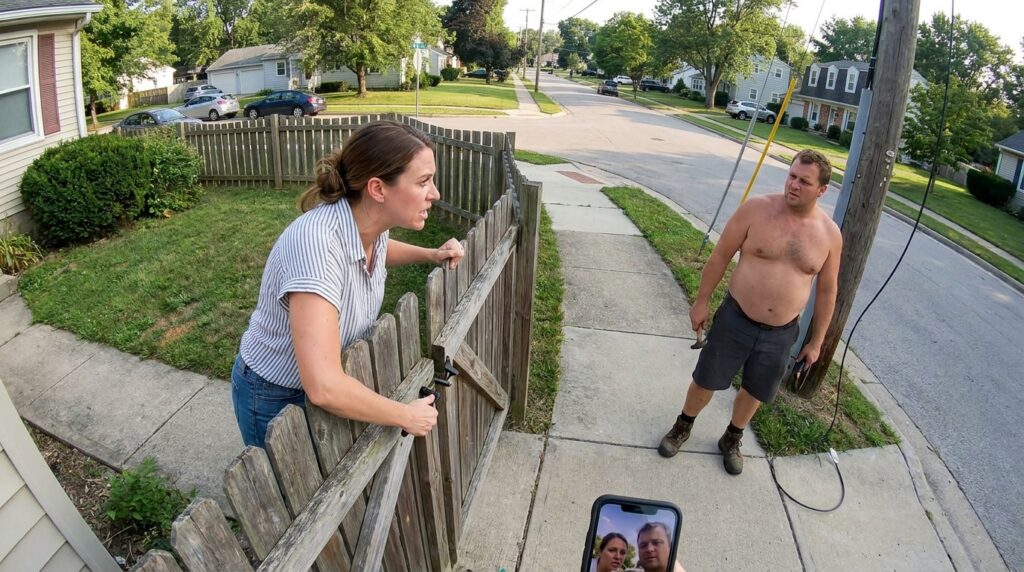
CHAPTER 3: THE MIDDAY STANDOFF
The heat radiating off the gravel shoulder tasted like sulfur and old transmission fluid. By the time Sarah rounded the corner of her property line, the heavy, air-braked hiss of a utility box truck had already died, leaving only the uneven, industrial rattle of a diesel engine idling in the blistering July glare. The contractor had already dropped his safety cones—cracked, sun-faded orange plastic pyramids that cast short, sharp shadows on the baking asphalt.
Brenda had already occupied the pivot point. She stood exactly where the public sidewalk met Sarah’s gravel driveway transition, her broad silhouette planted with low-centered permanence. Her bright patterned floral blouse looked like a neon warning sign against the desaturated gray of the utility pole behind her. She held her rigid plastic clipboard high against her chest, using the edge of it to gesture sharply at a young, stocky worker who had just hoisted a heavy spool of black telecommunication cable onto his shoulder.
The utility worker was already slick with sweat, his bare torso glistening with an oily sheen of dust and engine grease under the harsh noon sun. He wore only dark, canvas work shorts and a heavy leather tool belt that sagged under the weight of rusted lineman’s pliers and iron wire-twisters. He stood completely frozen beside the weathered cedar pole, his hand hovering inches from the low-hanging tension wire, caught completely in the administrative crossfire.
“This line installation is a non-sanctioned easement modification under the current district declaration,” Brenda announced, her voice rising above the low vibration of the diesel engine. She didn’t drop her arm. Her pen tapped the top sheet of her clipboard with a rhythmic, mechanical click that sounded like an approaching grasshopper. “I have the setback log right here. If you pierce the ground with those stabilization stakes before the board reviews the aesthetic variance, I will file an immediate civil injunction for corporate property disruption.”
The technician wiped his forehead with the back of a calloused, grime-streaked forearm, leaving a dark smudge of grease across his brow. He looked at the clipboard, then at the heavy iron anchors protruding from the base of the cedar pole. His boots shifted on the hot gravel, the dry stones crunching with a hollow, brittle sound. He was a laborer paid by the linear foot, not a corporate lawyer, and the sheer weight of Brenda’s unyielding, paperwork-backed certainty had clearly stalled his momentum.
“Look, lady,” the worker muttered, his voice gravelly from the heat and the dust of the road. “My work order says the junction box on this pole feeds the three houses down the cul-de-sac. It’s marked as a primary municipal utility easement. I don’t deal with neighborhood committees.”
“The committee regulates the physical access strip,” Brenda countered instantly, her chin lifting as her tortoise-shell sunglasses caught the full glare of the sun, obscuring her eyes behind two blank, reflective discs. “The county might own the circuit, but the association regulates the structural appearance of the surface. You do not have an approved landscape clearance certificate.”
Sarah watched the interaction from three paces back, her boots planted on the dry topsoil of her own lawn. She felt the heavy, taped-together iron key ring pressing against her hip—a hard, solid reminder of the boundaries she had sworn to keep. Her hand was tucked inside her pocket, her thumb resting on the cold screen of her phone, where the digital image of the 1974 vellum map lay locked in the dark.
As she stood there, she noticed something Brenda’s manicured authority had completely ignored. A faint, low-frequency tremor was passing through the soles of her boots—not the rhythmic vibration of the idling utility truck, but a strange, hollow fluid dynamic clicking deep beneath the concrete curb where the public drainage main met the edge of Brenda’s property across the street. The ground here felt unstable, worn thin by forces nobody was looking at.
Brenda stepped six inches closer to the pole, effectively cutting off the technician’s line of sight to the lower wire harness. She held the clipboard forward like a legal barrier. “If you drop that cable line across this fence section without an authorized supervisor present, I am calling the county code enforcement line to report an illegal contractor encroachment. They will impound your truck before you finish the splice.”
The utility worker’s hand dropped away from the cable line entirely. His stocky shoulders slouched under the sudden weight of institutional intimidation. He looked back toward the open cab of his truck, his eyes scanning the empty street as if searching for an escape route from a dispute he had never asked to join. He was on the verge of pulling his cones and driving away, leaving Sarah’s house completely cut off from the primary network loop before the infrastructure could even touch the ground.
Sarah’s fingers tightened around the iron gate latch just behind her, her thumb pressing the silver metal until the rusty spring groaned against the wood. The time for researching in the dark basement was over; the friction had reached the edge of the dirt.