
Chapter 4: The Video
Karen sat in her car outside the hospital.
She watched the recording.
Again.
And again.
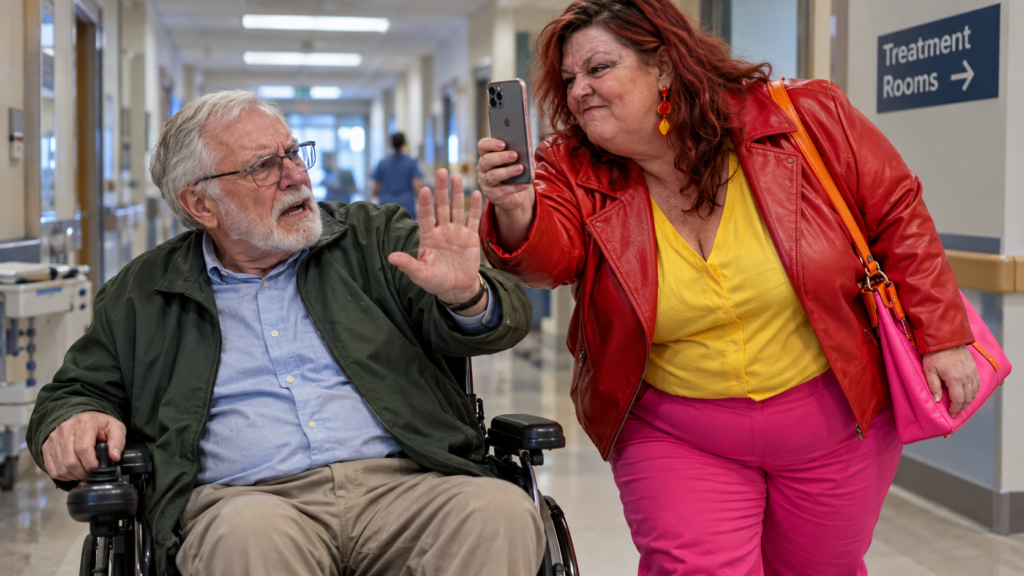
The footage showed Thomas reacting angrily.
It showed him blocking the camera.
It showed him moving toward her.
But it did not show what Karen had imagined.
It showed a frightened elderly man trying to protect his privacy.
Karen paused the video.
She zoomed in.
The image became grainy.
She could see the treatment-room door behind him.
Nothing else.
No secret.
No wrongdoing.
No revelation.
Just a door.
She watched again.
This time, she noticed something she had ignored before.
Thomas had never tried to hide his appointment.
He had only tried to hide his medical information.
There was a difference.
Karen frowned.
Then she replayed the final seconds.
Her own voice came through the speakers.
“If your disability means nobody is allowed to question you…”
She stopped the recording.
For the first time, she heard her own words without the adrenaline of the confrontation.
They sounded harsher than she remembered.
She stared at the phone.
She could delete the video.
That would end it.
But she did not.
Instead, she sent it to herself.
Then she created a new message.
Her fingers hovered over the screen.
She wanted to write that she had caught someone behaving suspiciously.
She wanted to suggest that the wheelchair user had something to hide.
But she could not explain exactly what.
Because she did not know.
That was the uncomfortable truth.
She had a feeling.
Nothing more.
Karen locked the phone.
Then unlocked it again.
She looked at the paused image.
Thomas’s face filled the screen.
His expression was not guilty.
It was exhausted.
Karen suddenly remembered something from the hallway.
When she had called him out, he had not defended himself with a long explanation.
He had simply said:
“You don’t know me.”
The sentence bothered her.
Because it was true.
She did not know him.
She knew only what she had decided to believe.
Karen eventually left the parking lot.
Thomas, meanwhile, was driving home.
His daughter called before he reached the house.
“How did it go?”
Thomas looked through the windshield.
He thought about telling her everything.
Instead, he said, “The appointment went fine.”
There was a pause.
“You sound upset.”
Thomas sighed.
“There was an incident.”
He explained what happened.
His daughter became quiet.
Then she asked, “Did she hurt you?”
“No.”
“Did she touch you?”
“No.”
“Then what hurts?”
Thomas looked down at his hands.
“Being treated like I was something to investigate.”
His daughter understood.
She had heard that tone before.
Not just from him.
From other people who had spent years being stared at, questioned, underestimated, or spoken about as though they were not standing there.
She told him he had done the right thing.
Thomas was not sure.
He had not wanted to be brave.
He had simply wanted to go to an appointment.
That night, he placed the photograph of his wife on the kitchen table.
He had planned to give it to his daughter.
Now he wondered whether he should keep it.
Not because Karen had changed anything about the photograph.
But because the incident had reminded him how quickly a stranger could turn something deeply personal into entertainment.
Then his phone buzzed.
A message from his daughter.
She had attached a screenshot.
Someone had posted about the hospital incident online.
The screenshot showed a familiar image.
Thomas recognized his own face.








