Chapter 2: What Karen Thought She Saw
Karen had noticed the man before she began recording him.
That was the part he did not know.
Twenty minutes earlier, she had been sitting in the hospital waiting area, scrolling through her phone while waiting for someone else.
She had seen the elderly man arrive alone.
He had driven his wheelchair through the automatic doors, paused near the reception area, and spoken briefly with a staff member. Nothing about the exchange seemed unusual.
Then he had disappeared through a restricted doorway.
Karen had barely thought about it.
Until several minutes later, when she saw him emerge.
There had been a folder in his lap.
A small personal bag hung from the side of his wheelchair.
He looked serious.
Karen had seen a staff member open the door for him, and then the door had closed behind him.
She had not heard the conversation.
She had not seen what happened inside.
She had not been invited to see it.
But Karen had filled in the missing pieces herself.
By the time the man reached the corridor again, she had convinced herself that she had witnessed something suspicious.
She had not decided exactly what.
That was what made her behavior more dangerous.
She had a suspicion without evidence, and now she was searching for evidence to support it.
The man’s name was Thomas Bennett.
He was seventy-eight years old.
He had spent most of his adult life working with his hands, raising a family, paying bills, repairing things instead of replacing them, and keeping promises even when they were inconvenient.
He was not accustomed to being treated as suspicious.
Least of all because he needed a wheelchair.
His appointment that morning was private.
That was all.
But Karen had turned his ordinary medical visit into a public spectacle.
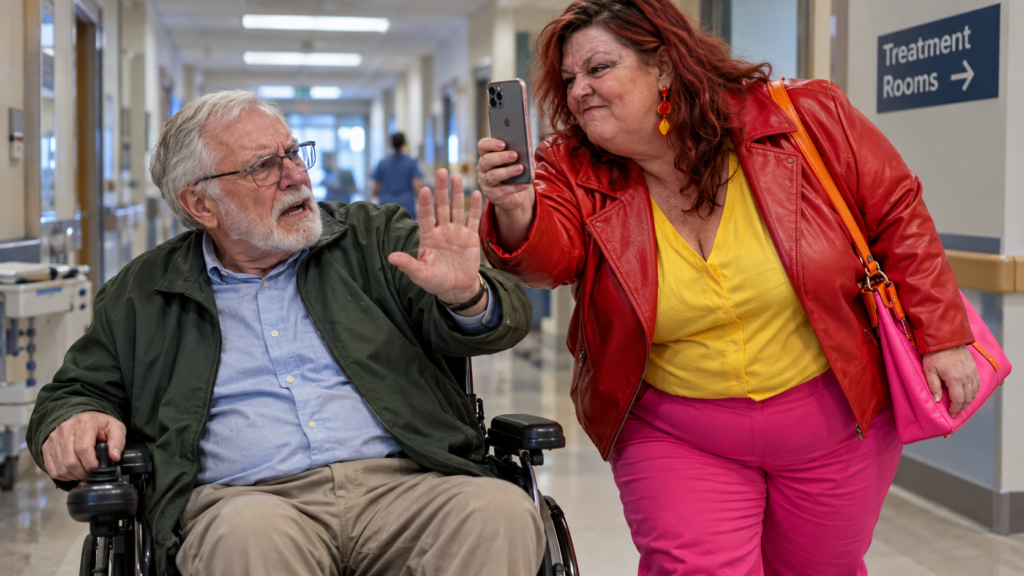
Thomas finally backed his wheelchair toward the treatment-room entrance.
Karen followed.
He stopped before the doorway.
“This is where you stop.”
She raised the phone.
Thomas stared at the camera.
Then at her.
Then at the doorway.
His anger was no longer loud.
It had become controlled.
“You don’t know me.”
Karen shrugged.
“I know what I saw.”
“No. You know what you think you saw.”
That distinction made her hesitate.
Only briefly.
Thomas reached toward the side pocket of his wheelchair and pulled out a folded appointment card.
He did not hand it to her.
He simply held it up.
“I’m here for an appointment. That’s it.”
Karen laughed softly.
“That’s your explanation?”
“It’s the truth.”
“You expect me to believe that?”
Thomas lowered the card.
“No. I expect you to stop filming me.”
She looked at the phone.
The red recording symbol was still visible.
For a moment, she seemed almost proud of it.
Then Thomas did something unexpected.
He turned his wheelchair sideways, positioning the broad back of the chair between himself and the camera.
Karen stepped left.
He turned left.
She stepped right.
He turned right.
Again, she tried to find his face.
Again, the wheelchair blocked her.
For the first time, Thomas controlled what entered the frame.
Karen’s expression changed.
She had expected him to become embarrassed.
Instead, he had become deliberate.
She lowered the phone.
Thomas waited.
The corridor fell quiet except for the soft mechanical hum of his wheelchair.
Karen finally said, “You’re making this look worse.”
Thomas looked at her.
“No. You’re making it look worse.”
Then he entered the treatment area.
The automatic door began to close.
Karen remained outside.
But before it shut completely, she caught another glimpse of the folder in his lap.
And one thought returned.
Maybe she had been wrong.
Or maybe there was something inside that folder she had not yet understood.