Chapter 3: The Door She Could Not Open
Karen waited outside.
She told herself she was waiting because she wanted answers.
But underneath that explanation was something simpler.
She did not like being uncertain.
The closed treatment-room door bothered her.
She replayed the earlier moments in her mind.
The folder.
The staff member.
Thomas emerging alone.
His reaction when she mentioned the room.
To Karen, every detail seemed connected.
What she could not see was the possibility that they were not connected at all.
Inside the treatment area, Thomas sat quietly while the staff prepared him for his appointment.
His hands were still tense on the wheelchair controls.
The confrontation had shaken him more than he wanted to admit.
He was angry.
But beneath the anger was something older.
Humiliation.
He had spent years adapting to changes in his mobility. He had learned how to navigate narrow spaces, crowded entrances, uneven sidewalks, and impatient strangers.
What he had never learned to accept was the assumption that needing a wheelchair made him less entitled to dignity.
He thought about his daughter.
She had asked him that morning to call her after the appointment.
He had promised.
Thomas had always kept promises.
When the appointment ended, he remained seated for a moment.
He looked at the small personal bag attached to his chair.
Inside it was something he had brought specifically for his daughter.
A photograph.
Not a medical document.
Not anything suspicious.
A photograph of his late wife, taken decades earlier.
He had planned to give it to his daughter because she had recently mentioned that she missed her mother.
The folder on his lap contained ordinary paperwork.
The kind of paperwork people carried into hospitals every day.
But Karen had never seen any of that.
She had seen fragments.
And fragments were enough for her imagination.
Outside, she was still waiting.
Then the automatic door opened.
Thomas emerged.
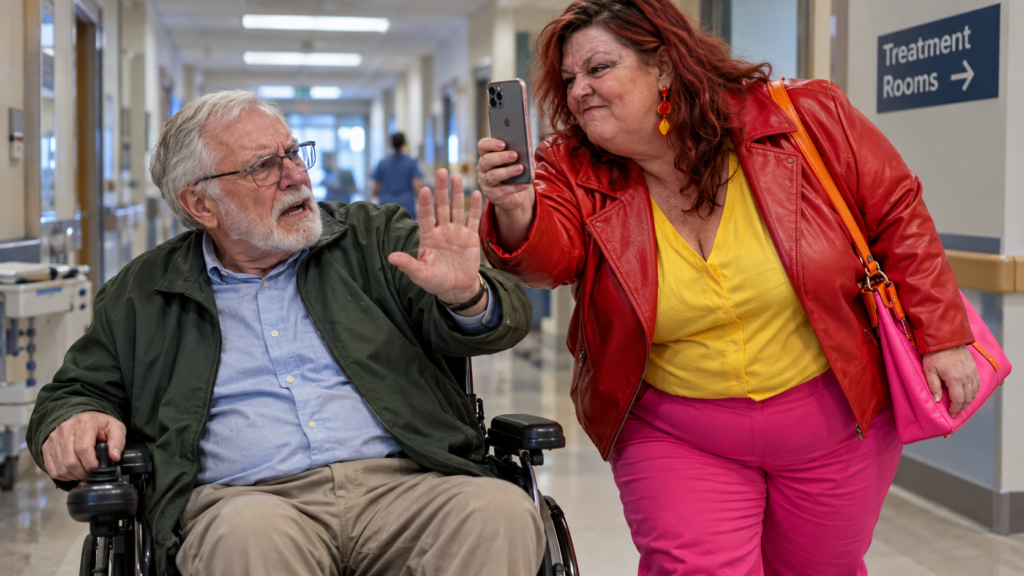
Karen immediately lifted her phone.
Thomas stopped.
The sight of the device brought the anger back to his face.
“You’re still recording?”
“I have a right to record what happens in a public hallway.”
Thomas looked around.
The corridor was public.
His medical information was not.
Those were two different things.
“You can stand here,” he said. “You can walk here. You can use the hallway. That doesn’t give you ownership of me.”
Karen’s lips tightened.
“I never said I owned you.”
“You’re acting like you do.”
She raised the phone again.
Thomas looked directly into the lens.
Then he deliberately turned his chair so the camera captured only the back of his head.
Karen moved.
He moved.
She moved again.
He calmly repeated the maneuver.
Eventually Karen stopped.
Her phone was still raised.
But now she was recording the back of a wheelchair.
The absurdity of it seemed to reach her.
She lowered the device.
Thomas did not move.
“You wanted to know what was behind that door,” he said.
Karen looked up.
His voice remained calm.
“So ask yourself why you decided you were entitled to know.”
She opened her mouth.
No answer came.
Then Thomas drove toward the exit.
Karen watched him go.
For the first time that morning, she had no control over the story.
She had a recording.
She had a suspicion.
But she had no proof.
And that should have been the end of it.
Instead, Karen looked down at her phone.
The recording was still running.
She stared at the screen.
Then she smiled faintly.
She had already decided that she was going to use it.