Chapter 4: The Video Nobody Expected
The next morning, Daniel received a phone call from the hospital.
Thomas asked whether he would be willing to speak with the patient services department.
Daniel agreed.
He returned to the hospital around noon.
There, Thomas showed him something unexpected.
A visitor had recorded part of the confrontation on a phone.
The video had been shared with the hospital after several people complained.
Daniel watched.
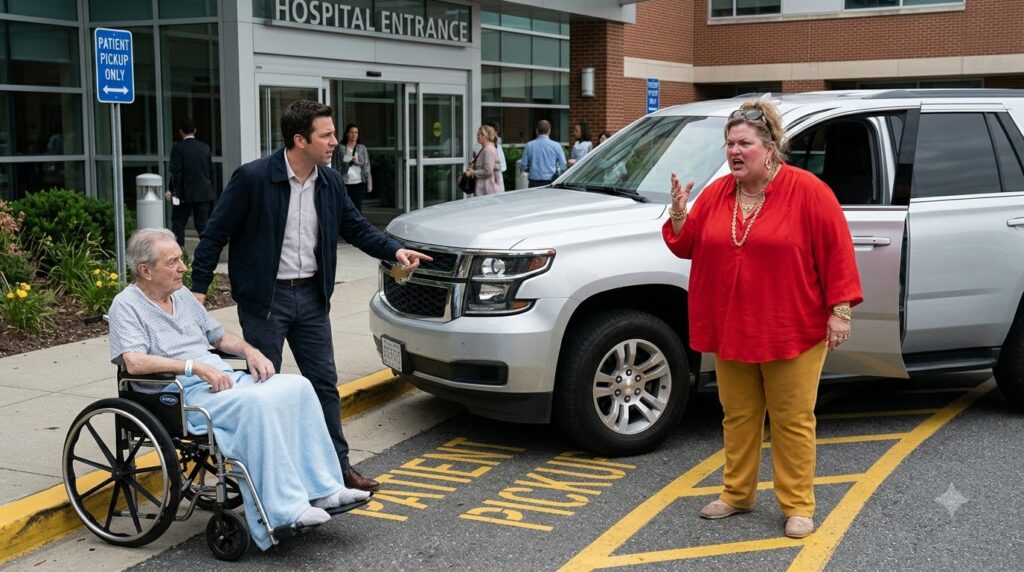
It showed Karen stepping in front of the wheelchair.
It showed the SUV blocking the lane.
It showed Daniel trying repeatedly to find a path around her.
And it showed Robert sitting silently behind them.
But the video also captured something Daniel hadn’t noticed.
When Karen first stepped in front of the wheelchair, she wasn’t merely protecting her SUV.
She had looked directly at Robert.
She had seen him.
She knew.
That detail bothered Daniel more than the argument itself.
Thomas asked whether the hospital could use the incident anonymously in staff training.
Daniel agreed.
But another development followed.
The hospital’s administration contacted Karen as well.
They learned that her mother, Evelyn Whitmore, had actually been waiting for discharge for nearly forty minutes.
Karen had been afraid that if she moved her car, another vehicle would take the spot and she would have to bring her mother farther down the sidewalk.
It didn’t excuse what she had done.
But it explained why she had become so territorial.
Karen agreed to meet with Thomas.
Daniel wasn’t present.
Neither was Robert.
During that meeting, Karen apparently admitted that she had become overwhelmed after spending months helping her mother with appointments.
She had felt that every task required fighting for something—parking, paperwork, elevators, pharmacy lines, insurance calls.
That morning, when she saw an open space near the entrance, she had decided it was hers.
Then, instead of reconsidering, she doubled down.
The hospital didn’t punish her.
There was no dramatic confrontation.
Instead, Thomas asked her to participate in a patient-access meeting.
Karen almost refused.
Then she looked at her mother, who was sitting beside her.
She agreed.
Weeks later, a new proposal was placed before the hospital board.
The pickup lane would receive additional markings.
Temporary stopping would be limited.
Staff would assist elderly and mobility-impaired patients during peak hours.
And a new sign would be installed:
PATIENT PICKUP ONLY — KEEP ACCESS CLEAR.
Daniel saw the photograph when the hospital sent him an update.
He stared at it for a long time.
Then he noticed something else.
The hospital had included a second photograph.
Karen was standing beneath the new sign.
Beside her was her mother.