
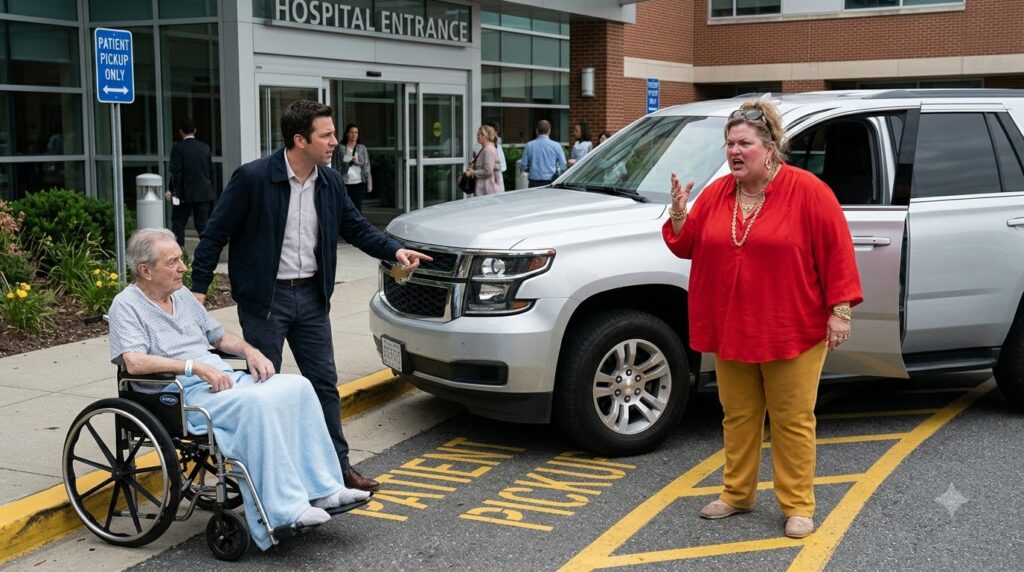
Chapter 3: Two Families Waiting for Home
Karen finally moved the SUV.
Daniel pushed Robert toward the family vehicle.
The lane opened.
The tension should have ended there.
But Robert wasn’t moving quickly.
His hands trembled slightly on the wheelchair armrests.
Daniel noticed immediately.
“Cold?”
Robert shook his head.
“Just tired.”
Daniel looked at the hospital behind them.
He had spent the last week sleeping in a chair beside his father’s bed, eating vending-machine sandwiches and pretending he wasn’t frightened.
He had imagined the drive home many times.
None of those versions included a stranger blocking the way.
Daniel opened the passenger door.
Before he could transfer Robert, Melissa approached.
“Let me help.”
Together, they carefully moved Robert into the seat.
Daniel placed the wheelchair in the trunk.
When he closed it, he saw Karen standing near the hospital entrance.
Her mother was beside her.
The older woman looked frail and confused, holding a small paper bag of belongings.
Karen’s expression was completely different now.
She was holding her mother’s arm.
Her voice was quiet.
“Take your time, Mom.”
Daniel watched from a distance.
Karen’s mother looked toward the silver SUV.
Then toward Robert sitting in Daniel’s car.
She asked something.
Karen answered.
Daniel couldn’t hear the words.
A moment later, Karen looked directly at him.
There was no anger in her face now.
Only discomfort.
She walked over.
Daniel expected another argument.
Instead she stopped several feet away.
“My mother has trouble walking,” Karen said.
Daniel nodded.
“So does my father.”
Karen looked down.
“I know.”
That was all.
She turned back toward her mother.
But the situation was not finished.
A hospital administrator named Thomas arrived at the entrance carrying a clipboard.
He spoke briefly with Harold, then approached Daniel.
“We’re sorry about what happened.”
Daniel shook his head.
“It’s okay.”
Thomas glanced toward Karen.
“No. It’s not something we want happening here.”
He explained that the hospital had recently received several complaints about the pickup lane. Families were sometimes forced to unload patients in traffic because vehicles stopped there for convenience.
The hospital had been considering installing additional signs and cameras.
Daniel looked at the lane.
“Then maybe this is the push you needed.”
Thomas smiled faintly.
“Maybe.”
Behind him, Karen was helping her mother toward the SUV.
Then her mother stopped.
She pointed at Robert’s car.
Karen followed her gaze.
Her mother said something.
Karen’s face tightened.
She looked embarrassed again.
Then she walked back toward Daniel.
This time, she didn’t defend herself.
“I was wrong,” she said.
Daniel said nothing.
Karen swallowed.
“I shouldn’t have blocked you.”
Robert, sitting in the passenger seat, looked through the open window.
He gave Karen a small nod.
“Thank you for saying that.”
Karen looked surprised.
She hadn’t expected forgiveness to come that easily.
But Daniel wasn’t finished.
“You scared him,” he said quietly.
Karen looked at Robert.
“I know.”
“And you made him feel like he was a burden.”
Karen’s eyes dropped.
That sentence stayed with her.
Because she knew exactly what that feeling was like.
Her mother had been afraid of becoming a burden for years.
And Karen had just treated another elderly person as though his needs were an inconvenience.








