Chapter 1: The Space She Refused to Give Up
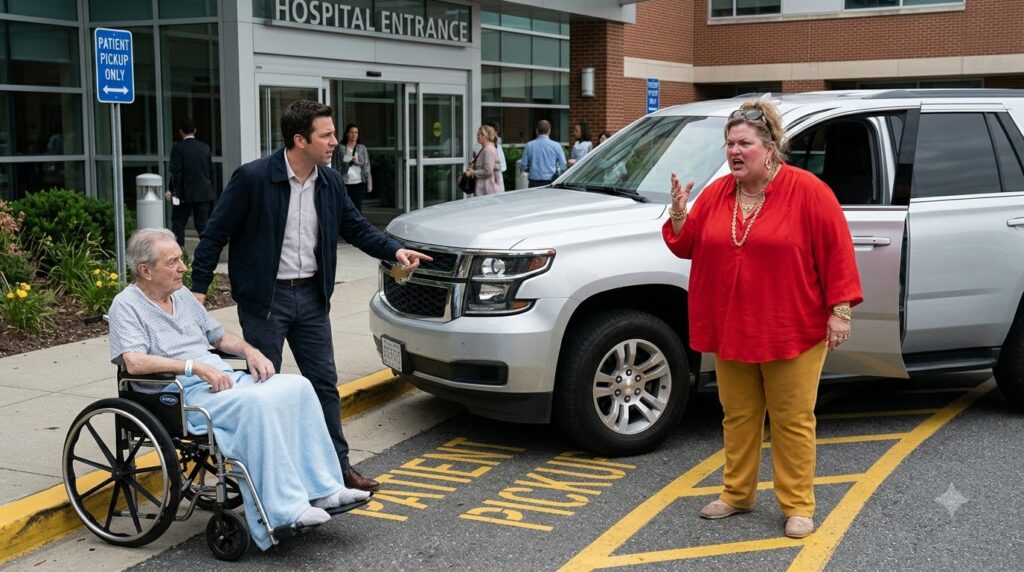
The wheelchair had barely cleared the hospital doors when the silver SUV moved into its path.
Daniel Mercer tightened his grip on the handles and stopped so suddenly that his father’s feet shifted beneath the light blanket covering his legs.
His father, Robert, seventy-eight, looked up at him with tired gray eyes.
Then Daniel looked forward.
A woman in a bright red blouse and mustard-yellow pants was standing directly in front of the wheelchair.
Behind her sat the silver SUV she had just parked across the marked patient pickup lane.
She spread both arms as if she were guarding a private parking space.
“Whoa! Stop right there!” she snapped. “You’re not pushing that chair past my SUV. I parked here, and I’m not moving.”
The sharp squeak of the wheelchair brakes seemed louder than the traffic around them.
Daniel stared at her for a moment.
“My father was just discharged,” he said. “We need to get him to our car.”
The woman—Karen, according to the name on a hospital visitor badge clipped to her blouse—gave him a dismissive look.
“Then go around.”
Daniel glanced toward the narrow curb.
There was barely enough room for a wheelchair.
He started angling the chair toward it.
Karen moved with him.
Daniel changed direction.
Karen stepped sideways again.
She was deliberately closing every opening.
Robert remained silent.
His face showed exhaustion more than fear, but Daniel could see the embarrassment beginning to settle over him. His father had spent five days in the hospital. He had finally been cleared to go home, and now they were standing outside arguing over a strip of pavement.
Daniel tried one more time.
“You can see him sitting right here. Just move your car a few feet.”
Karen’s eyes narrowed.
“Everybody thinks their problem is more important than mine,” she said. “I waited for this space.”
“You didn’t wait for it. You drove into a loading lane.”
“Don’t tell me where I can park.”
The automatic doors opened behind them.
A hospital transporter stepped outside, saw the situation, and stopped.
Another family coming out of the building slowed down.
Karen noticed.
For the first time, her confident expression flickered.
But instead of backing down, she grabbed her driver’s door and slammed it shut.
The sound cracked through the entrance plaza.
Then she planted herself between the SUV and the wheelchair again.
Daniel looked down at his father.
Robert quietly said, “Don’t make this worse.”
Daniel swallowed.
He didn’t want a scene.
He didn’t want his father exposed to more stress.
But he also wasn’t going to leave him sitting in the middle of a hospital pickup lane.
So Daniel turned the wheelchair toward the narrowest opening he could find.
Karen stepped into it.
Daniel stopped.
The woman smiled.
And for several seconds, neither moved.
Then a hospital employee came running toward them from the entrance.
“Mr. Mercer?”
Daniel turned.
The employee’s expression had changed.
She wasn’t looking at Karen.
She was looking at Robert.
“Your transport paperwork says you need assistance getting into the vehicle,” she said. “Why haven’t you left yet?”
Daniel pointed silently toward the SUV.
The employee finally understood.
And the look on her face told Daniel this was no longer just a disagreement between two strangers.