
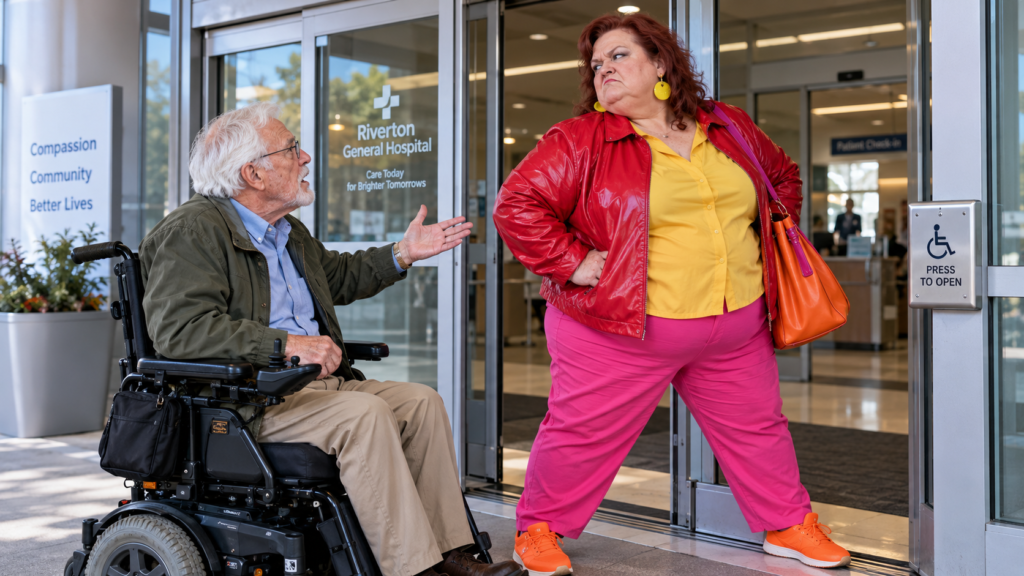
Chapter 6: What Harold Wanted People to Remember
Months later, Harold barely remembered the color of Karen’s jacket.
He remembered the orange shoes.
He remembered the warning beep.
He remembered the doors closing inches from his wheelchair.
But more than anything, he remembered how quickly an ordinary moment could become humiliating when another person decided that someone else’s dignity did not matter.
He also remembered what happened afterward.
The volunteer who documented the incident.
His daughter who stood beside him.
The hospital that changed the markings near the entrance.
And Karen, eventually, moving aside.
The incident became a story Harold occasionally told.
Not because he enjoyed being mistreated.
And not because he wanted people to hate Karen.
He told it because accessibility was easy to support in theory.
A sign was easy to install.
A button was easy to mount.
A policy was easy to print.
But none of those things mattered if another person physically stood in the way.
One afternoon, Harold attended a community meeting at the hospital.
The subject was accessibility.
He was asked to speak.
He kept his remarks short.
He told the audience that respect did not require extraordinary kindness.
It required ordinary consideration.
Leave the doorway clear.
Don’t block the ramp.
Don’t assume someone using a wheelchair is asking for special treatment.
And don’t make another person fight for access to a place they have every right to enter.
Harold paused.
Then he added something he had learned personally.
“Sometimes the hardest part isn’t getting through the door.”
The room became quiet.
“Sometimes it’s convincing someone standing in the doorway that you’re still a person.”
No one applauded immediately.
The silence lasted a few seconds.
Then people began clapping.
Harold looked toward Emily.
She was smiling.
Outside the meeting room, the automatic doors opened and closed as people came and went.
Nobody stopped them.
Nobody claimed the sensor area.
Nobody demanded to know whether they deserved to enter.
The doors simply opened.
Harold watched them for a moment.
Then he drove toward the entrance.
The doors opened before he reached them.
He passed through without hesitation.
And behind him, someone held the pathway clear.
That was all it should ever have taken.








