
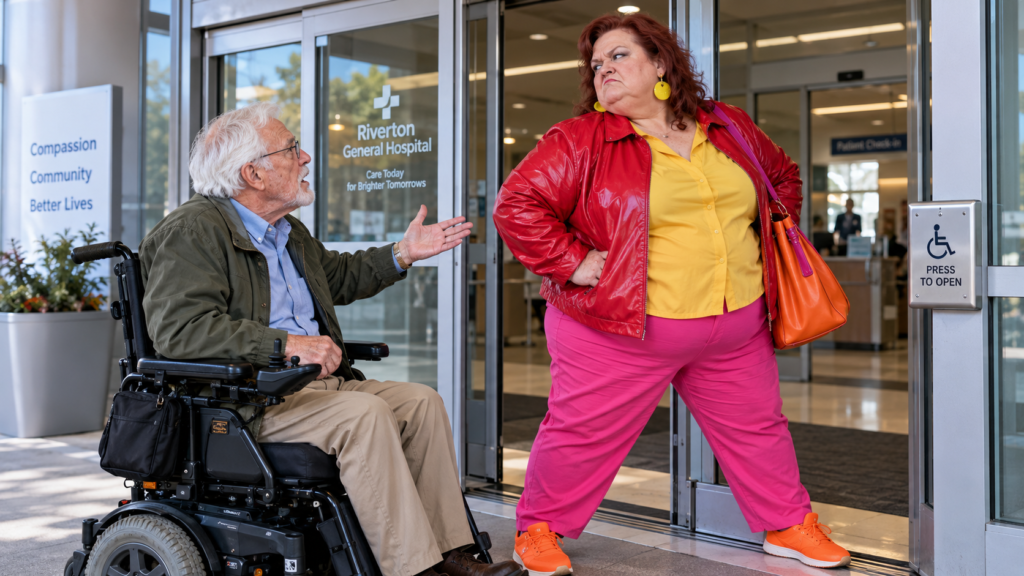
Chapter 3: The Daughter Arrives
Emily Bennett arrived twenty minutes later.
She came through the parking garage carrying a folder and Harold’s medication list.
She was forty-eight, practical, calm, and accustomed to her father’s habit of minimizing problems.
She spotted him before she saw Karen.
Her father was sitting several feet from the entrance, hands resting quietly on the controls.
The automatic doors opened.
Closed.
Opened.
Closed.
Emily stopped.
Then she saw Karen standing in the sensor zone.
She walked over.
“Dad, what happened?”
Harold looked at his daughter.
“Apparently I’m asking the world to make room for me.”
Emily’s eyes moved toward Karen.
Karen immediately became defensive.
“He was trying to push past me.”
Emily looked at the distance between them.
Her father had not moved.
“He hasn’t touched you.”
“He doesn’t have to.”
Karen folded her arms.
Emily did not argue.
Instead, she crouched slightly beside her father.
“Did she block the door?”
Harold nodded.
“Repeatedly.”
Emily looked at the automatic doors.
Then at the accessible button.
Then at Karen’s position.
The pieces were obvious.
But Emily also noticed something else.
Her father was pale.
Not frightened.
Not weak.
Just tired.
The confrontation had cost him more than Karen could see.
He had spent twenty minutes trying to enter a building where he was supposed to receive medical care.
Emily stood.
“Dad, let’s go around.”
“There’s no accessible entrance around the side.”
Emily checked.
He was right.
The other entrance required stairs.
She looked back toward the main doors.
Karen had moved slightly.
For a moment, the path appeared open.
Emily guided her father forward.
Karen suddenly stepped sideways.
The doors began closing.
Emily froze.
Her father stopped.
Again.
This time Emily understood the pattern completely.
“Why are you doing that?” she asked.
Karen’s face tightened.
“I already told him.”
Emily shook her head.
“No. You told him he was pushing people around. But he’s been sitting here waiting.”
Karen didn’t answer.
Emily continued.
“My father has an appointment inside. He’s not asking you for special treatment. He’s asking you to stop standing in front of an accessible entrance.”
Karen’s cheeks reddened.
“You people think you’re entitled to everything.”
Emily’s voice remained calm.
“No. We think people should be able to enter a hospital.”
That sentence landed differently.
Karen looked around.
For the first time, she seemed aware that the entrance itself made her behavior look exactly as it was.
She moved away.
The doors opened fully.
Harold drove forward.
He passed through.
Emily followed.
Karen remained outside.
Harold was finally inside the hospital.
But the conflict had already produced a consequence Karen hadn’t expected.
Harold’s appointment time had passed.
The receptionist checked his paperwork and explained that the specialist could still see him, but the schedule had shifted.
Harold apologized.
The receptionist frowned.
“You don’t need to apologize.”
He smiled faintly.
“I know.”
Emily sat beside him.
While they waited, Harold received a message on his phone.
A local community volunteer who had witnessed the confrontation had sent him a short note.
She had been outside the hospital too.
She had seen the repeated blocking.
She had seen Karen deliberately move with the wheelchair.
And she had written down the time.
Harold stared at the message.
He didn’t know the woman well.
He didn’t know what she intended to do with what she had seen.
But suddenly, the incident was no longer just Harold’s word against Karen’s.
There was a record.
And there was something else.
Emily opened the folder her father had brought.
A photograph slipped out.
It showed Harold standing beside a young woman in a graduation gown.
Emily picked it up.
“My sister?”
Harold nodded.
His late wife had taken the picture.
The young woman was his daughter, years earlier.
Harold smiled.
“I brought it for the appointment.”
Emily looked at her father.
She understood then why he had been so determined to enter the hospital.
The appointment wasn’t merely another medical visit.
It was connected to a promise he had made to his family.
And he had no intention of letting one stranger’s cruelty take that away from him.








