
Chapter 5: The Night the Homeowners Stood Up
The Silver Ridge clubhouse had never been particularly impressive.
It contained folding chairs, a kitchenette, a small library shelf, and a wall of photographs showing neighborhood celebrations from happier years.
On the evening of the special meeting, every chair was occupied.
Residents stood along the walls.
Others waited near the entrance.
Patricia arrived in a bright red jacket, carrying a thick binder and wearing the confident expression she reserved for public confrontations.
She had expected perhaps twenty people.
Nearly ninety homeowners were present.
The crowd unsettled her.
She opened the meeting by accusing a small group of residents of spreading false information.
She described the federal survey incident as a misunderstanding caused by trespassing contractors.
Then she displayed a photograph of Daniel standing near the boundary fence.
She claimed the image proved he had entered restricted HOA property.
Evelyn recognized the photograph immediately.
It had been taken after Patricia moved the marker.
It showed nothing about the original boundary or the assault.
Patricia continued speaking.
She insisted that the Scenic Garden was a legitimate community improvement.
She said the emergency assessment was necessary to protect homeowners from government overreach.
Several residents exchanged looks.
The phrase sounded impressive.
But nobody could explain how striking a survey technician protected the neighborhood.
Frank waited until Patricia finished.
Then he stood.
He calmly stated that the minutes of the October 22 board meeting listed him as present when he had been out of state.
He offered documentation supporting his absence.
Patricia interrupted.
She claimed the meeting had been conducted electronically.
Frank asked for the meeting notice, attendance record, and vote.
Patricia did not produce them.
Margaret then presented a summary of the financial discrepancies.
She carefully distinguished verified payments from unresolved questions.
The homeowners learned that the association’s records showed $86,400 in project-related disbursements, while the landscaping contractor acknowledged receiving only $41,000.
The difference required explanation.
Patricia called the figures misleading.
Margaret invited an independent accountant to examine the complete records.
That suggestion drew applause.
Patricia struck the table with her palm.
She warned that continued disruption would result in removal from the meeting.
Nobody left.
Then Evelyn approached the front.
She had brought a copy of the security recording.
She did not intend to turn the gathering into a spectacle.
But Patricia had repeatedly claimed that Daniel was the aggressor, and the homeowners deserved to know that evidence existed contradicting that account.
With the meeting’s consent, Evelyn played the relevant footage on the clubhouse screen.
The room became silent.
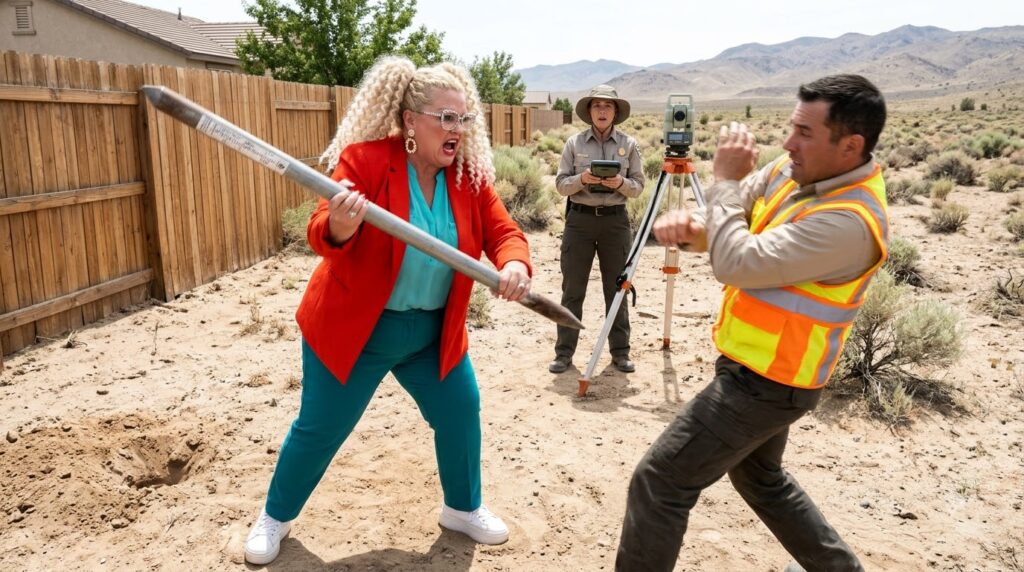
Residents watched Patricia pull the boundary marker from the ground.
They watched her carry it into federal land.
They watched Daniel approach.
Then they saw the strike.
A woman near the back covered her mouth.
An older man shook his head.
Frank looked away.
He had already seen the recording, but watching it among his neighbors made the event feel even more serious.
These were people who had trusted Patricia to manage landscaping, maintenance, and community finances.
Now they were watching their HOA president attack a man for doing his job.
When the recording ended, Patricia accused Evelyn of manipulating the footage.
Evelyn explained that the original file had already been provided to investigators.
Patricia demanded that the screen be turned off.
It already was.
For several seconds, no one spoke.
Then seventy-six-year-old Harold Benton stood near the rear of the room.
Harold had lived in Silver Ridge since the development opened.
He walked with a cane and rarely attended HOA meetings.
His wife had died the previous winter.
Patricia had fined him because a memorial flower arrangement remained on his porch longer than the association’s decorative display rules allowed.
He had paid the fine without complaint.
Now he looked directly at the board president.
He said he had spent forty years working in construction, where boundaries and safety procedures mattered.
He had seen mistakes, disagreements, and accidents.
What he had never accepted was a supervisor hurting someone and then blaming the injured worker.
His voice was quiet.
That made the room listen.
Other residents began sharing their experiences.
A retired nurse described repeated fines over a garden bench.
A widower explained how he had been threatened with legal action after requesting access to the HOA budget.
A younger homeowner described being denied approval for a modest accessibility modification without a clear explanation.
Each account was different.
Together, they revealed a pattern.
Patricia tried to interrupt, but the room no longer responded to her anger.
The homeowners voted to request an independent financial examination and to suspend the disputed assessment pending legal review.
They also authorized the appropriate process for a membership vote on board leadership under the HOA’s governing documents.
The meeting did not instantly remove Patricia.
There were notice requirements, voting procedures, and legal questions to resolve.
But something important had changed.
The residents were no longer afraid to be seen disagreeing with her.
Patricia gathered her binder and left before the final discussion ended.
Outside, the desert evening had turned cool.
She climbed into her SUV and sat behind the wheel.
For the first time, she could not be certain that the people of Silver Ridge would follow her instructions.
And the next morning, she learned that the federal investigation had moved forward.








