
Chapter 2: The Neighborhood That Learned to Stay Quiet
By late afternoon, Silver Ridge Estates had received three different versions of what happened.
Patricia’s version reached the homeowners first.
An emergency HOA email accused federal contractors of entering restricted community property, intimidating the board president, and interfering with an approved improvement project.
The message described Patricia as the victim of an aggressive confrontation.
It made no mention of the metal post.
It made no mention of Daniel’s injury.
And it certainly did not mention the original boundary marker.
Evelyn read the email twice at her kitchen table.
Her husband, Robert, had died four years earlier. Since then, she had kept to herself, tending her roses, attending the occasional neighborhood gathering, and enjoying the quiet retirement they had planned together.
Silver Ridge had once been a pleasant place to grow older.
Most residents were between fifty and seventy-five. Some were retired teachers, nurses, electricians, and small-business owners. Others had moved there to be closer to their grandchildren.
They had purchased their homes for the mountain views, wide streets, and promise of a peaceful community.
Over time, Patricia had changed the atmosphere.
Small disagreements became disciplinary matters.
A porch swing could trigger a warning.
A faded mailbox could result in a fine.
One widow had received three violation notices because her late husband’s pickup truck remained in the driveway while she arranged to sell it.
Patricia called these actions necessary enforcement.
Many residents privately called them intimidation.
Evelyn’s closest neighbor, seventy-one-year-old Frank Delaney, arrived shortly after five.
Frank was a retired Air Force mechanic with a deliberate manner and a lifelong dislike of bullies.
He had heard about the confrontation but did not know what to believe.
Evelyn played the security recording.
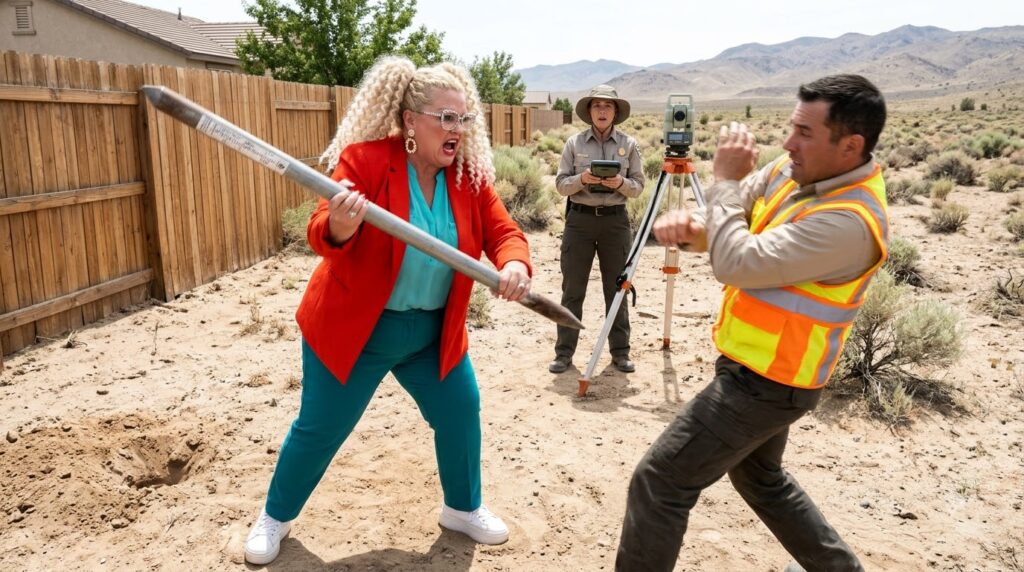
The camera overlooked her backyard and part of the common-area fence. It had captured Patricia uprooting the marker, relocating it, arguing with Daniel, and striking him.
The recording contained no dramatic camera angles or perfect sound.
It did not need them.
Frank watched without speaking.
When it ended, he asked Evelyn to play it again.
The second time, he leaned closer.
He noticed something Evelyn had overlooked.
Before the federal technicians approached Patricia, she had already placed several orange landscaping flags beyond the original boundary.
The flags formed a rough line across the desert.
This had not been a spontaneous disagreement.
Someone had planned the expansion.
Frank knew that Patricia had been promoting a new project called the Silver Ridge Scenic Garden.
The proposal included a walking path, decorative stonework, drought-resistant landscaping, and a private seating area overlooking the desert.
Residents had been told the project would increase property values.
They had also been told the land was already controlled by the HOA.
At the previous annual meeting, Patricia had presented a polished illustration showing the garden extending beyond the existing backyard fences.
Nobody had questioned the boundary.
The board president had assured them that everything had been reviewed.
Now Frank wondered what, exactly, had been reviewed.
Evelyn contacted the county sheriff’s office and offered the recording.
A deputy arranged to collect a copy and document where the camera was located.
She also preserved the original file, including its timestamp.
Daniel, meanwhile, had been examined at a medical clinic.
He had a severe shoulder contusion and a painful strain. Initial imaging showed no fracture, but his physician recommended limited activity and follow-up evaluation.
His supervisor temporarily removed him from field duty.
For Daniel, the physical pain was only part of the problem.
His wife, Laura, worked as an elementary school counselor. They had two children, ages nine and twelve.
Their family depended on his steady income, and Daniel took pride in work that rarely attracted attention.
Surveying was not glamorous.
Most days involved careful measurements, long drives, and quiet responsibility.
But the work mattered.
Property lines determined where people could build, what land could be sold, and which areas belonged to the public.
Daniel understood that a boundary marker represented more than a piece of metal.
It represented a record people were supposed to respect.
That evening, his supervisor called.
The BLM had been notified, and the agency was reviewing the incident with appropriate law-enforcement personnel.
The assault would be investigated separately from the boundary disturbance.
Daniel was relieved.
Still, he worried that Patricia’s political connections within the development might complicate matters.
He had seen powerful people turn straightforward disputes into exhausting battles.
Back in Silver Ridge, Evelyn and Frank examined the HOA’s latest financial report.
The Scenic Garden project had already received a substantial deposit from the association’s reserve funds.
The contractor was listed as Desert Crown Landscaping.
Frank recognized the name.
He had seen the company’s truck parked outside Patricia’s house several times.
Then Evelyn noticed something unusual.
The contract had been approved during a special board meeting held only three weeks earlier.
According to the minutes, the vote had been unanimous.
Frank stared at the page.
He was a board member.
And he had never attended that meeting.








