Chapter 6: The Price of Calling a Community Your Own
The next six weeks were unusually busy at Lakeside Palms.
The board adopted a series of changes designed to prevent a similar situation from happening again.
Major maintenance decisions now required documented authorization.
Contractors received written confirmation from the management office before beginning unusual or expensive work.
All board decisions involving shared amenities had to be recorded in meeting minutes.
Residents were also given a clearer process for submitting complaints and requesting access to association records.
The changes were not dramatic.
They were ordinary safeguards that should have existed all along.
But they represented something important.
The association was returning to the people who funded it.
Michael received an unexpected letter from the association’s insurance representative.
The company had reviewed the incident and requested additional information about the pool damage and physical confrontation.
The association’s attorney also advised the board to evaluate whether any costs could be recovered from the responsible individual, subject to the governing documents and applicable law.
The board decided not to make public accusations or attempt to collect money without following the proper process.
Instead, it preserved the evidence and allowed the appropriate parties to handle the matter.
Officer Davis’s report remained part of the record.
The police investigation had documented the confrontation, the witnesses, and the video evidence. Any further decision about possible legal consequences would be handled by the appropriate authorities.
Michael appreciated that approach.
He had never wanted revenge.
He wanted the truth established and the community protected.
The election arrived on a warm Saturday morning.
The clubhouse was filled with residents.
Some had lived at Lakeside Palms for decades. Others had moved in only recently.
There were retirees, working couples, young families, and people who had chosen the community because they wanted a peaceful place to enjoy the Florida sunshine.
Karen was among the candidates.
She wore a bright coral jacket and a large floral brooch.
Her campaign message emphasized experience, discipline, and the need to restore respect for HOA leadership.
She did not mention the garbage incident.
She did not discuss the shove.
She did not address the pool repair bill.
Instead, she argued that the association needed someone strong enough to make unpopular decisions.
Robert Bennett presented a different message.
He spoke about transparent finances, consistent maintenance, fair enforcement, and respect for residents.
He acknowledged that the HOA had made mistakes.
He also promised that no officer would again be allowed to treat a shared facility as personal property.
Michael attended the meeting but did not campaign against Karen.
Margaret Ellis did not either.
Instead, she quietly encouraged residents to read the candidates’ statements and make their own decisions.
When the ballots were counted, Robert won by a substantial margin.
Karen received far fewer votes than she had expected.
She sat motionless as the result was announced.
For several seconds, the only sound in the room was the shuffling of papers.
Then residents began applauding.
Not because Karen had lost, but because they believed the community had finally chosen a different direction.
Over the following months, the board completed its independent financial review and corrected the recordkeeping problems.
Several disputed expenses were clarified. Some required additional documentation, and a small number were referred for further review.
The board also reached an agreement with its insurance and legal advisers concerning the pool damage and related costs.
The association did not announce a dramatic punishment or pretend that every issue had been resolved overnight.
Instead, it followed the procedures available to it.
Karen eventually received formal notice of the association’s position regarding the damage, along with an opportunity to respond through the appropriate process.
Her membership rights as a homeowner remained separate from her former officer position.
She could still use the community facilities under the same rules as other residents, but she no longer had the authority to issue orders to staff or make unilateral decisions.
For someone who had spent years believing that leadership meant control, the distinction was difficult to accept.
One Saturday morning, Michael returned to the pool.
The water was clean and blue again.
Children played near the shallow end while several older residents sat beneath the umbrellas.
Margaret was there with her granddaughter, and Walter had brought his folding chair.
Dennis, the maintenance supervisor, was checking a pump near the equipment room.
Everything looked ordinary.
That was what made the moment meaningful.
The community had not needed a grand ceremony or a dramatic victory.
It had needed its shared spaces returned to the people who actually used and paid for them.
Michael sat down beside Margaret.
She smiled as she watched her granddaughter splash in the water.
For a moment, neither of them said anything.
Then Margaret quietly observed that she had never imagined a swimming pool could teach an entire neighborhood so much about respect.
Michael smiled.
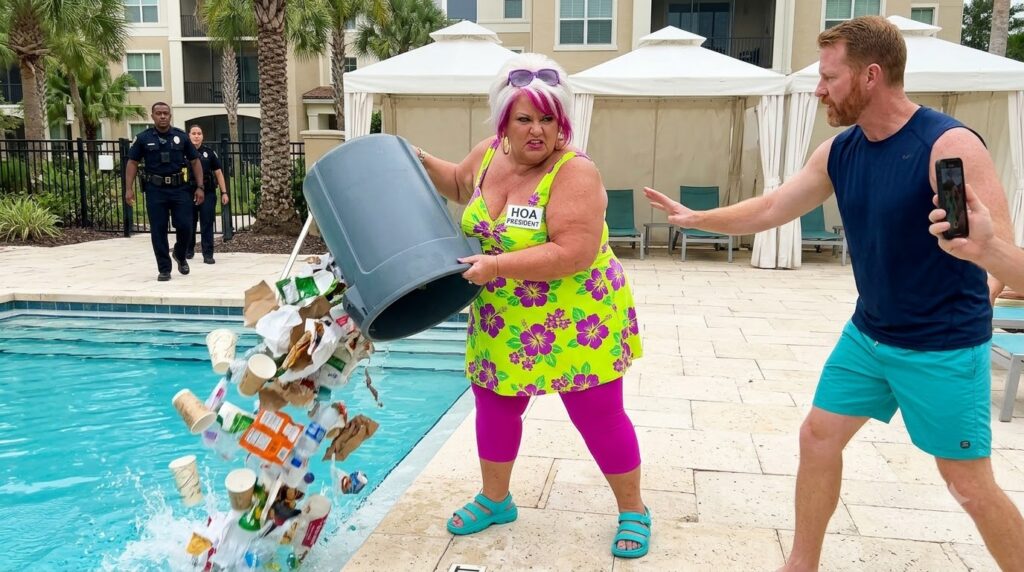
He remembered Karen standing beside that gray garbage bin, wearing her enormous sunglasses and declaring that everyone else’s property belonged to her.
He also remembered how powerless the residents had initially felt.
But they had not remained silent.
They had recorded the truth, collected evidence, asked questions, and insisted that the rules apply to everyone.
And that had made the difference.
A few minutes later, Michael noticed a small sign near the pool entrance.
It had been installed by the new board.
LAKESIDE PALMS COMMUNITY POOL
Shared by all residents. Maintained through everyone’s contributions. Respect everyone’s right to enjoy it.
Michael read the words twice.
Then he looked across the water.
The pool belonged to no single person.
Not to the president.
Not to the board.
Not even to the loudest homeowner in the community.
It belonged to the community itself.
And that was precisely the lesson Karen Whitmore had refused to learn.
The HOA president had once believed that collecting residents’ fees gave her ownership over their lives. In the end, those same residents reminded her that paying for a home does not mean surrendering the right to be treated with dignity.