Chapter 5: The Community Finally Took Its Garden Back
The final board meeting took place on a rainy Thursday evening.
By seven o’clock, every seat in the clubhouse was occupied.
Some residents stood along the walls. Others watched from the doorway.
The atmosphere was different from the previous meetings.
Nobody was there to argue about decorative preferences.
They were there to decide whether their community would continue to be governed by one person’s ambitions or return to the rules everyone had agreed to follow.
Karen entered wearing a bright pink suit, a white blouse, and oversized gold earrings.
Her platinum-blonde curls were perfectly arranged.
She still wore her HOA PRESIDENT badge, although the board had already suspended her authority.
She sat down with a thick folder and a determined expression.
Linda opened the meeting.
She summarized the financial review and presented the contractor’s documents.
The first finding was clear.
The fountain project had never received the required board approval.
The second finding was more serious.
Karen had signed a contract representing that she had authority to commit community funds.
The third finding concerned the money already spent.
The board’s review had identified $9,000 in initial payments, along with additional expenses connected to the project.
Some costs could be recovered through cancellation or resale of materials.
Others would require negotiation.
The HOA attorney then explained that the board could seek reimbursement for unauthorized expenditures and pursue further remedies if the investigation established that Karen had knowingly misrepresented her authority.
Karen interrupted several times.
She claimed the board was punishing her for trying to improve the neighborhood.
She argued that the greenhouse was unattractive, inefficient, and unnecessary.
She even suggested that the residents should be grateful she had developed a plan to make Cedar Ridge more prestigious.
But the residents had heard enough.
The board voted to cancel the fountain project.
The motion passed unanimously.
The contract would be terminated through a negotiated settlement with Dennis. The foundry would be instructed to stop further work on the sculpture.
The board also voted to remove Karen from the HOA presidency pending the formal completion of the investigation.
She stared at the board members.
For several seconds, she appeared unable to process what had happened.
Then she stood.
She accused Linda of staging a coup and claimed that Frank had manipulated the residents.
Nobody responded.
The attorney calmly reminded her that the decision had been made according to the bylaws.
Karen gathered her folder and stormed out.
But the meeting was not finished.
The residents still had to decide what would happen to the greenhouse.
Linda proposed a new management structure.
The garden would remain community property, but its daily operations would be managed by a volunteer committee. Any major changes would require board approval, transparent budgeting, and an opportunity for residents to comment.
Frank was asked to chair the committee.
He initially hesitated.
He was seventy-eight years old. His knees were not what they used to be, and he had no desire to become involved in another administrative battle.
But then he looked around the room.
Evelyn was smiling.
Walter was nodding.
Several residents who had never planted anything before were already volunteering to help.
Frank accepted.
The board also approved the immediate replacement of the irrigation system.
The greenhouse would receive a modest repair budget, and the landscaping reserve would be monitored by the property manager rather than controlled solely by the HOA president.
Over the following weeks, Dennis worked with Linda to resolve the construction contract.
Because the project had been ordered without proper authorization, the parties negotiated a reduced cancellation settlement. Unused materials were returned or credited, and the bronze sculpture was never installed.
The HOA’s attorney pursued reimbursement for the losses attributable to Karen’s unauthorized actions.
The board also referred the financial findings for an independent review under the community’s governing procedures.
Karen eventually resigned from the HOA after the board completed the formal process to remove her.
She continued living at Cedar Ridge, but she no longer controlled the landscaping budget, issued unilateral construction orders, or treated the common areas as her personal kingdom.
The greenhouse reopened six weeks after the incident.
The new irrigation system worked better than the old one.
Frank supervised the repairs, Walter upgraded the controls, and the residents replanted the damaged beds.
Evelyn returned with a small packet of lettuce seeds.
She planted them in the same bed she had considered abandoning.
On opening day, the residents gathered around the greenhouse with baskets, gardening gloves, and homemade refreshments.
There was no bronze statue.
There was no expensive fountain.
There was no grand announcement about increasing property values.
Instead, there were rows of healthy tomatoes, fresh lettuce, cucumbers, and herbs.
A small wooden sign had been installed near the entrance.
It read:
CEDAR RIDGE COMMUNITY GARDEN
Built by neighbors. Maintained by neighbors. Shared by everyone.
Frank stood beside the sign, holding a basket of tomatoes.
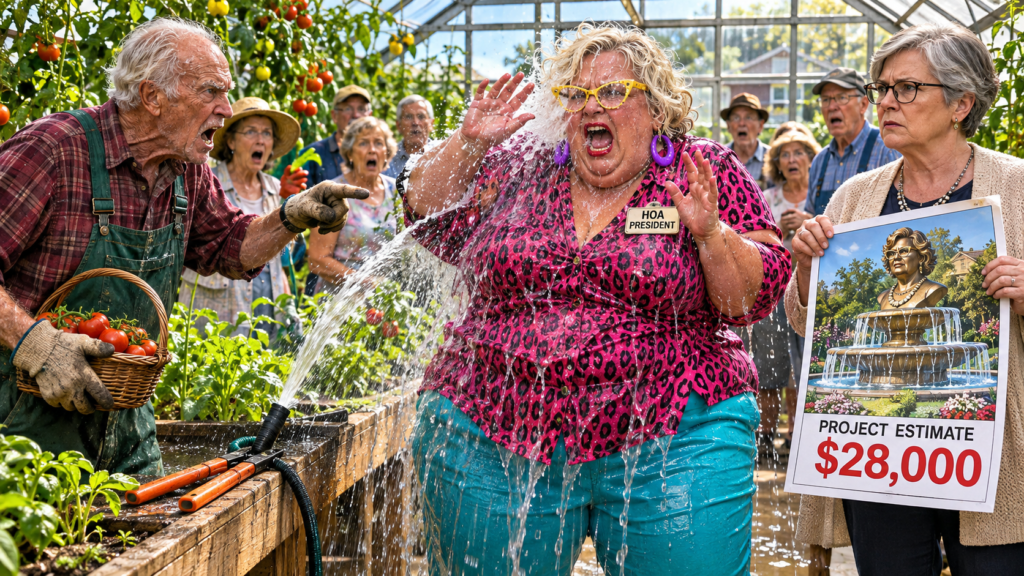
He remembered the afternoon Karen had cut the irrigation hose.
He remembered the water striking her face, her furious expression, and the shocking words she had shouted about her statue being more important than their food.
For a moment, he wondered whether she had ever understood what she had tried to destroy.
Then Evelyn approached him.
She placed a handful of freshly harvested lettuce into his basket and smiled.
Her little garden bed was growing again.
That was enough.
Across the greenhouse, residents were laughing and exchanging vegetables. A widower who had barely spoken during the previous winter was showing a new volunteer how to prune tomato plants.
The place felt alive.
Frank looked toward the clubhouse, where the architectural rendering of Karen’s fountain had once been displayed.
The community had almost spent $28,000 to celebrate one person’s ego.
Instead, it had chosen to protect something that belonged to everyone.
And perhaps that was the most important lesson of all.
A community was not made valuable by expensive stone, polished metal, or a monument bearing someone’s face.
It was made valuable by the people who showed up, worked together, and cared enough to leave something better for their neighbors.
Karen had wanted a statue that would make everyone look up at her.
But in the end, the residents chose something far more meaningful.
A garden where everyone had a place to grow.