CHAPTER 3: THE ACCOUNT COGNIZANCE
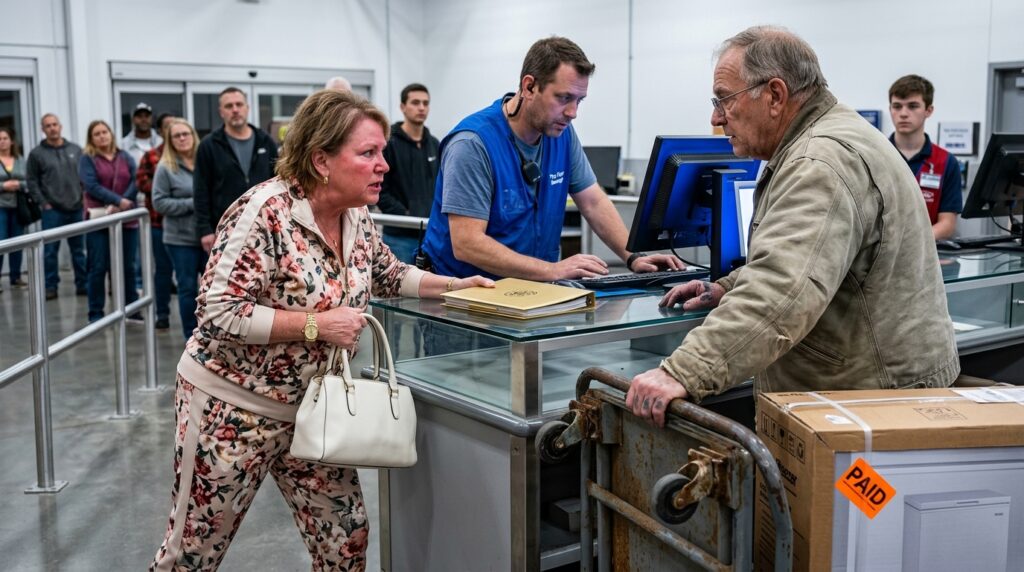
“Let me see the folder, Brenda,” Marcus said. His hand extended across the scratched laminate surface, his fingers tapping an uneven rhythm against the edge of the terminal housing. He didn’t look at Arthur. His attention was pinned entirely to the golden emblem stamped into the clear plastic cover of the loyalty binder.
Brenda didn’t release her grip immediately. Her manicured nails pressed into the thick seam, leaving dull, white crescent marks in the vinyl before she slid it across the counter. “It’s all verified by the commercial division, Marcus. Account tier triple-zero. If your desk crew had the training to cross-reference unallocated floor stock before accepting a standard retail terminal clearance swipe, we wouldn’t be standing here wasting logistics hours.”
The flatbed cart shivered slightly under Arthur’s boots as a forklift rumbled past the mouth of the customer service alcove, its rear wheels lifting slightly as it hit a expansion joint in the concrete floor. The smell of burning propane exhaust drifted into the corner, dry and sour, mixing with the stale, heavy perfume that clung to Brenda’s tracksuit. Arthur’s eyes stayed low, fixed on the metal foot brake beneath his heel. He didn’t reach for the receipt in his breast pocket yet. In his line of work, you never revealed the final blueprint until the contractor finished making his claims on the rough foundation.
Marcus pulled the folder behind the glass partition, his thumb smoothing down the corner where the tiny, fine-point green T.C. initials sat near the barcode. He didn’t call the name over his radio. Instead, he dropped his left hand onto the mechanical keyboard overlay, his knuckles cracking as he began typing a long numerical sequence into the store’s central mainframe. The screen, visible only as a pale blue wash against the front of his wrinkled vest, flickered three times as the legacy system parsed the data.
“Eli,” Marcus muttered under his breath, his eyes never leaving the monitor. “Pull up the regional allocation log for the Thursday delivery cycle. Look under the commercial hold category for property management returns.”
The young clerk stepped back from the counter, his sneakers squeaking against the coarse grit of the concrete floor. He hit two buttons on the auxiliary terminal, his shoulder blades shifting beneath his blue vest as he leaned in close to the small monochrome tube display. “It’s not showing an active ticket number for this layout code, Marcus. The only thing listed under clearance tier three is a broken-seal inventory transfer from the city warehouse.”
“Check the backup ledger,” Brenda commanded, her voice dropping into a low, metallic vibration that vibrated through the silver divider bars. She stepped forward until her heavy gold watch clicked against the glass counter. “The regional manager cleared the priority replacement voucher himself. It’s a commercial line account, not an individual floor tag. The system doesn’t require a manual stock room hold when the tier code is active on the sales floor.”
Arthur watched the manager’s expression change. The fine lines around Marcus’s eyes tightened, the grey hue of his skin deepening under the yellow tint of the service lamps. Marcus wasn’t looking at the video feeds yet; he was staring at the line items on the corporate database. He saw the validation stamp, the matching item classification code, and the priority tier label that appeared to give Brenda the authority to override a standard point-of-sale clearance voucher.
“Sir,” Marcus said, turning his face toward Arthur for the first time since the dispute had moved past the registers. His tone had lost its casual customer-service lilt; it was flat, heavy with the institutional pragmatism of a corporate outlet that couldn’t risk a litigation hold on a high-tier commercial account. “There’s a priority flag on this inventory number from forty-eight hours ago. The database shows a tier-three voucher was issued to this account for a replacement floor model in this district.”
“The paper in my pocket has the registration stamp from five minutes ago,” Arthur said. His hand remained inside his canvas jacket, his thumb flat against the coarse grain of his wife’s seed packet. “The box was marked for the floor. The clerk took the payment.”
“The clerk didn’t check the ledger override,” Brenda said, her phone lifting again, its dark lens catching the white flare of the halide lamps above the aisle. “He accepted a raw card swipe on a flagged item. That’s an internal policy breach, Marcus. The transaction is invalid until the account priority is cleared manually.”
Marcus leaned his elbows on the counter, his eyes dropping to the printed register slip that Arthur had left on the glass. The orange ink was still bright, the text crisp, but beneath the register number, the corporate mainframe had printed a small, three-digit warning code—an inventory discrepancy marker that usually signaled an unverified account hold on the retail floor.
“We have an account overlap here, Arthur,” Marcus said, his voice dropping into a stern whisper that barely carried over the steady beep of the front-end registers. “If the commercial tier holds the priority allocation from Thursday, the store has to honor the corporate voucher first. We’ll have to reverse the register four credit and process an exchange voucher for a future delivery from the main hub.”
Arthur didn’t pull his boots off the brake. He felt the cold iron of the frame shifting beneath his weight, the heavy mass of the chest freezer sitting immovably on the wire flatbed. He looked at the tiny green initials on the folder, then at the small sequence of expiration codes blinking on the side of Marcus’s terminal monitor. The decoy was holding—the golden emblem and the commercial ledger were doing exactly what Brenda had engineered them to do—but the true nature of the paper in her hand was already beginning to leave its mark in the system log.