CHAPTER 1: THE RESIDUE OF HARVEST
The warehouse floor smelled of dry pine pallets, heavy plastic shrink-wrap, and the sharp, chemical tang of new compressor oil. It was a desaturated world beneath the high-bay metal halide lamps—everything coated in a thin, microscopic grit that rose from the constant scraping of forklifts against the gray concrete. Arthur Pendelton moved through Aisle Seven with a slow, mechanical deliberation, his boots leaving faint, dull prints in the high-traffic dust.
His fingers, permanently stained with the dark ink of a manual draftsman, traced the rough edge of a cardboard box. This was the final unit—a low-profile, commercial-grade chest freezer, marked down with a handwritten red marker on the inventory tag. To anyone else, it was an oversized metal bin meant for cheap frozen bulk goods. To Arthur, it was a vault. His wife’s community garden plot across the county line was still heavy with late-summer heirloom tomatoes, Swiss chard, and standard root crops that would rot within three weeks if he couldn’t drop the temperature of his pantry. The silver band on his left hand felt loose against his skin, a small, cold circle of metal that slipped whenever his hands dried out from the store’s air conditioning.
He gripped the rusted wire handle of the flatbed cart, his shoulder muscles tightening as he heaved the dead weight of the appliance onto the steel frame. The heavy casters shrieked against the concrete, a raw, iron-on-stone sound that didn’t even make him blink. He didn’t have the energy for small annoyances anymore. Since the funeral in April, his world had shrunk to a series of maintenance tasks—checking the oil in the tractor, clearing the gutters, and ensuring the residue of her final planting didn’t go to waste in the dirt.
At Register Four, the transaction was transactional and silent. The cashier, a teenager with oil-stained knuckles and a faded blue vest, scanned the clearance barcode without looking up. Arthur slid his card through the plastic terminal, watched the small green light flicker to life, and waited for the slow, mechanical chatter of the thermal printer.
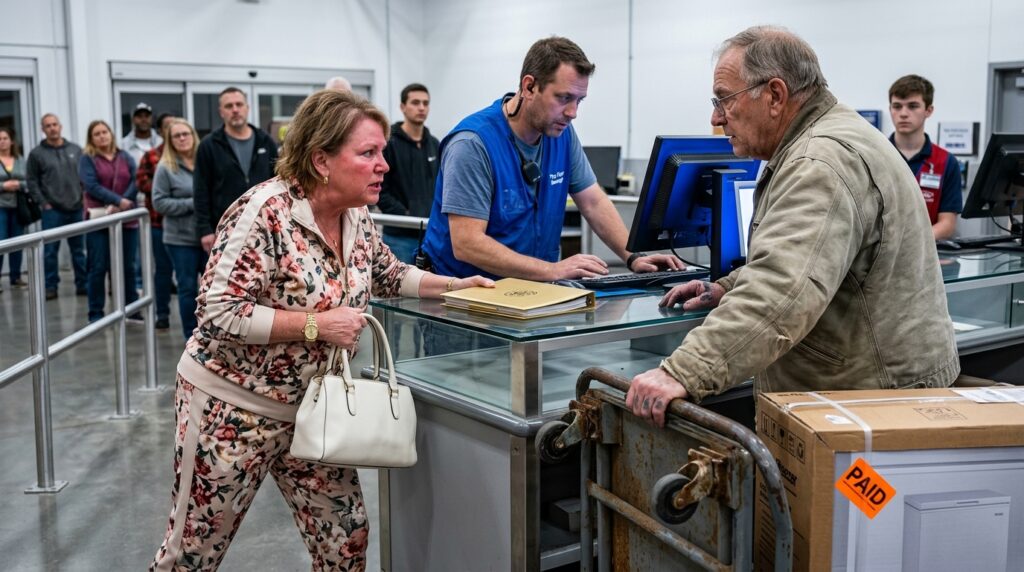
“Sticker’s on the side, sir,” the boy muttered, sliding a bright, high-visibility orange slip across the counter. It was sticky, smelling of industrial adhesive. Arthur took the paper and pressed it directly over the main cardboard seam of the freezer box, his rough palm flattening the edges until the glue took hold. He didn’t fold the receipt; he placed it precisely into his breast pocket, right behind the crinkled envelope containing the layout map of the garden beds.
The front end of the store was a bottleneck of mid-day noise—the constant beep of laser scanners, the heavy thud of timber loading outside, and the low, thick murmur of families arguing over the price of drywall screws. Arthur pushed the cart toward the customer service desk to secure his loading dock gate pass, his movements unhurried, his eyes fixed on the silver railing that marked the exit line.
He had just reached the counter when the air behind him shifted, thick with the heavy, artificial scent of aggressive floral perfume and the rapid, sharp click of hard-soled shoes against the concrete floor. A shadow fell across the orange sticker on his box—large, solid, and smelling of money and clean leather.
“That’s my unit,” a voice cut through the register static. It wasn’t loud yet, but it carried the heavy, flat edge of an order. Arthur didn’t turn around immediately. He kept his hands on the cart handle, his eyes watching the customer service clerk slowly reach for the gate stamp.