
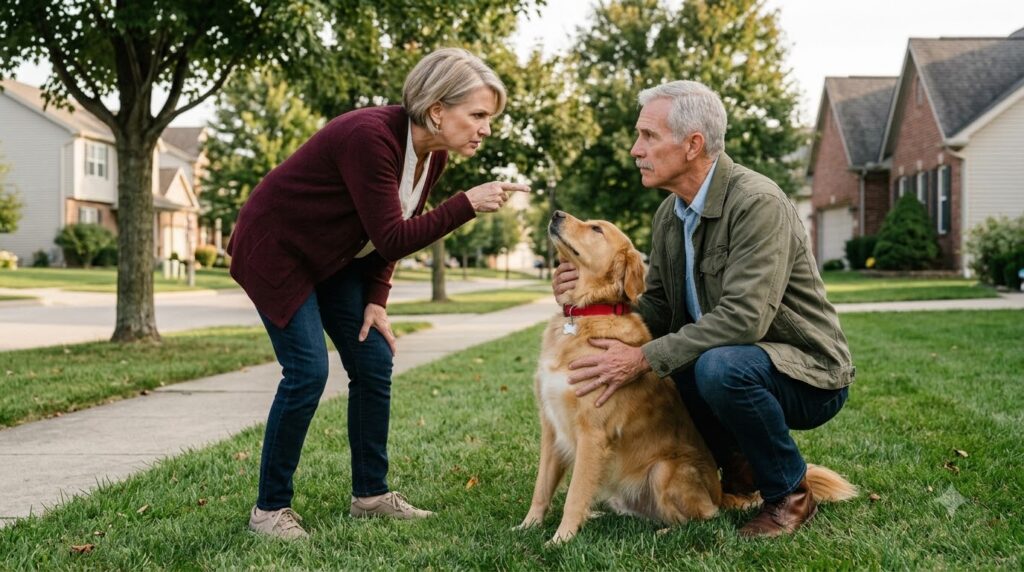
Chapter 6: The Meeting
They met the following afternoon at Margaret’s condominium.
Buddy recognized Diane immediately.
That mattered.
He wagged his tail when she entered.
Diane stopped in the doorway.
Her face crumpled.
For almost a year, she had fed him, walked him and slept under the same roof with him.
Whatever else she had done, Buddy had known kindness in her house.
That did not erase the deception.
But it made the truth more complicated.
Margaret remained seated.
Buddy stood between the two women.
For a long time, no one spoke.
Then Diane apologized.
Not the kind of apology that began with excuses.
She told Margaret when Buddy had arrived.
When she recognized him.
When she removed the collar.
Every opportunity she had to make the right choice.
Every time she chose not to.
Margaret listened.
Susan sat beside her.
Walter remained near the window.
When Diane finished, Margaret asked only one question.
“Was he loved?”
Diane began crying.
“Yes.”
Margaret looked down at Buddy.
“That matters.”
Diane covered her face.
“But it doesn’t make what I did right.”
“No,” Margaret said. “It doesn’t.”
There was no shouting.
No dramatic forgiveness.
No instant friendship.
Just two older women sitting in a quiet room with the consequences of choices neither could undo.
Susan later provided Diane’s statement to animal services.
Carol was contacted as part of the inquiry.
Because the exact circumstances of Buddy’s initial disappearance and transfer were disputed, authorities handled the matter based on available evidence and local procedures. Margaret’s veterinary records and microchip registration established her ownership clearly.
Buddy remained with Margaret.
The reward was never paid.
Margaret had originally offered it for information leading to Buddy’s safe return, but after speaking with Susan, she decided that giving money to anyone connected to withholding him would be wrong.
Walter refused any reward too.
“You found him,” Margaret told him.
“I found a dog walking beside a creek.”
“You brought him home.”
“He brought himself home.”
That was closer to the truth.
There was one more complication.
Buddy missed Diane.
During his first week back with Margaret, he occasionally waited near the door in the afternoon.
He had spent nearly a year learning another routine.
Animals did not understand moral categories.
They remembered voices.
Hands.
Smells.
Places where they had slept safely.
Margaret understood that better than anyone.
Two weeks later, she surprised Susan.
She asked whether Diane might visit Buddy.
Susan objected immediately.
Margaret listened.
Then she said, “Forgiveness and trust aren’t the same thing.”
She was not ready to trust Diane.
Perhaps she never would be.
But she refused to punish Buddy for human mistakes.
The first visit took place on Margaret’s small patio.
Susan stayed.
Walter stayed too.
Diane arrived without treats or toys.
She had been told not to bring anything.
Buddy saw her through the glass door and wagged his tail.
Diane crouched.
Buddy walked to her.
She pressed her forehead against his.
For several seconds, no one said anything.
Then Diane stood and left when Margaret said the visit was over.
No argument.
No request for more time.
It was the first boundary Walter had seen her accept without trying to control it.
But Willow Ridge had not forgotten what happened.
And the neighborhood had its own judgment waiting.








