
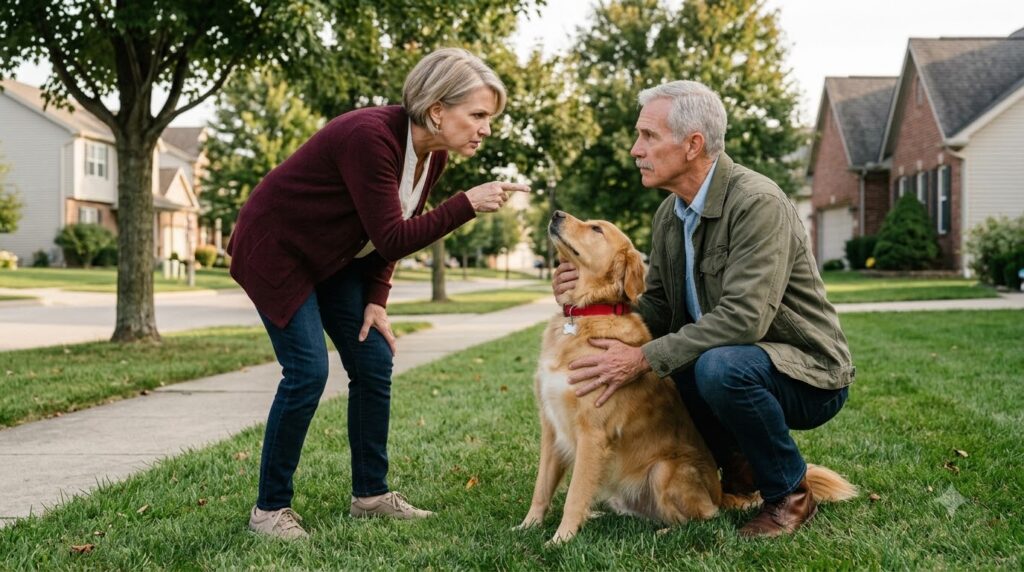
Chapter 4: The Photograph That Shouldn’t Exist
Susan enlarged the photograph Diane had shown Walter.
Ellen had quietly taken a picture of Diane’s phone screen during the confrontation.
“I spent thirty-eight years with children,” she explained. “You learn to document first and discuss later.”
Walter almost smiled.
They sat that afternoon at Margaret’s condominium dining table while Buddy slept beneath it.
The image quality was poor.
But Susan noticed something.
“Look at the patio.”
Walter leaned closer.
Behind the golden dog was a distinctive pattern of red-and-gray pavers.
A white planter stood near the edge.
Ellen recognized it first.
“That’s Diane’s backyard.”
Walter stared at her.
“You’re sure?”
“I walk past it three mornings a week.”
The implications changed everything.
Diane had said the photograph showed her sister’s dog.
But if it had been taken in Diane’s yard, Buddy—or a remarkably similar dog—had been there before.
Susan zoomed further.
The dog wore no visible collar.
But the white patch on its chest was unmistakable.
Margaret covered her mouth.
“That’s him.”
Walter did not want to jump to conclusions.
The photograph did not show when Buddy had been there, how he arrived, or why.
But it destroyed Diane’s claim that she had merely recognized her sister’s missing dog.
Susan checked the photo Ellen had captured for any visible metadata, but there was none.
“We need to know when this was taken,” she said.
Margaret shook her head.
“I don’t want a war with a neighbor.”
Walter understood.
At their age, people valued peace differently.
Not because they were weak.
Because they knew how expensive conflict could become.
“You don’t need a war,” he said. “You need the truth.”
That evening, the truth arrived from an unexpected source.
Walter was watering two tomato plants beside his garage when a teenage boy approached on a bicycle.
Walter recognized him as Noah Bell, who lived three houses behind Diane.
“Mr. Hayes?”
Walter shut off the hose.
Noah looked uncomfortable.
“I heard about the dog.”
Neighborhood information traveled faster than weather.
“What about him?”
“I think I saw him before.”
Walter waited.
Noah sometimes walked dogs for residents during school breaks.
The previous summer, Diane had paid him twice to feed a golden dog while she was away for the day.
“She told me his name was Charlie.”
Walter felt his stomach tighten.
“When?”
Noah pulled out his phone and searched his messages.
“Last August.”
Eleven months earlier.
“Did the dog look like Buddy?”
Noah nodded.
“He had the white chest.”
“Did he wear a red collar?”
“No. She kept a blue one on him.”
Walter looked down the street.
“Did Diane say where he came from?”
“She said her sister couldn’t keep him.”
That matched part of her story.
But there was more.
Noah shifted uneasily.
“One time he got out when I opened the gate.”
Walter listened.
“He didn’t run randomly. He went toward the old part of the neighborhood. Diane got really mad when I told her.”
“How mad?”
“She said if he ever got loose, I was supposed to call her and nobody else.”
Walter was silent.
Buddy had not been wandering for fourteen months.
At least not all of them.
He had apparently been living less than half a mile from Margaret’s former house.
That night Walter called Susan.
The next morning, Susan contacted the county animal services office and reported what they knew.
They did not accuse Diane of theft.
They reported a recovered dog whose registered owner had been located, along with conflicting claims about where the animal had been living.
A microchip scan at Margaret’s veterinarian provided the strongest fact yet.
Buddy’s chip was still registered to Frank and Margaret Doyle.
There was no transfer of ownership.
No surrender.
No adoption record.
Nothing connecting him to Diane.
The veterinarian also found something else.
Buddy’s medical history contained a gap of more than a year.
But his nails had been trimmed.
His weight was healthy.
His coat showed signs of regular brushing.
Someone had been caring for him.
The question was no longer whether Buddy had survived.
Someone had kept him.
That afternoon Walter received a knock at his door.
When he opened it, Diane stood on the porch.
No burgundy cardigan this time.
No pointing finger.
No audience.
Her face looked exhausted.
“You should have stayed out of this,” she said.
Walter studied her.
“You brought me into it.”
Diane looked past him toward the empty hallway.
Then she said the sentence that changed the story again.
“I didn’t steal Buddy.”
Walter waited.
Diane’s eyes met his.
“But I know who did.”








