CHAPTER 5: The Shifting Focus
The white municipal placard slapped against the raw timber with a sound like a small pistol shot.
Maya kept her fingers clamped to the rough, splintered edge of the stacked pine planks, watching the paper vibrate under the rhythmic, low-frequency hum of the code enforcement truck’s engine. Evelyn’s hand dropped. The orange document she had spent her afternoon securing at the district clerk’s office slipped from her fingertips, its crisp, clean corners dipping into the gray, alkaline dust at the base of the fence line.
“This is an administrative error,” Evelyn said. Her voice didn’t rise; it had lost its public timber entirely, turning into a thin, scratchy whistle that barely carried over the clicking heat-shields of the idling police cruisers. “The structure was surveyed during the ninety-two expansion. The tax maps were certified.”
“The tax maps reflect self-reported footprints until a dispute triggers a physical verification, ma’am,” the code inspector said. He didn’t lift his head from the transit level. His gloved hand turned a knurled brass screw on the instrument’s side, adjusting the narrow crimson line that cut across Evelyn’s gravel border and crawled up the raw concrete foundation of her tool workshop. “Your foundation isn’t just sitting over the residential line. It’s sitting squarely over a primary municipal drainage corridor. That means the city has an automatic right of summary removal at the owner’s expense.”
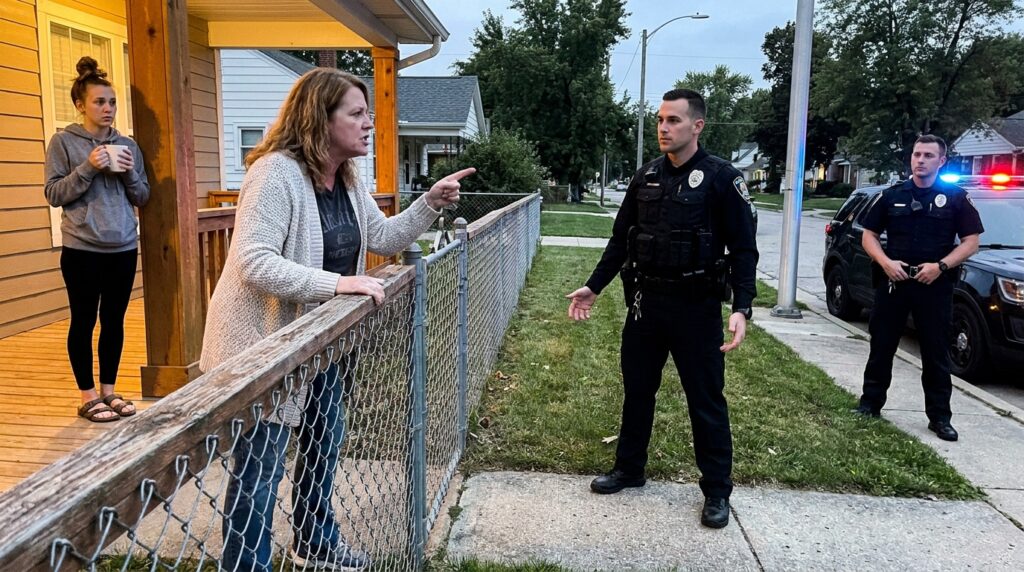
Maya didn’t step back. Her boots remained fixed in the dry soil beside the exposed zinc benchmark pin. She watched the primary officer lift his clipboard—a heavy, matte-black aluminum folder with a double-hinged steel clip that held a three-page state citation package. The blue strobe lights caught the white paper, turning each sheet into an alternating window of indigo and sharp, cold gray.
“Sign the acknowledgment line, ma’am,” the officer said, his voice entirely devoid of neighborly patience. He extended a solid plastic pen across the wire rail, the tip pointing at the bottom of the form.
Evelyn didn’t move her arm. Her fingers stayed tucked inside the pockets of her stiff denim shirt, her shoulders hunched forward as if she could absorb the weight of the municipal machinery by sheer physical resistance. “I am not signing an admission of harassment. I have documented every infraction on this block for thirty-four years. I have a record of every commercial vehicle that has broken the curb weight rules.”
“This isn’t an admission of guilt,” the officer replied, his voice dropping an octave, carrying the flat, mechanical certainty of an institutional grinder. “It’s an acknowledgment of service. If you refuse to sign, the backup officer will log the refusal on camera, and the city attorney will move to the next phase of the enforcement protocol by sunrise. That includes an immediate freeze on all active structural variances for this parcel.”
The silence that followed was dense, smelling of unburnt diesel and the damp stone dust kicked up by the inspector’s boots. Across the street, a curtain in lot thirty-eight snapped shut, the white plastic slats clattering against the frame as a porch watcher pulled back into the dark. The street wasn’t supporting Evelyn anymore. The audience she had spent weeks cultivating with her phone calls and her clipboards had vanished, leaving her alone on a four-inch strip of contested dirt.
“Sign it, Evelyn,” Maya said, her voice flat, matching the rhythm of the officer’s delivery.
Evelyn’s head snapped toward Maya, her pupils needle-thin behind her glasses. “You think you’ve settled this? You think because you brought the city into my yard you own this cul-de-sac? This house was here before your bank was even chartered.”
“The deed doesn’t care about the history, Evelyn,” Maya said, her thumb pressing down into the green-tinted timber until a small drop of moisture rolled from the wood. “The deed only cares about the line.”
Evelyn’s hand emerged from her pocket, trembling slightly as she snatched the plastic pen from the officer’s glove. She dragged the tip across the bottom sheet, the paper tearing slightly under the pressure of her stroke before she dropped the pen into the gravel between them. Without looking back at the inspector or the cruisers, she turned and marched toward her dark kitchen door, her boots dragging through the loose sod she had spent half her life maintaining.
The code inspector stood up, his leather case closing with a sharp click of its brass latches. He walked over to Maya’s side of the fence, his eyes running along the stacked timber. He didn’t smile; his face had the same weathered, dry texture as the maps in the county vault.
“Don’t start digging the post-holes yet, Miss Lin,” the inspector said, his voice dropped so low it didn’t carry past the wood pile.
Maya paused, her hand freezing on the pine plank. “The survey is certified. The line belongs to this lot.”
“The line belongs to the lot,” the inspector agreed, his fingers tapping the rusted metal edge of his clipboard. “But the city attorney didn’t flag your neighbor’s file because of four inches of concrete. They flagged it because the state human relations commission has been running an active monitoring folder on this entire subdivision since last winter. Your call wasn’t the first, but it was the one that completed the pattern for a federal civil injunction.”
He turned away before Maya could answer, his boots crunching toward the waiting white sedan. The primary officer was already back in his cruiser, the blue and red flashes dying out one by one until the front yard was left in the quiet, dim orange glow of the streetlamp at the end of the lane.
Maya stood alone in the cool air, her phone screen illuminating the stamped numbers on the zinc tag by her feet, while the ultimate reality of the street remained locked behind the closed doors of the municipal office.