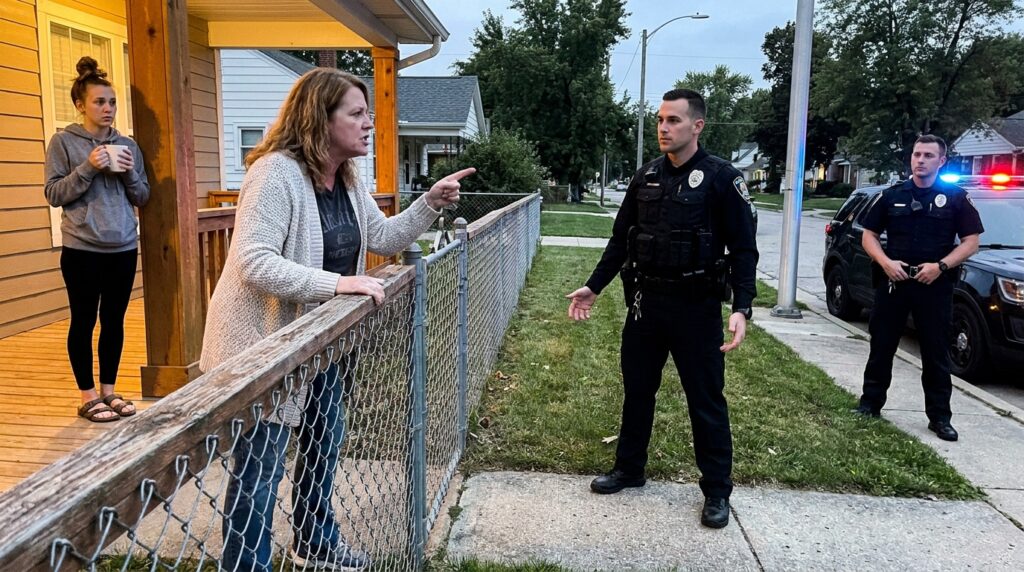
CHAPTER 3: The Boundary Enforcer
The morning sun didn’t soothe the cul-de-sac; it simply baked the gray asphalt until the smell of old tar rose between the houses. By eight o’clock, the diesel rumble of a flatbed delivery truck was vibrating the glass pane of Maya’s front door.
Maya stood at the boundary line, her boots half-buried in the loose, dry topsoil right beside the tarnished zinc surveyor’s pin she had uncovered the night before. In her hand, she held the original, brittle cardboard property folder the bank had handed her at closing. The edges were fraying into gray fuzz, and the paper within smelled faintly of cellar mold and old ink, but the red line drawn across lot forty-two was legally immutable.
“I can’t drop the timber on the street, miss,” the delivery driver said, his voice competing with the rhythmic wheeze of the truck’s hydraulic brakes. He was leaning out of the cab, his neon vest coated in a thin sheen of highway dust, his hand tapping against the grease-stained steering wheel. “The municipal code says I can’t block the public easement for more than fifteen minutes without a city permit. If I drop it there, I’m the one who gets the citation.”
“You aren’t dropping it on the street,” Maya said, her thumb pressing down hard against the cold, galvanized steel fence post. Her voice stayed low, matching the steady drone of the truck. “You’re dropping it right here on the grass lane. Four inches inside this wire mesh.”
“That’s a tight squeeze,” the driver muttered, squinting down at the narrow strip of turf between the chain-link divider and Evelyn’s perfectly edged brick border. “Looks like I’ll be scraping her hedges if the forklift swings too wide.”
“The dirt belongs to this lot,” Maya replied. She didn’t look up at the windows of Evelyn’s house, but she knew the blinds were already functional. She could hear the faint, dry scrape of a front screen door sliding along its aluminum track across the wire.
The hydraulic arm of the flatbed groaned, a high-pitched metallic shriek that set the local crows off in the maples. The first bundle of treated pressure-treated four-by-fours swung out over the property line, casting a heavy, moving shadow across the dry grass. It was the raw material for the new privacy barrier—thick, heavy timber that smelled of chemicals and wet earth, ready to replace the see-through mesh that Evelyn had weaponized for months.
“Stop that machine right now!”
Evelyn’s voice didn’t have the theatrical tremor of the previous night. It was sharp, transactional, and carried the specific authority of someone who had spent thirty years monitoring the city zoning maps from her kitchen table. She was marching across her lawn, her sneakers sinking into the manicured sod, a thick white three-ring binder clamped under her arm like a shield. She wasn’t wearing the cardigan today; she was in a stiff denim shirt with the sleeves rolled up to her elbows, her skin looking like dry parchment under the morning glare.
“The driver cannot unload that material,” Evelyn said, stopping exactly two inches from her side of the wire mesh. She didn’t address Maya; she looked directly up at the operator in the cab, her finger pointing down at the brick border. “You are in direct violation of the residential setback codes. Section twelve-B clearly states that no commercial delivery may disrupt the sightlines of an adjacent driveway.”
The forklift operator paused, the bundle of timber dangling six inches above the dirt, swaying slightly in the hot breeze. The heavy chains clinked against the iron frame with a dry, rhythmic sound.
“The material is being placed on my deeded land, Evelyn,” Maya said, stepping forward until her boot touched the rusted base of the fencepost. She opened the brittle folder, revealing the faded plot map with its certified blue county seal. “The sightline code applies to permanent structures, not temporary drops for active construction. I checked the clerk’s database at six this morning.”
Evelyn’s jaw tightened, her teeth making a dry click before she opened the white binder. “This block has an implied covenant of architectural continuity. You cannot erect a solid barrier without the review of the district committee. I have the petition right here.”
“There is no registered HOA on this subdivision map, and you know it,” Maya said, her voice remaining entirely flat, devoid of the anger Evelyn was trying to cultivate. She pointed her phone down toward the loose dirt near her heel, where the zinc pin remained exposed. “And according to the 1984 county survey baseline, this entire fence line is misaligned. Your detached tool workshop back there isn’t just violating the three-foot residential setback rule—the concrete foundation is sitting four inches over my deeded property line.”
The silence that followed was heavy, filled only with the heat-tick of the truck’s cooling engine. The forklift operator looked between the two women, his gloved hand still resting on the hydraulic lever.
Evelyn didn’t look down at the exposed zinc tag. Her eyes stayed locked on Maya’s face, her pupils small and dark behind her sunglasses. The confidence in her silhouette didn’t vanish, but it shifted, hardening into something calculated and dangerous. She knew the map was real. She had always known where the concrete met the dirt, but forty years of silence from the previous owner had turned her overreach into an assumed right.
“You think you’re very smart, don’t you?” Evelyn said, her voice dropping into a low, scratchy whisper that didn’t carry past the wire mesh. “You think because you found an old iron pin you can rewrite the peace of this block? This street has a memory, girl. If you dig up this line, you’re digging up things you can’t afford to settle.”
“Drop the lumber,” Maya said to the driver, her eyes never leaving Evelyn’s face.
The operator pulled the lever. The heavy bundle of four-by-fours hit the dry turf with a dull, ground-shaking thud, flattening Evelyn’s encroaching weeds and sending a small cloud of gray dust rising between them.