
CHAPTER 4: ANCHORS IN THE CLAY
The heavy iron sledgehammer hit the steel surveyor pin with a high-pitched, ringing ping that echoed off the white garage door and carried straight across the quiet cul-de-sac.
Mark stood on the wet grass of his lawn edge, his arms crossed over his chest, his boots caked with fresh black earth. Beside him, Greg Mercer, a licensed county surveyor with thirty years of commercial fieldwork behind him, wiped a bead of sweat from his forehead with the back of his canvas work glove. Mercer knelt in the dirt, adjusting his optical transit tripod, its laser beam painting a thin, invisible crimson line along the outer lip of Mark’s concrete apron.
“That pin hasn’t moved an eighth of an inch since the original subdivision plot was recorded in ’98,” Mercer said, his voice gravelly from decades of outdoor labor. He pointed his brass-tipped plumb bob down at the ground. “Your driveway border is four inches inside your deeded line, Mark. You gave her four inches of your own dirt just to be clean.”
“I don’t need her dirt,” Mark said, his eyes tracking the red laser line as it cut straight through the patch of overgrown crabgrass Brenda had claimed as her property. “I just need mine clearly marked.”
Mercer picked up a bright wooden survey stake painted neon yellow, driving it deep into the soil right beside the iron pin with two sharp, heavy blows of his mallet. He tied a fluttering strip of hot-pink surveyor’s ribbon around the top notch, letting it snap in the cool morning breeze.
Down the block, the front passenger door of a dark blue sedan slammed shut. Brenda Vance walked briskly down her sidewalk toward the curb, wearing a heavy trench coat despite the morning humidity, her phone raised at chest height as she recorded every strike of Mercer’s hammer.
“You can put all the wooden sticks in the mud you want, Mark!” Brenda called out, her voice sharp and trembling with nervous energy. She stopped right at the curb line, her slide sandals replaced by stiff leather walking shoes. “That pin is unverified! I’ve filed an official injunction with the County Public Works department! They’re issuing a freeze on all disputed boundaries in Division 4!”
Mercer didn’t even look up from his transit lens. “I’m a state-licensed land surveyor, ma’am. This pin is tied to the county monument on State Route 4. If you touch this stake, it’s a misdemeanor interference charge.”
Brenda’s mouth twitched, her eyes flicking toward the newly installed camera array mounted under Mark’s garage eaves. The sleek black housing sat flush against the vinyl siding, three high-definition lenses pointing down at the driveway, the curb line, and the newly staked iron pin.
“That camera is an invasion of my privacy!” she snapped, stepping around Mercer’s truck to point her screen at Mark. “You have a lens pointed directly at my front porch steps! I’m adding voyeurism and harassment to the county report!”
“The lens is static, Brenda,” Mark said calmly, taking two steps toward the edge of his new concrete apron. He pulled his smartphone from his pocket, tapping the screen once to mirror the camera’s live grid view. He held the screen up, showing her the crisp, wide-angle field of view: it cut off precisely two inches inside her lawn line, capturing every inch of his concrete and the pink-ribboned stake, but leaving her porch entirely in shadow. “It records public space and my property line. Nothing else.”
“We’ll see what the sheriff says when he reviews the file!” Brenda pulled a folded white envelope from her coat pocket—the same certified county notice Mark had seen in his garage file—and held it up like a shield. “The drainage audit is active! You think you can build a wall out of concrete and cameras, but the county owns the easement! They’re taking six feet of this apron for a culvert, and your little security cameras won’t stop a bulldozing crew!”
Mark didn’t answer. He watched her turn on her heel and stride back up her driveway, her trench coat flapping against her legs.
He walked over to Mercer, who was tightening the locking thumb-screws on his tripod legs. “Did you check the county drainage overlay when you pulled the parcel map this morning, Greg?”
Mercer paused, his hand resting on the aluminum tripod frame. He looked up at Mark, his weathered face darkening slightly. “I pulled the file from the clerk’s office at eight AM. The official parcel record shows zero active drainage realignments for this cul-de-sac.”
Mark felt a subtle shift in his chest—a cold, calculating click. “What about File #4B-8819?”
Mercer frowned, reaching into his back pocket and pulling out a folded printout of the official county map. “That case number was rejected by the board three weeks ago, Mark. It was a private petition filed by an individual home owner trying to force a municipal buyout of a low-lying backyard. The county denied it because there’s no public water flow here. The drainage is working exactly as designed.”
Mark looked past Mercer toward Brenda’s garage door.
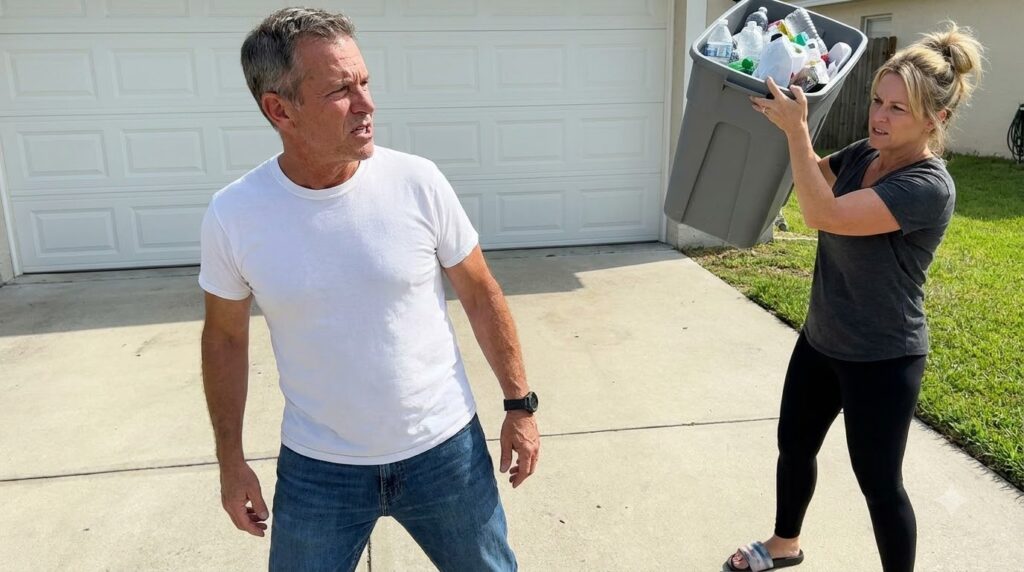
She wasn’t trying to help the county fix a drainage problem. She had filed a fraudulent buyout petition, trying to trick the county into seizing Mark’s land so the local municipality would pay her for the “impacted” portion of her own yard. The fake hazardous waste reports, the bottle-loaded trash bin, the handwritten notices—they weren’t just petty harassment. They were her desperate attempts to manufacture evidence of a “flooding crisis” before the county clerk officially closed the file and threw out her petition for good.
And now that Mark’s 4K camera and certified survey pins were locked in place, her window to fabricate the crisis was closing by the second.
“Leave the stakes high, Greg,” Mark said, looking down at the pink ribbon fluttering in the wind. “She’s going to make her move before the sun goes down.”








