
CHAPTER 2: THE AFTERMATH ON THE APRON
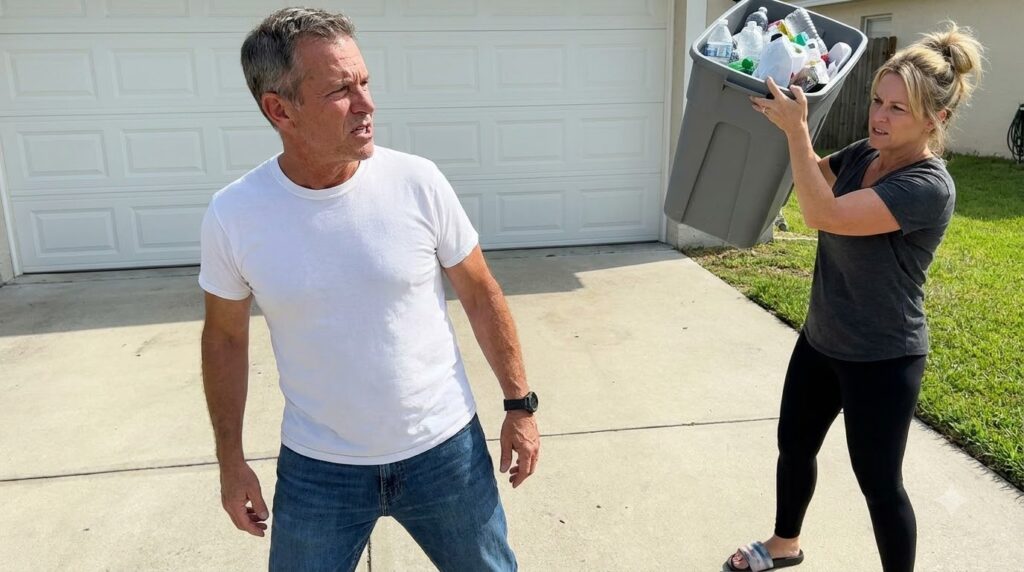
“You’re not going to leave that bin sitting on the property line, Brenda,” Mark said, his voice dropping into the low, measured register he used when a high-voltage cable had snapped and hung live over a wet trench.
Brenda’s phone was still pointed at his chest, the screen flickering with the high-contrast preview of his motionless frame. Her thumb trembled against the glass edge. Her slide sandals were dusted gray with concrete powder from his fresh pour, a pale chalk line marking where her heels had skidded.
“It’s on my grass, Mark!” She gestured wildly with her free hand toward the gray plastic container, though its left wheel still rested directly over the clean, four-inch border of his concrete apron. “You don’t own the easement! You don’t own the air space! You think because you poured five thousand dollars of concrete you own the whole dammed block?”
“I own to the iron pin,” Mark said. He didn’t look down at the ground; he didn’t need to. He knew the precise spatial geometry of the lot. “And your bin is three inches over it. Move it.”
“I was bringing it to show you what your workers left behind!” Brenda’s voice pitched higher, catching the attention of two more neighbors who had stepped onto their porches down the cul-de-sac. She reached into her dark gray T-shirt pocket and pulled out a folded slip of yellowed paper, shaking it in the air between them. “Chemical residue! Solvent bottles! Your concrete crew dumped hazardous materials right along my drainage swale, and I have the documentation!”
Mark looked at the paper in her hand. Even from four feet away, under the hard glare of the midday sun, he could see the faint, purple-ink stamp at the top of the sheet—a county filing mark, but the typeface was wrong. It was the blocky, manual-typewriter impression from the old regional office that had been decommissioned five years ago, not the sleek digital header used by current code enforcement.
“Show me the log, Brenda,” Mark said softly, taking a single step toward the edge of his porch.
She pulled the paper back instantly, shoving it deep into her stretch leggings pocket. Her knuckles were white against her phone casing. “I don’t have to show you anything! I’m submitting this directly to the county inspector! They’re coming out here tomorrow morning, Mark. You think you can just pave over the natural runoff and pretend you’re above the law? We’ll see what the county says about your ‘pristine’ driveway when they look at the hazardous waste report!”
“You brought a bin full of empty household wine bottles and rusty tin cans onto my concrete,” Mark said, his eyes narrowing slightly as he tracked the nervous, darting movement of her pupils. “That’s not contractor solvent. That’s your domestic garbage.”
“It came off your side!” she snapped, backing up two steps until both her slide sandals were firmly buried in her own overgrown, weeds-choked turf. “Your crew threw it over the fence while you were out! I’m taking this to the sheriff! I’m filing an injunction!”
She grabbed the plastic handle of the heavy trash bin with her left hand, yanking it backward with a violent, metallic crash. The glass inside rattled violently, a green wine bottle neck cracking against the inner plastic lip. She turned her back on him, dragging the heavy bin behind her like a battle-damaged sled, her slide sandals slapping loudly against the dry asphalt of her own driveway.
Mark remained seated on his top brick step, watching the heavy wooden door of her garage slam shut. The mechanical thud echoed off the surrounding houses, followed by the high-pitched whine of her automatic garage opener pulling the panel down to seal her inside.
He didn’t move for three full minutes. Across the street, the neighbor holding the idle lawnmower gave a brief, tight nod of understanding before pulling the pull-cord again. The engine roared back to life, masking the quiet hum of the neighborhood.
Mark reached down and picked up his tablet from the porch floor. He opened the local storage directory for the eaves camera. The raw file from five minutes ago had already rendered: 1080p, sixty frames per second, crisp daylight exposure. He zoomed in on Brenda’s hand as she had waved the yellow paper in the air.
On the magnified screen, the purple stamp was clear enough to read in the direct light: COUNTY EASEMENT AUDIT – DIVISION 4. Below it was a handwritten case number, scribbled in dark blue ballpoint pen.
Mark stared at the case number. Division 4 hadn’t handled residential code enforcement since the county rezoned the creek basin three years ago. They only handled one thing now: public access rights-of-way and eminent domain assessments for county drainage expansion.
He set the tablet on his knee and looked down at his clean, light-gray concrete. The pour was solid, reinforced with rebar, cured to perfection. But right along the property edge, buried four inches beneath the turf where Brenda’s weeds grew thick and unchecked, lay the iron survey pin he’d driven into the earth himself twenty-two years ago.
She wasn’t just trying to get him fined for a messy yard. She was trying to build a paper trail.








