Chapter 3: The Meeting on Maple Street
The community meeting was held in the clubhouse.
Nearly thirty residents attended.
Some had watched the fire from their windows. Others had helped Evelyn find temporary clothes and medication after the evacuation.
Daniel stood near the front with photographs from the response.
Karen sat in the second row.
She had prepared notes.
When Daniel explained the emergency perimeter, she raised her hand.
“You could have positioned the truck differently.”
Daniel answered without hesitation.
“No.”
Karen leaned forward.
“You’re saying there was no other option?”
“Not one that gave us the same access to the house, hydrant, hose line, and rescue path.”
He pointed to a photograph.
The fire engine was positioned at an angle across the street.
Behind it, a second vehicle had stopped farther down.
“The engine wasn’t there to block anyone’s property,” Daniel said. “It was positioned to support the crew.”
Karen crossed her arms.
A man sitting nearby, Frank Dawson, spoke up.
“My wife and I were inside Evelyn’s house when the smoke started coming through the hallway. The firefighters reached us through the side entrance.”
Karen looked at him.
Frank was seventy-one.
He had lived on Maple Street for more than twenty years.
His voice was quiet.
“We wouldn’t have gotten out as quickly if that truck hadn’t been where it was.”
The room went still.
Karen looked down at her notes.
She had written:
MY DRIVEWAY.
Suddenly the words looked smaller.
But she still wasn’t ready to surrender.
“What about homeowners’ access?” she asked.
Daniel nodded.
“That’s a legitimate concern. Emergency incidents can make access difficult. That’s why we ask residents not to approach vehicles or equipment. If someone has an urgent medical need or another emergency, we can coordinate access.”
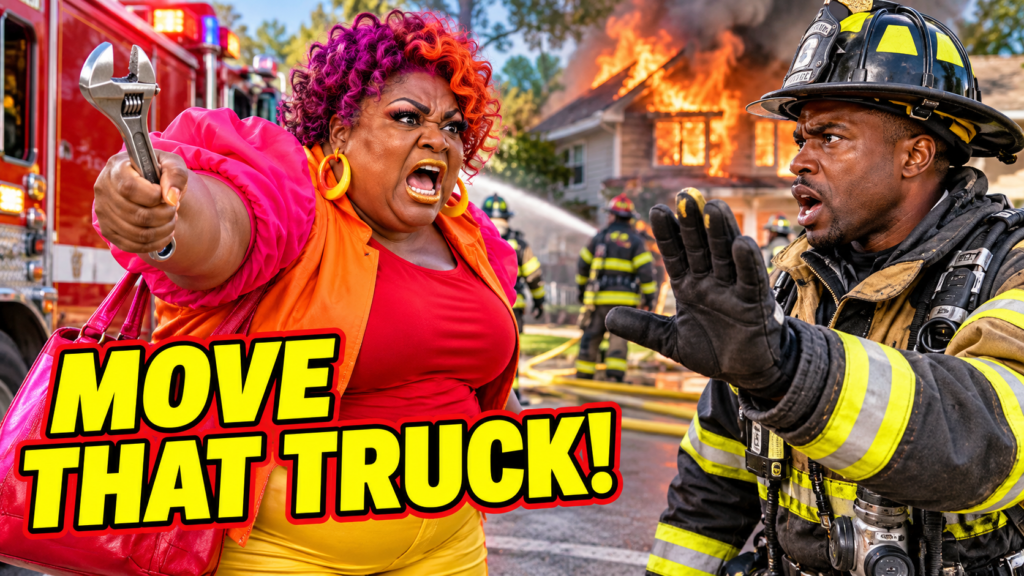
Karen glanced at the wrench lying inside her handbag.
Daniel noticed it.
He didn’t say anything.
Instead, he showed another photograph.
It was a close-up of the fire engine.
Karen’s face appeared in the background, holding the wrench.
The room became uncomfortable.
“I never touched the truck,” Karen said.
“No,” Daniel replied. “But one of our firefighters had to leave the hose line briefly because he was concerned you might approach the equipment.”
Karen stared at him.
“Who?”
Daniel looked toward the back of the room.
A younger firefighter raised his hand.
“Me.”
He was sitting beside his wife.
His name was Eric.
Karen recognized him from the street.
“I thought you were trying to control me,” she said.
Eric shook his head.
“I was trying to make sure nobody got hurt.”
Karen looked at the photograph again.
For the first time, she saw the scene from outside herself.
She saw the flames.
The hoses.
The firefighters.
And herself.
Standing there with a wrench.
She suddenly understood why everyone else had been looking at her differently.
But before she could say anything, Evelyn spoke from the back of the room.
“I don’t blame Karen.”
Everyone turned.
Evelyn held her damaged house keys in one hand.
“But I hope she understands something.”
Karen looked at her.
Evelyn continued.
“When your house is burning, you don’t want the people saving it to have to stop and argue with your neighbor.”
No one spoke.
Karen’s notes slid slowly from her lap.
And then the fire chief announced something that would affect every homeowner on Maple Street.
The department had discovered that several properties had emergency access problems.
Karen’s was one of them.
Her driveway was narrow.
Her decorative planters extended into the access lane.
And the gate she had installed two years earlier was too narrow for some emergency vehicles.
Karen stared at the report.
The problem she had accused the firefighters of creating…
was partly a problem she had created herself.