
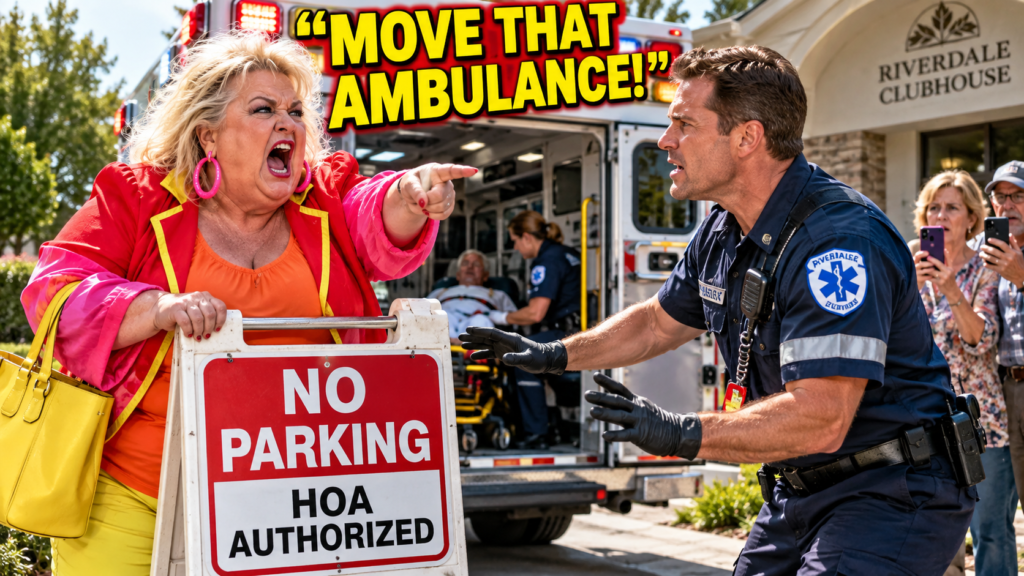
Chapter 6: The Footage Nobody Had Seen
The security footage showed Karen entering the clubhouse corridor.
She walked toward the storage room.
Thirty seconds later, another person appeared.
It was not another board member.
It was a longtime resident named Walter Hayes, a quiet man who rarely attended HOA meetings.
Walter carried a folder.
He spoke briefly with Karen outside the storage room.
The audio was too faint to make out every word.
But the video clearly showed him pointing toward the emergency access lane.
Then Karen entered the storage room.
Walter left.
The board contacted him.
At first, Walter denied knowing anything about the sign.
But when Linda showed him the footage, he admitted he had been speaking with Karen.
He explained that he had complained to her about residents parking too close to the clubhouse.
He had told her that the board needed to take enforcement seriously.
He had never told her to interfere with an ambulance.
He had never authorized her to take the sign.
And he had not even known the sign was marked obsolete.
Walter’s mistake was different from Karen’s.
He had spoken carelessly about a real problem.
Karen had turned those words into authority.
The board documented both facts.
But when Linda spoke privately with Karen afterward, she discovered something unexpected.
Karen wasn’t angry anymore.
She looked exhausted.
“I thought nobody respected the rules,” Karen said.
Linda sat across from her.
“You wanted people to respect you.”
Karen didn’t answer.
Linda continued.
“And you thought making people obey you would prove that you mattered.”
Karen looked toward the window.
For the first time, there was no audience.
No phones.
No residents.
No ambulance.
Just a woman confronting the consequences of a decision she could no longer explain away as community service.
“I didn’t know what was happening inside that ambulance,” she finally said.
Linda nodded.
“That was the problem.”
Karen looked down.
“I thought the sign gave me authority.”
“It didn’t.”
Karen swallowed.
“And if I had been wrong?”
Linda didn’t answer immediately.
“You were.”
That answer stayed with Karen.
A week later, Karen attended the HOA meeting.
She did not demand anything.
She did not accuse anyone.
She simply stood at the microphone.
She apologized to the residents.
Then she turned toward Elaine.
“I was wrong to block the ambulance,” she said. “I was wrong to use the sign. And I was wrong to act like my rules mattered more than someone else’s emergency.”
Elaine listened quietly.
She did not hug Karen.
She did not tell her everything was forgiven.
She simply nodded.
That was enough.
But the story still had one final piece.
Frank had something he wanted to show the community.
And it had nothing to do with Karen.








