
Chapter 4: The Cost of Being Right
Frank came home three days later.
He was tired but smiling.
Elaine helped him into their living room, where the afternoon sunlight fell across the photographs on the mantel.
Their children had been calling every day.
Their daughter had offered to stay for a week.
Their son had arranged grocery deliveries.
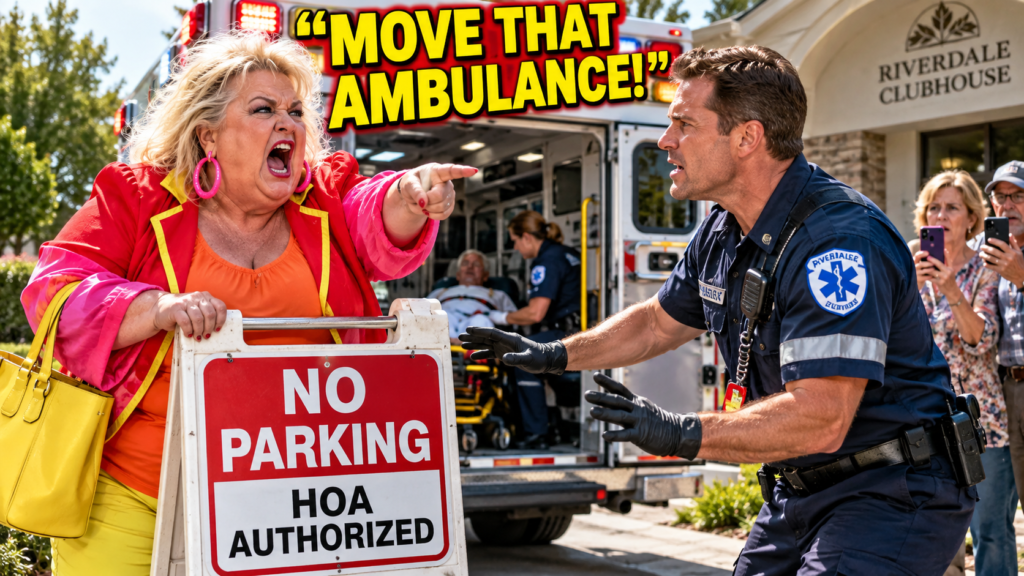
For the first time since the ambulance incident, Elaine felt the house becoming peaceful again.
But the neighborhood had changed.
Residents who had once greeted Karen casually now avoided long conversations with her.
Karen responded by insisting she was being unfairly targeted.
She complained to the HOA.
She wrote a letter accusing residents of humiliating her.
She demanded that the board issue a statement confirming that she had acted in the community’s best interests.
The board refused.
Linda instead proposed a new emergency-access policy.
No resident could place cones, signs, vehicles, furniture, or other objects in an emergency access route.
Emergency personnel would have unrestricted access during active calls.
The policy was simple.
But it wasn’t the only change.
At the next community meeting, Frank asked to speak.
He walked slowly to the microphone.
He didn’t mention Karen’s clothes.
He didn’t insult her.
He didn’t even raise his voice.
“I’ve spent most of my life believing that neighbors protect one another,” he said. “Not because we’re friends all the time. Not because we agree. Because when something goes wrong, we don’t make the person in trouble prove they deserve help.”
The room became quiet.
Frank looked toward Karen.
“You didn’t know me that day.”
Karen stared at the floor.
“You didn’t know whether I was someone’s husband, someone’s father, or someone’s grandfather.”
He paused.
“But you knew I was inside that ambulance.”
Karen’s jaw tightened.
Frank returned to his seat.
After the meeting, Linda found something else in the HOA records.
The sign Karen had used had been marked “damaged — remove from service.”
It was never supposed to be displayed anywhere.
The maintenance log showed it had been removed six months earlier.
That meant Karen hadn’t merely misunderstood a rule.
She had taken an obsolete sign and presented it as current authority.
Linda knew the board needed to address that.
But she also knew something more important.
They needed to understand why Karen had felt entitled to do it.
The answer was waiting in the next board meeting.
Karen had submitted a written statement.
And in that statement, she named the person she claimed had encouraged her to enforce HOA rules herself.








