
CHAPTER 7: THE PROOF IN THE DIRT
The hiss of air brakes echoed down through the pine canopy as the county lowboy transport pulled onto the upper shoulder, its yellow strobes painting the wet foliage in sweeping arcs of amber light.
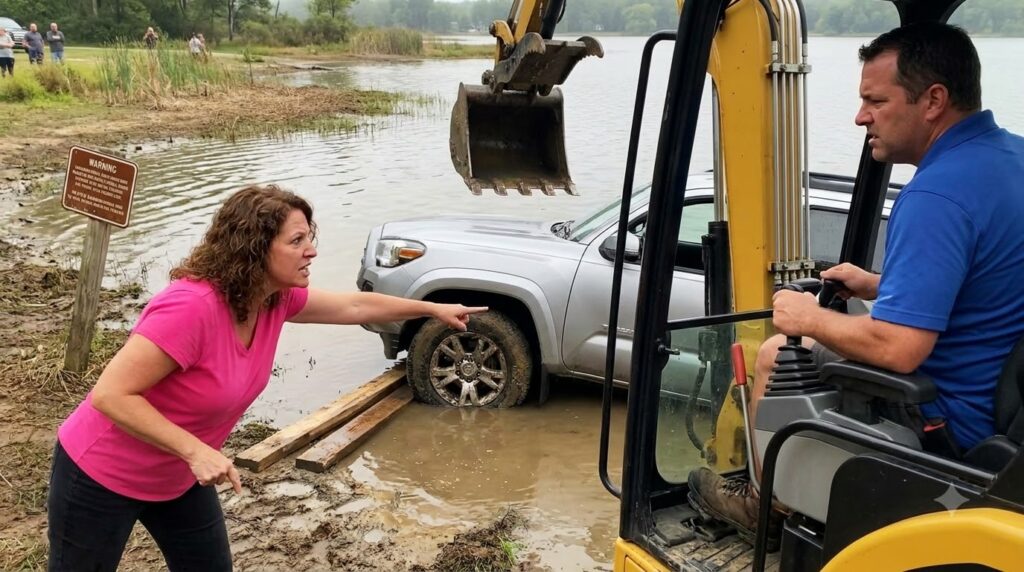
Jesse kept his left foot pinned on the swing pedal, maintaining five hundred pounds of hydraulic pressure against the pine’s root ball. Through the cab’s front windshield, he watched Deputy Miller stride toward his cruiser, grab the official laptop from its dash mount, and walk back down the mud slide toward the excavator.
Miller didn’t look at Brenda. She sat motionless on the gravel, her hands wrapped around her shins, her wet pink shirt clinging to her shoulders like a rag as two public works crew members set orange traffic cones around her ruined SUV.
“Jesse,” Miller called up, stepping over the yellow steel Corps pin sticking out of the red clay. “I need your digital log before the county flatbed hooks her winch.”
Jesse reached down to the dash bracket, unclipped his ruggedized county tablet, and slid the side door open three inches to hand it down. His palm was calloused and stained black with grease, the screen smudged with dried red clay, but the green LED charging light blinked steady.
“File 08-04,” Jesse said, his voice gravelly from the diesel fumes. “Automatic cab camera logged my arrival at four-twelve p.m. GPS is locked to six decimal places.”
Miller tapped the glass with his gloved thumb. The tablet’s screen flickered, casting a sharp blue glow across the deputy’s face. A high-resolution, wide-angle photograph loaded instantly.
The image showed the shoreline at four-twelve p.m., ten minutes before Jesse ever touched a hydraulic control. In the photo, the yellow excavator was still sitting on the upper lowboy trailer. The silver SUV was already nose-down in the murky brown water, its front bumper submerged to the fog lights, two feet past the rusted, half-buried county warning sign. Standing right beside the driver’s door, holding a pair of muddy rubber floor mats she had tried to wedge under the spinning tires, was Brenda Hollings.
Miller tapped the screen again, pulling up the embedded metadata overlay.
“Timestamp: 16:12:04,” Miller read aloud, his voice amplified by the quiet stillness that had settled over the cove. “Vehicle elevation: three hundred and forty-one feet above sea level. Two feet below the federal easement line.”
He turned the tablet screen toward Brenda. She didn’t look up, but her shoulders collapsed another inch into the mud.
“You told dispatch the contractor drove his tracks onto your bumper and shoved your car into the lake, Brenda,” Miller said, his tone devoid of anger, carrying only the dry, administrative finality of a law enforcement officer closing an incident report. “Your own vehicle’s position was recorded by automated county telemetry before Jesse Vance ever unchained his bucket.”
Up on the timber guardrail, the man in the yellow poncho lowered his phone. “She tried to pin a insurance fraud on the county worker,” he muttered to the woman standing next to him. “Whole thing was a setup to cover her own bad driving.”
“It wasn’t just the car,” Jesse said, looking down from the cab. “She wanted the excavator off the ramp because she knew if I dug two feet into that bank to set shoring timbers, I’d hit her father’s seventy-eight boundary pin. Once that pin came out of the dirt, the whole eighty-four deed story was dead.”
Miller closed the digital file on the tablet and handed it back up to Jesse. He reached into his belt pouch, pulled out a thick yellow citation book, and began writing in deliberate, measured strokes. The scratch of his ballpoint pen against the carbon paper was the only sound along the water’s edge besides the quiet idle of the CAT 320.
“Brenda Hollings,” Miller said as he tore the top carbon copy from the pad. “You’re being cited under County Code 402 for obstructing emergency operations during a declared flood event, filing a false report to law enforcement, and unauthorized encroachment on a federal public waterway.”
He offered the paper to her. Brenda didn’t reach for it. Miller leaned down and placed the yellow slip gently on her knees, right on top of her mud-soaked, ruined top.
“The county flatbed is taking your vehicle to the impound lot in Eatonton,” Miller added, stepping back toward his cruiser. “If you want it back, you’ll need to present proof of insurance and clear the obstruction fines with the magistrate on Monday morning.”
The two public works crewmen stepped past her, hooking the flatbed’s heavy steel cable to the SUV’s rear recovery loop. With a high-pitched metallic whine, the winch began to reel the silver vehicle up the gravel ramp, pulling it cleanly away from the shoreline once and for all.
Jesse pulled the boom lever back, easing the bucket out of the clay as the crew slid a three-ton concrete retaining block into the gap at the base of the pine. The bank held firm. The mud stopped sliding.
Jesse wiped his hands on his gloves, cut the excavator’s engine, and finally stepped down onto dry ground.








