
CHAPTER 2: THE LINE IN THE SINKHOLE
The paper tore with a sound like wet silk. Brenda didn’t seem to notice. Her thumb pressed hard against the rip, pinning the yellowed, water-stained page against her hip while the strobe of Deputy Miller’s cruiser painted her face in rhythmic flashes of blue and red.
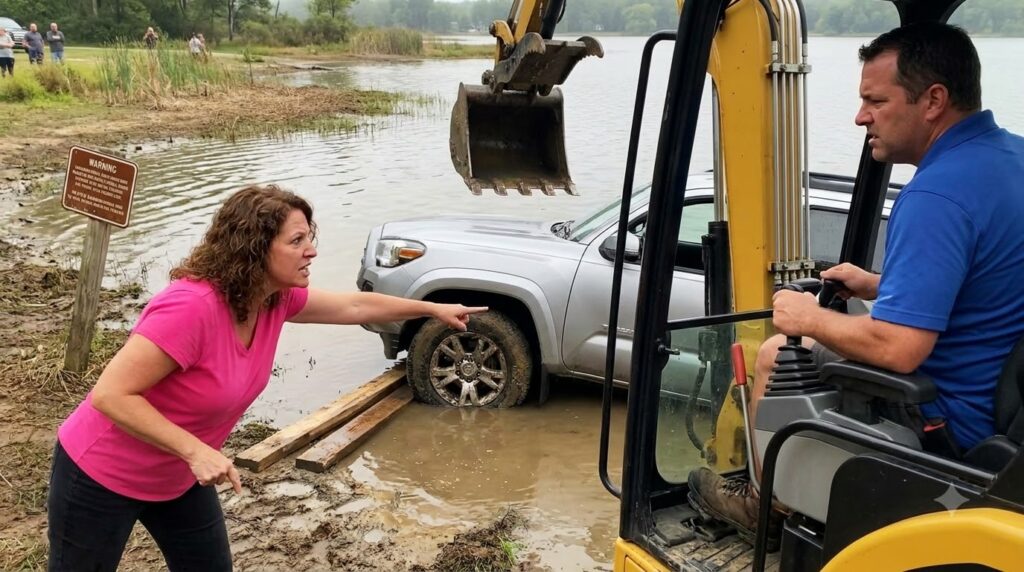
Jesse didn’t look up at the cruiser. He kept his weight low, centered on the balls of his dark work sneakers, feeling the churned mud creep over the eyelets. The lake was moving faster now. A small wave, kicked up by a passing bass boat out in the main channel, slapped the silver SUV’s rear bumper and sent a muddy film skimming over the wooden wheel braces he had just set.
The creosote timber held, but the ground beneath it was liquefying.
“You’re wasting time, Brenda,” Jesse said. He wiped his forearm across his forehead, leaving a dark smudge of clay near his hairline. “That front axle is setting into the silt. Five more minutes of wave action and I won’t be able to get a strap under the lower control arm without tearing your steering rack out.”
“Let it tear,” she snapped, stepping closer until the toe of her leather shoe was inches from the track of the CAT 320. “You don’t touch a frame rail until Miller sees this document. This isn’t county land. It never was. My father paid the county surveyor in eighty-four to record the boundary line forty feet past that warning sign. The water line belongs to the Hollings estate.”
Jesse looked past her shoulder toward the tree line. In the brush, half-choked by wild blackberry vines and rotted pine needles, sat a square post. It was split down the middle, bleached gray by thirty years of Georgia sun, but near the base, a small aluminum tag remained wired to the wood. It was caked in rust and lichen, the notched edge bent inward as if someone had struck it with an axe blade decades ago.
He knew that tag. Every contractor who worked the eastern shore of Oconee knew it. It was a corner marker, but it wasn’t a county boundary.
“Your father paid for a plat map, Brenda,” Jesse said quietly, his voice grinding like gravel under a tread. “He didn’t pay for the dirt.”
Deputy Miller’s car door slammed shut up on the gravel turnout. The heavy crunch of boots on loose stone signaled his approach before his silhouette cleared the pine branches. Miller was a tall man, his uniform shirt stiff with starch despite the thick, heavy humidity hanging off the water. He held a long flashlight in one hand, though the late afternoon sun was still high enough to make the mud glare like wet lead.
“Jesse,” Miller nodded, stopping short of the mud line where the ground turned soft. He looked from the yellow excavator idling on the bank down to the silver SUV, then to Brenda. “Mrs. Hollings. Dispatch said we had an unauthorized operator obstructing private property.”
“He’s trespassing, Thomas,” Brenda said immediately, her voice taking on the sharp, practiced cadence of someone used to giving orders at town hall meetings. She thrust the torn document toward Miller’s chest. “He drove heavy machinery onto my private shoreline access without a permit. He’s already damaged the front air dam, and now he’s trying to winch it into deeper water to hide the structural impact.”
Miller took the paper by the dry edge, his eyes scanning the faded ink while his flashlight beam flickered uselessly against the paper in the daylight. He frowned, his brow furrowing over the bridge of his nose.
Jesse didn’t wait for Miller to finish reading. He turned back to the excavator, taking two heavy, sucking steps through the clay toward the cab’s steel ladder.
“Jesse, hold up a second,” Miller called out, holding up a flat palm. “Let me look at this plat before you drop the bucket again.”
“Look at it all you want, Deputy,” Jesse said, his hand gripping the cold, grease-slicked steel of the handrail. He paused, his boot resting on the bottom step, feeling the vibrations of the idling diesel engine travel through his bones. “But while you’re reading, the undertow is pulling two hundred pounds of silt under her oil pan. You tell me to stop, I stop. But when that car rolls into four feet of lake water, it’s on your log, not mine.”
“He’s threatening us!” Brenda shouted, turning toward the three bystanders on the bank who were still holding up their phones, recording every breath. “You hear that? He’s refusing to halt operations!”
Miller shifted his weight, his boots sinking an inch into the shoulder. He looked at the paper, then down at the water lapping against the SUV’s tires, then back at Jesse. The deputy was trapped between the legal weight of a stamped document and the physical reality of two tons of steel sliding into a lake.
“Jesse,” Miller said, his tone dropping into a guarded, transactional hum. “What’s holding the front end right now?”
“Two timber blocks,” Jesse replied, pointing down at the water. “And my track on the upper bank. But the bank is sloughing off. If I don’t set the winch line now, the braces are going to float.”
Brenda stepped directly between Jesse and the excavator ladder, her pink shirt practically touching the iron grousers. “Touch that lever again, Vance, and I’ll have the sheriff’s department seize this rig before sunset.”
Jesse looked down at her. He didn’t raise his voice. He didn’t move his hand from the rail. He simply reached into his back pocket, pulled out his heavy leather work gloves, and began pulling them on, finger by finger, feeling the stiff leather conform to his knuckles.
“The rig belongs to the county under Emergency Order 402, Brenda,” Jesse said. “And if you don’t move your feet off my track path in three seconds, Deputy Miller isn’t going to be reading your paper—he’s going to be pulling you out of the mud.”








