
CHAPTER 3: THE THREAT OF THE THRESHOLD
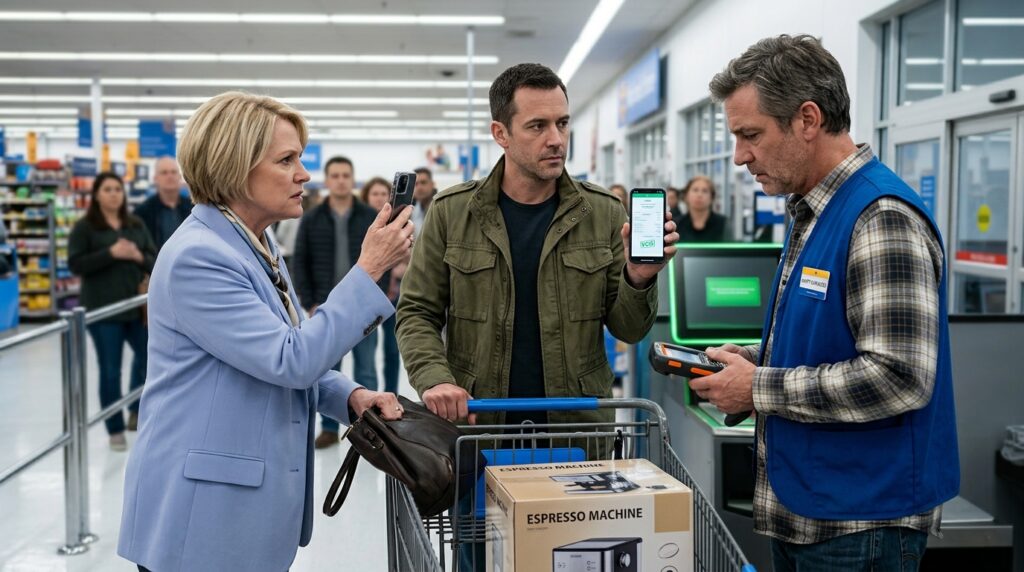
The high-priority chime from the supervisor’s terminal did not break Marcus’s concentration; it merely shifted the geometric parameters of the room. Harrison Blake’s shoulders dropped three degrees, his left hand shifting away from his pocket toward the central console. The word Discrepancy flickered across the master monitor in thick, low-resolution red blocks, casting a pale crimson hue across the brushed steel backing of Checkout Lane 4. To the surrounding ring of shoppers, the red text was an unvarnished verdict. The subtle shift in the crowd’s mass was physical—a collective lean forward, the tightening of a circle that had previously been loose and unformed.
Brenda Gantry stepped closer, the rigid seam of her pastel blazer pressing directly against the wire nose of Marcus’s cart. The movement was calculated to choke off his physical exit lane completely. Her smartphone lens remained locked on his face, the tiny reflective glass of the camera aperture capturing the flickering alert light behind him.
“The system doesn’t lie, Harrison,” Brenda said, her tone hardening into a sharp, structural drill. She did not look at the monitor; she kept her eyes anchored on Marcus, checking for the microscopic shoulder drop or the shallow breath that signaled a crack in his defense. “It flags what the human eye misses. This isn’t a simple scanning glitch. It’s an explicit inventory halt. He knew the network would lag in the back corridor, and he timed his run precisely to beat the baseline ledger update.”
Marcus turned his head slowly toward the register terminal housing. He did not look at Brenda’s phone. He did not offer a verbal contradiction to her theory. Instead, his eyes scanned the specific string of digits scrolling beneath the error code on the master console: ERR-404-SYS-SYNC-0914. In a relational database, a 404 sync error was never a validation of a missing payment; it was a tracking hold—a sign that the local node had committed the transaction to the primary cloud server but had failed to download the handshake receipt block before the local lane checkout time expired. The system hadn’t caught a thief; it had simply dropped a packet.
“We need to follow the protocol, Mr. Vance,” Blake said, his voice losing its neutral diplomatic weight and taking on the cold, transactional edge of corporate liability. He tapped the touchscreen on the console twice, his finger leaving a faint smudge of oil on the matte display. “The front terminal is locking this lane out from the central database. Until we run a manual inventory verification, the cart cannot cross the baseline threshold. Please hand your mobile device to the officer so we can cross-check the internal token ID.”
The uniform security guard took a single step forward, his boots making a dry, scraping sound against the white linoleum tile. His hand stayed flat against his heavy utility belt, but his body weight shifted onto his front leg, casting a wide, dark shadow that cut across Marcus’s field jacket and the top handle of the shopping cart.
“The device remains in my possession,” Marcus said. His voice was a calm, unyielding baseline that didn’t rise to match Brenda’s pitch. He held the smartphone perfectly steady at Blake’s eye level, his index finger resting precisely on the active security signature flashing at the bottom of the PDF invoice. “The internal token ID is fully visible on the display interface. If your terminal is experiencing a localized synchronization block, scanning the matrix code directly from this panel will force a manual query through the core network backbone.”
“He’s stalling,” Brenda interrupted, her manicured index finger snapping outward to point directly at the silver wristwatch on Marcus’s left arm. “Look at the timing loop. He’s waiting for the shift change at five o’clock when the concourse clears out. He wants you to pull the lane offline so he can argue his way past the security desk without a line-item audit. I’ve watched three different crews run this exact corporate bypass in the north-end branch last winter.”
The witness layer behind the chrome dividing bars grew completely motionless. A cashier at Lane 5 lowered her hand, leaving a black plastic divider resting on the moving rubber belt as she leaned over the register housing to see the screen. The initial, vague suspicion in the room had hardened into something far more dangerous—a quiet, collective consensus that Marcus’s restraint was merely a polished corporate mask designed to conceal an ongoing grand larceny. They wanted the box opened; they wanted the manual search; they wanted the visible exposure of the hidden truth.
Blake hesitated, his eyes darting between Brenda’s confident posture and the specific alphanumeric string on Marcus’s screen. The pressure of the public square was a physical weight in the narrow corridor, and his corporate training dictates were forcing him toward the path of least resistance. He reached out his hand toward the handle of Marcus’s cart, his fingers wrapping around the metal frame. “We’re moving this into the asset protection office, Mr. Vance. Let’s clear the lane.”
Marcus did not pull the cart back. He kept his fingers locked on the rubber grip, his body weight anchoring the wheels against the linoleum tile seam. “Scan the barcode on the console screen first, Mr. Blake,” he said, his voice dropping into a razor-sharp register that seemed to isolate itself from the ambient noise of the market. “If the core network backbone returns a zero-balance verification after a manual query, I will walk into the back room myself. If it returns a cleared invoice, you are currently executing a false detention on an authenticated customer.”
The manager’s hand froze on the chrome frame, his knuckles turning a dry, pasty white as he calculated the legal friction of Marcus’s proposition.








