
CHAPTER 2: THE GATHERING SHADOW
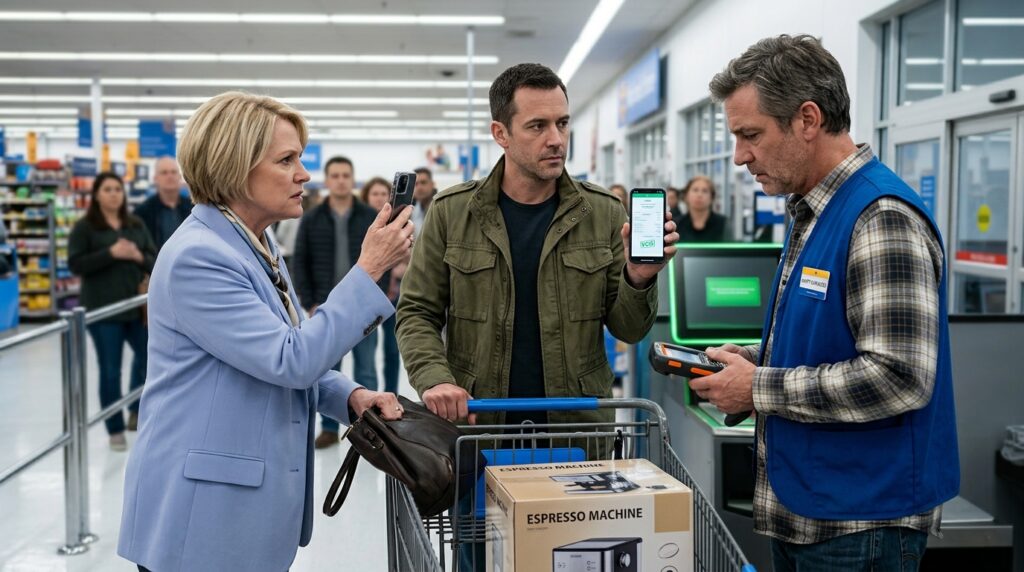
The white linoleum floor felt rigid beneath Marcus’s boots, a vast grid of sterile squares that seemed to magnify the sudden deceleration of the room. Brenda Gantry’s smartphone remained suspended between them, a small pane of dark glass reflecting the overhead fluorescent banks as a series of distorted white bars. Her index finger hovered near the screen’s edge, twitching in time with her breath. To Marcus, every element of her posture was an exposed lane—the white-knuckled grip on her leather handbag, the overextended lean of her torso across the cart’s metal perimeter, the rapid, shallow rise of her pastel lapels. She was operating on the absolute certainty of her social capital within the store’s geography, transforming the narrow corridor of Checkout Lane 4 into a makeshift tribunal.
Marcus kept his left hand locked on the rubberized handle of the cart, his palm registering the microscopic texture of the molded grip. He did not shift his weight. He did not pull his phone from his field jacket to counter her recording with his own. In the logic of a strategic pursuit, moving too early simply provided the opponent with an anchor for their momentum. Instead, he watched the small, rectangular register terminal mounted to the side of the bagging carousel. Beneath its grey plastic housing, a tiny amber LED indicator was pulsing in a irregular, broken rhythm. It was a three-quarter beat—the specific diagnostic signature of a localized network buffer queue trying to push a heavy data packet through a throttled corporate switch.
“You’re quiet, Mr. Vance,” Brenda said, her voice dropping an octave into a low, transactional hiss that didn’t lose its carrying power. She leaned forward, the sharp scent of synthetic lavender perfume breaking through the store’s ambient smell of floor wax and cardboard. “That’s the data office habit, isn’t it? Sit behind a double monitor, keep your head down, and assume the people who actually live in this community won’t notice when you start treating the inventory like a private warehouse. I know exactly what your type does when you think nobody is watching the high-value aisles.”
The accusation hung in the dry, static-charged air. To his left, the cashier’s register lane had transformed into a physical dead zone. The belt had stopped moving; a half-scanned plastic container of spinach sat directly over the red optical window, its laser beam scattering across the clear wrapping in a web of thin, crimson lines. The murmurs from the adjacent queues had solidified into a heavy, collective silence. Marcus could feel the geometric distribution of the crowd changing behind his shoulder. Shoppers from Lanes 3 and 5 were shifting their positions, leaning over the chrome dividing bars, their faces hardening into the passive, uniform mask of a public audience awaiting a confession. They were not analyzing the data; they were responding to the volume of the claim.
“The item is fully accounted for,” Marcus said. His voice was flat, devoid of the defensive spikes that a guilt-driven panic would produce. He kept his vocal register low, forcing Brenda to lower her device slightly to catch the frequency. “Please step away from my cart so I can leave.”
“Accounted for by whom?” Brenda countered, her thumb snapping against her phone case with a sharp clack. She turned her torso slightly, addressing the perimeter of watching shoppers without lowering the camera lens. “He expects us to believe the box just walked into the bottom rack on its own. Harrison! Over here, please. We have a clear failure at the perimeter.”
Harrison Blake, the evening shift manager, broke through the line of waiting carts at Lane 3. His movements were governed by the profound, structural exhaustion of a middle manager whose entire career was spent mitigating friction within tight corporate parameters. His store vest was slightly unaligned at the shoulder, and his eyes carried the dull glare of someone who had spent the last four hours reviewing spreadsheet discrepancies in a windowless back office. Behind him, a uniform security guard moved with a slow, heavy gait, his hand resting automatically on the thick leather utility belt housing his radio and flashlight.
“What’s the disruption, Brenda?” Blake asked, his voice carrying the practiced, neutral weight of an official intervention. He stopped at the axis point where the two carts intersected, his eyes immediately dropping to the large, unbagged espresso machine box in the lower rack.
“A direct bypass,” Brenda said, her finger pointing sharply toward the grey cardboard. “He took it from the appliance bay, avoided the cashier registers entirely, and was moving toward the automatic exit doors when I intervened. He’s refusing to show a physical paper slip.”
Blake turned his head toward Marcus, his eyebrows gathering into a tight, professional knot. The security guard moved an inch closer, his boots squeaking against the linoleum, his shadow falling across the metal front of Marcus’s cart.
Marcus kept his eyes fixed on the register terminal’s housing. The amber light was still blinking its broken, irregular code. The localized server was hanging, holding the confirmation packet in suspension while the terminal waited for an override signal from the front desk. The system wasn’t broken; it was simply delayed, leaving a visual gap that Brenda was currently filling with her own narrative. Marcus slid his right hand into the pocket of his field jacket, his fingers finding the cool, smooth glass face of his smartphone. He pulled it out, the screen activating instantly to display the high-contrast matrix code of the digital receipt.
“I used the mobile application,” Marcus said, holding the device steady at Blake’s eye level. “The digital invoice cleared the corporate ledger three minutes ago.”
Brenda let out a short, jagged laugh that rattled the plastic dividers in the bagging rack. “Harrison, look at the screen texture. It’s a static image file. It’s an offline template. They’re running these mock invoice codes through the community forums every week now. Scan his physical cart, or let the guard take him to the holding room.”
Blake stepped closer, his hand reaching for the portable inventory scanner at his hip. But before the red laser could line up with Marcus’s screen, a sharp, electronic chime echoed from the main supervisor’s terminal behind the customer service counter. A bright red text alert began to flash across the master monitor screen: Transaction Discrepancy — Terminal 4 Override Required.
Brenda’s posture snapped back into its full, dominant height, her eyes gleaming under the fluorescent tubes. “There it is,” she whispered, her voice tightening like a ratchet. “The system flagged it. He didn’t pay for it.”








