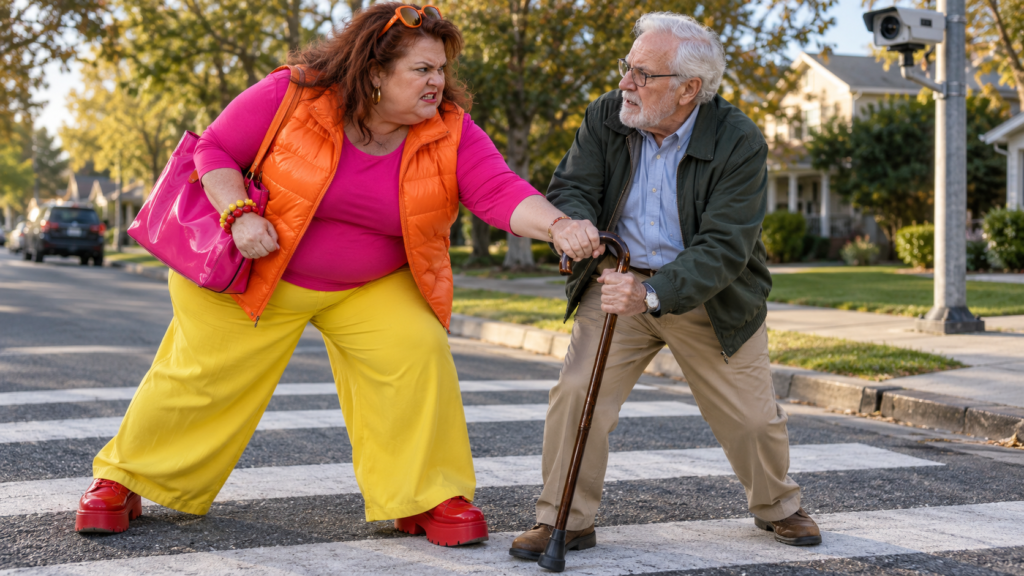
Chapter 6: The Apology
Three days later, Karen knocked on Walter’s door.
Walter was surprised.
He almost didn’t answer.
When he opened it, Karen stood on the porch without her sunglasses, without her handbag, and without the exaggerated confidence she usually carried like armor.
She held something in both hands.
A handwritten letter.
“I owe you an apology,” she said.
Walter waited.
Karen looked uncomfortable.
Not angry.
Not defensive.
Just uncomfortable.
She admitted that she had been watching residents for too long.
She said she had convinced herself that keeping order was the same as helping people.
The crosswalk incident had forced her to see the difference.
She had told herself she was protecting the neighborhood.
But when she saw the footage, she realized something she had refused to acknowledge.
Walter had never been a threat.
He had simply been slower than she wanted him to be.
And instead of waiting ten seconds, she had decided his independence was an obstacle.
Walter listened.
He didn’t interrupt.
He didn’t tell her that everything was forgiven.
He didn’t tell her she was a terrible person.
When she finished, he looked at the letter.
“Thank you,” he said.
Karen nodded.
Then she started to leave.
Walter stopped her.
“One thing.”
She turned.
“You don’t have to like how slowly I walk.”
Karen looked down.
“But you do have to let me walk.”
She nodded.
“I know.”
That was all.
There was no embrace.
No sudden friendship.
No miraculous transformation.
Just a boundary finally understood.
Over the next several months, the neighborhood changed in small ways.
Karen stopped keeping her spreadsheet.
The association introduced a formal accessibility policy.
The crosswalk was repainted with brighter markings.
A bench was placed near the clubhouse for residents who needed to rest.
And Walter began seeing more older neighbors outside.
Mr. Lewis started walking again.
Margaret returned to the pool.
People who had once hurried through common areas began taking their time.
It was a quiet change.
But Walter noticed.
One Saturday morning, he crossed the same street alone.
A car waited patiently at the curb.
Walter lifted his cane.
Tap.
One step.
Tap.
Another.
The driver waited.
Nobody honked.
Nobody shouted.
Nobody told him to hurry.
When he reached the other side, Walter turned.
The traffic camera still watched from above.
He smiled.
Then he kept walking.