
CHAPTER 5: THE FORGED MAP
“The grand jury audit.”
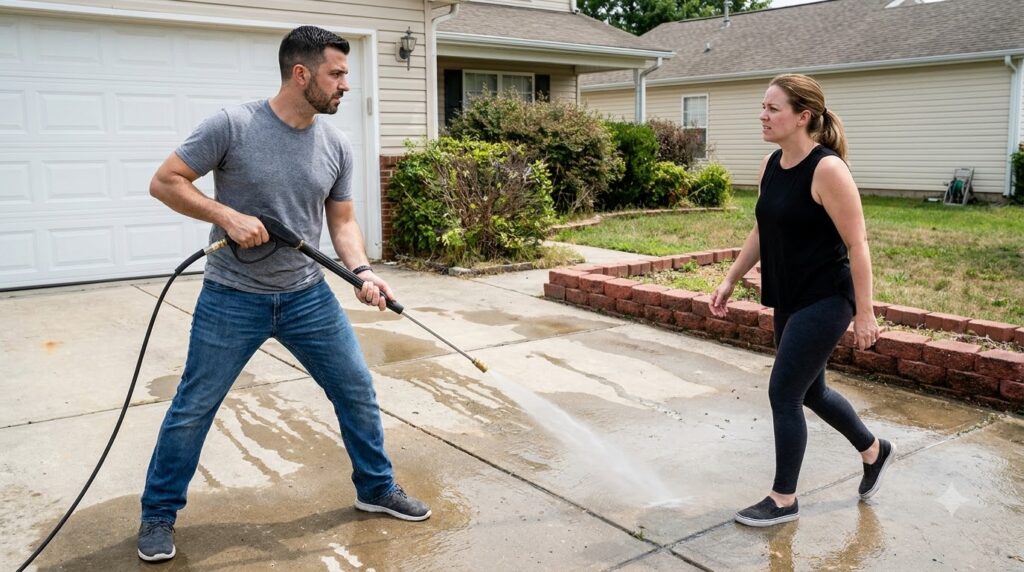
Mark repeated the words to the empty driveway, letting them settle over the smell of drying concrete. He dropped his phone into his pocket, gripped the handle of the pressure washer, and dragged the heavy frame into the dark rectangle of his garage. The rubber tires left two thin, black tracks across the clean slab he’d just cleared.
He didn’t head inside to change out of his damp jeans. He walked straight to the steel workbench at the back of the garage, grabbed a flathead screwdriver and a brass wire brush, and pried open the rusted lock on the gray metal filing cabinet beneath his shelving unit.
Inside sat three binder-clipped stacks of yellowed paper: the original deed from 2011, the closing plat from the title company, and the boundary survey stamped by Miller & Associates Civil Engineering when the subdivision was platted.
Mark spread the large, folded blueprints across the hood of his truck. The heavy paper crackled, releasing a puff of dry dust that caught the afternoon light filtering through the garage window.
He ran his thumb over the boundary lines. The asphalt control joint wasn’t an approximation. According to the original recorded plat, parcel 44-092-B extended exactly two feet beyond the concrete seam, encompassing the raised brick flowerbed and the soil line where Evelyn’s lawn began. The drainage easement she kept screaming about didn’t exist on the original county survey.
Ten minutes later, Mark was behind the wheel of his truck, heading toward the county clerk’s public records repository on West Main Street.
The basement of the county administration building smelled of stale floor wax, ozone, and decades of decaying paper. A single fluorescent tube overhead hummed with an irritating, low-frequency buzz that vibrated in Mark’s jaw. Behind the scratched plexiglass counter, a clerk with thick bifocals slid a heavy, canvas-bound ledger across the Formica surface.
“Microfilm reels for 2018 are in drawer four,” she said, her voice gravelly and indifferent. “If you need certified copies, it’s three dollars a page. Cash or cashier’s check.”
Mark carried the ledger to the optical reader in the corner. The machine’s cooling fan rattled like a loose heat shield on an old exhaust pipe. He fed the film through the glass plates, spinning the manual crank until the microfilmed records for the Oakridge Estates subdivision flickered across the green monitor.
Page 142: The 2018 Master Drainage Amendment.
Mark locked the focus dial. The document displayed on the glowing screen was the exact compliance report Evelyn had held against her chest—the same layout, the same bold header, the same pink paper texture reproduced in grainy monochrome.
He zoomed in on the bottom right corner, where the county surveyor’s seal was stamped.
The seal was there, but the registry number inside the inner ring—#40912—was typed in a sharp, modern sans-serif font that stood out against the feathered, hand-stamped ink of the surrounding ring. Beneath it, visible under the green light of the reader, was the faint, ghosted imprint of a completely different text string that had been whited out prior to scanning: TAX REASSESSMENT EXEMPTION – PARCEL 44-088.
Parcel 44-088 wasn’t Mark’s property.
It was Evelyn’s.
Mark leaned back, the vinyl chair groaning under his weight. His pulse stayed slow, calculated, and cold.
She hadn’t just fabricated a noise or drainage violation to bully him off his own driveway. She had altered official county parcel records, filed a forged architectural compliance report, and registered a fake drainage easement on his property to cover up an illegal parcel modification on her own land.
By shifting the official drainage map two feet onto Mark’s driveway, she had effectively transferred a major structural runoff violation on her property—one that carried a fifteen-thousand-dollar municipal remediation mandate—directly onto his parcel, making his home liable for the repairs while clearing her own title.
Mark pulled out his phone, snapped a high-resolution photo of the illuminated screen, and printed three certified copies at the counter.
“Is this the official filed record?” Mark asked, sliding a twenty-dollar bill across the glass to the clerk.
The woman stamped the copies with an embossed seal, the heavy iron press striking the paper with a sharp thwack. “If it’s on that reel, mister, it’s what’s legally on file with the registrar. Unless somebody presents a court order proving forgery, that map is the law of the county.”
Mark took the certified papers, the fresh ink cool against his fingertips.
He had the physical evidence. He had the forged seal, the altered registry number, and the certified paper trail that proved Evelyn had committed administrative fraud to saddle him with her property liability. It was a complete, bulletproof defense that would crush her standing at Thursday’s board meeting.
Yet as he walked out into the blinding sunlight of the parking lot, something in the math didn’t add up.
A home bed printer and a whited-out document couldn’t bypass the registrar’s intake desk. A private citizen couldn’t get an altered microfilm reel logged into the county vault without an insider pushing the spindle into the drawer.
Mark unlocked his truck, the hot leather seat burning through his shirt, and looked down at the second number handwritten on the back of the landfill gate pass—the direct line to the regional water authority supervisor.
He hadn’t found the end of the line. He had only found the decoy she wanted him to hit.








